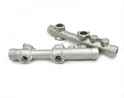

The lead time for brass investment casting production is a crucial factor that both suppliers and customers need to understand clearly. As a seasoned brass investment casting supplier, I'd like to share in - depth insights into this topic, covering various aspects that influence the lead time.
Understanding Brass Investment Casting
Brass investment casting, also known as lost - wax casting, is a precise and intricate manufacturing process. It involves creating a wax pattern of the desired part, coating it with a ceramic shell, melting out the wax, and then pouring molten brass into the resulting mold. This method allows for the production of highly detailed and complex parts with excellent surface finishes. For related information on other casting types, you can refer to Alloy Steel Lost Wax Casting and Stainless Steel Lost Wax Casting.
Factors Affecting Lead Time
Design and Pattern Making
The first step in brass investment casting is creating a wax pattern. If the part design is simple, the pattern - making process can be relatively quick. However, for complex geometries with fine details, thin walls, or undercuts, more time is required. Designers need to ensure that the pattern can be properly removed from the mold and that the final casting will meet all the specifications. In some cases, multiple iterations of the design may be necessary to optimize the part for casting. This can add several days to weeks to the lead time, depending on the complexity of the design changes.
Mold Preparation
Once the wax pattern is ready, it is used to create a ceramic mold. The pattern is dipped multiple times in a ceramic slurry and then coated with a refractory sand. Each dipping and drying cycle takes time, and for large or complex parts, more layers may be required to ensure the mold's strength and integrity. The mold then needs to be fired at high temperatures to remove the wax and harden the ceramic. This firing process can take anywhere from a few hours to a couple of days, depending on the size and type of the mold.
Metal Melting and Pouring
After the mold is prepared, molten brass needs to be poured into it. The melting process itself depends on the quantity of brass required. Larger parts or large production runs will need more molten metal, which takes longer to heat up to the appropriate pouring temperature. Additionally, the pouring process needs to be carefully controlled to avoid defects such as porosity or incomplete filling. Factors like the pouring speed, temperature, and the presence of any additives in the brass can affect the quality of the casting. Ensuring the right conditions for a successful pour may add some time to the overall process.
Post - Casting Processing
Once the brass has solidified in the mold, the casting needs to go through several post - casting processes. These include removing the ceramic shell, cutting off the gating system, and performing finishing operations such as grinding, sanding, and polishing. For parts that require heat treatment to improve their mechanical properties, additional time is needed for heating, soaking, and cooling. Surface finishing operations, especially for parts with high - quality surface requirements, can be time - consuming. Deburring and cleaning the parts to remove any remaining impurities also contribute to the lead time.
Quality Control
Quality control is an essential part of the brass investment casting process. Every casting needs to be inspected for dimensional accuracy, surface defects, and internal integrity. Non - destructive testing methods such as X - ray inspection, ultrasonic testing, or dye penetrant testing may be used, depending on the application requirements. If any defects are found, the casting may need to be re - worked or even scrapped in some cases. This can significantly impact the lead time, especially if multiple castings in a batch are found to be defective.
Typical Lead Times for Different Scenarios
- Small, Simple Parts: For small and simple brass investment castings, with basic geometries and standard surface finishes, the lead time can range from 2 - 3 weeks. This includes all the steps from design to final inspection, assuming there are no major design changes or unforeseen issues.
- Medium - Sized, Moderately Complex Parts: Medium - sized parts with some complexity in their design, such as parts with moderate undercuts or more detailed features, may take around 4 - 6 weeks. The additional time is mainly due to the more elaborate pattern - making and mold - preparation processes.
- Large, Highly Complex Parts: Large and highly complex brass castings, such as those used in aerospace or high - end machinery applications, can have lead times of 8 weeks or more. These parts often require extensive design optimization, multiple mold layers, and more rigorous quality control measures.
Batch Size and Production Volume
The batch size also plays a significant role in determining the lead time. For small production runs, the setup time for each step in the casting process represents a relatively large proportion of the total lead time. For example, creating a mold for a single casting may take almost as long as for a small batch of 10 - 20 castings. However, for large production runs, the per - part lead time can be reduced. Once the initial setup is complete, subsequent castings can be produced more efficiently. This is because the pattern - making and mold - preparation processes are already optimized, and the production line can run more smoothly.
Expediting the Lead Time
There are several ways to expedite the brass investment casting lead time. One option is to use advanced manufacturing technologies. For instance, 3D printing can be used to create wax patterns more quickly, especially for prototypes or small - batch production. Additionally, by streamlining the design process and having a clear communication channel between the customer and the supplier, design changes can be made more efficiently. Working with a supplier who has a well - organized production facility and experienced staff can also help reduce the lead time. A supplier with a good inventory management system can ensure that the necessary raw materials are readily available, minimizing delays due to material shortages.
Industry Standards and Customer Expectations
In the brass investment casting industry, different sectors have different expectations regarding lead times. For the automotive industry, where just - in - time manufacturing is often practiced, short lead times are crucial. Suppliers need to be able to deliver castings within a few weeks to keep up with the production schedules of automotive manufacturers. On the other hand, industries such as art and jewelry may be more flexible with lead times, as the focus is often on the quality and uniqueness of the castings.


As a brass investment casting supplier, we understand the importance of meeting our customers' lead - time requirements. We work closely with our clients to understand their needs and find the best solutions to optimize the production process. Whether it's a simple part for a consumer product or a complex component for a high - tech application, we strive to deliver high - quality brass castings within the agreed - upon time frame.
If you are in need of brass investment casting services or would like to discuss your specific requirements, we invite you to contact us for a detailed quote and to start a procurement discussion. We have the expertise and experience to handle a wide range of casting projects, from small - scale prototypes to large - volume production runs. You can also learn more about general casting concepts in Casting (Metal Processing).
References
- Campbell, J. (2003). Castings. Butterworth - Heinemann.
- Flemings, M. C. (1974). Solidification Processing. McGraw - Hill.
-ASM Handbook Committee. (2008). ASM Handbook, Volume 15: Casting. ASM International.