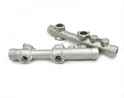

As a well - established supplier in the field of investment casting, I often encounter clients who are curious about the differences between precision investment casting and general investment casting. These two processes, though related, have distinct characteristics that make them suitable for different applications.
1. Definition and Basics
Investment casting is an ancient manufacturing process that has been refined over centuries. It involves creating a wax pattern of the desired part, coating it with a ceramic shell, melting out the wax, and then pouring molten metal into the resulting cavity. The process is also known as lost - wax casting. You can find more details about the general Investment Casting Process.
General investment casting is a broad term that encompasses a wide range of applications where the focus is on producing parts with a reasonable level of accuracy and surface finish at a relatively lower cost. It is commonly used in industries such as automotive, machinery, and general engineering.
Precision investment casting, on the other hand, is a more advanced and refined version of the investment casting process. It is designed to produce parts with extremely high dimensional accuracy, tight tolerances, and excellent surface finishes. Precision investment casting is often used in high - tech industries such as aerospace, medical devices, and electronics.
2. Pattern Making
In general investment casting, pattern making is relatively less precise. Wax patterns are typically made using simple injection molds. These molds may have some minor inaccuracies, which can be acceptable for applications where high precision is not required. The wax used in general investment casting may also have a lower quality, which can lead to some surface irregularities on the final part.
For precision investment casting, pattern making is a highly controlled process. High - quality waxes are used, which have low shrinkage rates and excellent flow properties. The injection molds for precision investment casting are made with very high accuracy using advanced machining techniques such as CNC machining. This ensures that the wax patterns have the exact dimensions and surface finish required for the final part.
3. Shell Making
The shell - making process is crucial in both general and precision investment casting, but there are significant differences. In general investment casting, the shell - making process aims to create a strong and durable ceramic shell that can withstand the molten metal pouring. The ceramic materials used are usually of a more standard grade, and the coating process may be less precise. You can learn about the Investment Casting Shell Making in more detail.
For precision investment casting, the shell - making process is much more intricate. Multiple layers of high - quality ceramic materials are applied to the wax pattern. Each layer is carefully controlled in terms of thickness, density, and composition. This results in a very uniform and precise ceramic shell that can maintain the accuracy of the wax pattern during the metal - pouring process. The ceramic materials used in precision investment casting are often specifically formulated to have low thermal expansion coefficients and high strength at high temperatures.


4. Dimensional Accuracy and Tolerances
One of the most significant differences between precision investment casting and general investment casting is the dimensional accuracy and tolerances of the final parts.
General investment casting can typically achieve tolerances in the range of ±0.1 - 0.5 mm, depending on the size and complexity of the part. This level of accuracy is sufficient for many general engineering applications. However, for more demanding applications, such as aerospace components or medical implants, these tolerances are not acceptable.
Precision investment casting can achieve much tighter tolerances, often in the range of ±0.05 mm or even better. This high level of accuracy is achieved through the precise pattern - making and shell - making processes described above. It allows for the production of parts with complex geometries and very exact dimensions.
5. Surface Finish
The surface finish of the final part is another area where precision and general investment casting differ.
In general investment casting, the surface finish may have some minor roughness and irregularities. This is due to factors such as the quality of the wax pattern, the shell - making process, and the metal - pouring process. While the surface finish may be improved through post - processing operations such as grinding and polishing, it is still generally not as smooth as that achieved by precision investment casting.
Precision investment casting can produce parts with extremely smooth surface finishes. The combination of high - quality wax patterns, precise shell - making, and controlled metal - pouring ensures that the surface of the final part has a very fine texture. This is particularly important in applications where the surface finish affects the performance of the part, such as in medical devices or optical components.
6. Material Selection
Both general and precision investment casting can use a wide range of metals and alloys, but there are some differences in the types of materials commonly used.
General investment casting is often used with more common metals and alloys, such as carbon steel, stainless steel, and aluminum. These materials are relatively inexpensive and easy to work with, making them suitable for high - volume production in general engineering applications.
Precision investment casting is more likely to use high - performance materials such as titanium alloys, nickel - based superalloys, and some specialty steels. These materials offer excellent mechanical properties, corrosion resistance, and high - temperature performance, which are required in high - tech industries. However, they are also more expensive and difficult to process, which is why precision investment casting is often used to make the most of their properties.
7. Cost
Cost is an important factor in any manufacturing process. General investment casting is generally less expensive than precision investment casting. The lower cost is mainly due to the use of less - precise pattern - making and shell - making processes, as well as the use of more common materials. This makes it a more cost - effective option for applications where high precision and tight tolerances are not essential.
Precision investment casting, on the other hand, is more expensive. The high - quality waxes, advanced pattern - making and shell - making techniques, and the use of high - performance materials all contribute to the higher cost. However, in applications where the performance and precision of the part are critical, the higher cost of precision investment casting is often justified.
8. Applications
The different characteristics of precision and general investment casting make them suitable for different applications.
General investment casting is widely used in the automotive industry for making engine components, transmission parts, and other structural components. It is also used in the machinery industry for manufacturing gears, shafts, and other mechanical parts. In the construction industry, general investment casting can be used to produce various hardware items.
Precision investment casting has a more niche set of applications. In the aerospace industry, it is used to make turbine blades, compressor discs, and other critical components that require high precision and performance. In the medical field, precision investment casting is used to produce surgical instruments, dental implants, and other medical devices. The electronics industry also benefits from precision investment casting for making connectors, sensors, and other small, high - precision parts.
Conclusion
In summary, precision investment casting and general investment casting have distinct differences in terms of pattern - making, shell - making, dimensional accuracy, surface finish, material selection, cost, and applications. As a professional investment casting supplier, we understand the unique requirements of each process and can provide high - quality solutions to meet the diverse needs of our clients.
If you are in the market for investment casting products and need to determine whether precision investment casting or general investment casting is the right choice for your project, please feel free to reach out to us. Our team of experts is ready to discuss your requirements in detail and offer the best investment casting solutions. You can also explore our Investment Casting Supplies to see the range of products we offer.
References
- Smith, J. (2018). Investment Casting Technology. Publisher X.
- Johnson, A. (2019). Precision Manufacturing Processes. Publisher Y.
- Williams, B. (2020). Advances in Investment Casting Materials. Publisher Z.