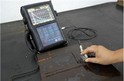

Hey there! As a supplier of Ultrasonic Flaw Detection equipment, I've seen firsthand how crucial it is to have accurate results in this field. Today, I'm gonna dive into how signal processing can significantly boost the accuracy of ultrasonic flaw detection.
First off, let's briefly talk about what ultrasonic flaw detection is. Ultrasonic flaw detection is a non - destructive testing method used to find internal flaws in materials like metals, plastics, and composites. It sends high - frequency sound waves into the material, and when these waves encounter a flaw, they reflect back, creating an echo. This echo is then analyzed to determine the size, location, and type of the flaw. You can learn more about it here.
Now, signal processing steps in to take this basic process to a whole new level. When the ultrasonic waves are sent into the material and the echoes are received, the raw signals are often quite messy. There are all sorts of background noises, interference from the surrounding environment, and even some inherent noise from the testing equipment itself. Signal processing helps us clean up these signals and extract the useful information.
One of the key techniques in signal processing for ultrasonic flaw detection is filtering. Filtering is like a sieve that lets through only the frequencies we're interested in and blocks out the rest. For example, low - pass filters can be used to remove high - frequency noise that might be caused by electrical interference or mechanical vibrations in the testing setup. High - pass filters, on the other hand, can get rid of low - frequency components that might come from slow - moving background signals. By using the right combination of filters, we can isolate the echoes that are actually coming from flaws in the material, making it much easier to detect and analyze them.


Another important aspect is signal amplification. The echoes received from flaws can be very weak, especially if the flaws are small or located deep within the material. Signal amplifiers increase the amplitude of these weak signals so that they can be more easily detected and measured. But it's not just about turning up the volume. Amplifiers need to be carefully designed to avoid amplifying the noise along with the useful signals. That's where techniques like automatic gain control (AGC) come in. AGC adjusts the amplification factor in real - time based on the strength of the incoming signals, ensuring that the weak flaw echoes are boosted while the noise remains under control.
Digital signal processing (DSP) has revolutionized ultrasonic flaw detection. With DSP, we can perform complex operations on the received signals using software algorithms. For instance, we can use algorithms to perform time - domain analysis. This involves looking at how the signal changes over time. By analyzing the shape, duration, and arrival time of the echoes, we can get a lot of information about the flaws. For example, a sharp, short - duration echo might indicate a small, well - defined flaw, while a more spread - out echo could suggest a larger or more irregularly shaped flaw.
Frequency - domain analysis is also a powerful tool in DSP. By converting the time - domain signal into the frequency domain using techniques like the Fast Fourier Transform (FFT), we can see which frequencies are present in the signal. Different types of flaws and materials have characteristic frequency responses. For example, a crack in a metal might cause certain frequencies to be attenuated more than others. By analyzing the frequency spectrum of the received signal, we can identify these characteristic patterns and use them to classify the flaws more accurately.
In addition to improving the detection of flaws, signal processing can also enhance the measurement accuracy. When it comes to determining the size and location of flaws, signal processing techniques play a vital role. For example, by accurately measuring the time of flight of the ultrasonic waves (the time it takes for the waves to travel to the flaw and back), we can calculate the distance to the flaw. Signal processing helps to improve the accuracy of this time - of - flight measurement by reducing the noise and interference that could otherwise lead to errors.
Similarly, for sizing the flaws, we can use signal processing to analyze the amplitude and shape of the flaw echoes. By comparing these characteristics with calibration standards, we can estimate the size of the flaw more precisely. This is crucial in industries where the size of a flaw can determine whether a component is still safe to use or needs to be replaced.
Let's compare ultrasonic flaw detection with other non - destructive testing methods. There's Dye Penetrant Inspection, which is mainly used to detect surface - breaking flaws. It works by applying a colored dye to the surface of the material, letting it seep into the flaws, and then removing the excess dye. A developer is then applied to make the flaws visible. While this method is effective for surface flaws, it can't detect internal flaws. Ultrasonic flaw detection, on the other hand, can reach deep inside the material and find hidden flaws that dye penetrant inspection would miss.
X Ray Inspection is another popular non - destructive testing method. X rays can penetrate materials and create an image of the internal structure. However, X ray inspection requires special safety precautions due to the radiation involved, and it can be more expensive and time - consuming compared to ultrasonic flaw detection. Ultrasonic flaw detection is generally a more cost - effective and portable solution, especially for on - site inspections.
In real - world applications, the improved accuracy provided by signal processing in ultrasonic flaw detection has huge benefits. In the aerospace industry, for example, even the smallest flaw in an aircraft component can have catastrophic consequences. By using advanced signal processing techniques in ultrasonic flaw detection, we can ensure that these components are free from hidden flaws, improving the safety and reliability of the aircraft.
In the automotive industry, ultrasonic flaw detection with signal processing can be used to inspect engine components, welds, and other critical parts. This helps to ensure the quality and durability of the vehicles, reducing the risk of failures and costly recalls.
In the oil and gas industry, where pipelines and storage tanks are constantly under stress, accurate flaw detection is essential. Ultrasonic flaw detection with enhanced signal processing can detect corrosion, cracks, and other defects in these structures, allowing for timely maintenance and preventing potential leaks and disasters.
So, if you're in an industry that requires reliable and accurate non - destructive testing, ultrasonic flaw detection with advanced signal processing is definitely the way to go. As a supplier, I can offer you state - of - the - art equipment that incorporates the latest signal processing technologies. Whether you're a small - scale manufacturer looking to ensure the quality of your products or a large - scale industrial operator in need of regular inspections, we have the solutions for you.
If you're interested in learning more about our Ultrasonic Flaw Detection products or want to discuss your specific testing needs, don't hesitate to reach out. We're always happy to have a chat and see how we can help you improve the accuracy of your flaw detection processes.
References
- "Ultrasonic Testing: A Practical Guide" by Paul C. McIntire
- "Digital Signal Processing: Principles, Algorithms, and Applications" by John G. Proakis and Dimitris G. Manolakis
- Journal articles on ultrasonic flaw detection and signal processing in NDT&E International and other related journals.