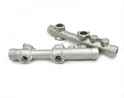

Hey there! As a supplier of Brass Investment Casting, I often get asked about the elongation of brass investment castings. So, I thought I'd take a moment to break it down for you in a way that's easy to understand.
First off, let's talk about what elongation actually means. In the world of materials science, elongation is a measure of how much a material can stretch before it breaks. It's usually expressed as a percentage of the original length of the material. For example, if a piece of brass casting has an elongation of 20%, it means that it can stretch to 120% of its original length before it snaps.


Now, why is elongation important in brass investment castings? Well, it's all about the performance and durability of the final product. A higher elongation means that the casting is more ductile, which means it can withstand more deformation without breaking. This is especially important in applications where the casting will be subjected to stress or impact, such as in automotive parts, plumbing fixtures, or machinery components.
So, what factors affect the elongation of brass investment castings? There are several, but the most important ones are the composition of the brass alloy, the casting process, and the heat treatment.
Let's start with the composition of the brass alloy. Brass is an alloy of copper and zinc, but it can also contain other elements such as lead, tin, aluminum, or nickel. The exact composition of the alloy can have a big impact on its mechanical properties, including its elongation. For example, adding a small amount of lead to brass can improve its machinability, but it can also reduce its elongation. On the other hand, adding aluminum or nickel can increase the strength and corrosion resistance of the brass, but it can also make it more brittle and reduce its elongation.
Next, let's talk about the casting process. The way the brass is melted, poured, and cooled can also affect its elongation. For example, if the brass is poured too hot or too cold, it can cause defects in the casting, such as porosity or shrinkage, which can reduce its strength and elongation. Similarly, if the casting is cooled too quickly or too slowly, it can cause internal stresses in the material, which can also reduce its elongation.
Finally, let's talk about heat treatment. Heat treatment is a process of heating and cooling the brass casting to change its microstructure and improve its mechanical properties. There are several types of heat treatment, including annealing, quenching, and tempering. Annealing is a process of heating the brass to a high temperature and then cooling it slowly to relieve internal stresses and improve its ductility. Quenching is a process of heating the brass to a high temperature and then cooling it quickly to harden it. Tempering is a process of heating the quenched brass to a lower temperature and then cooling it slowly to reduce its brittleness and improve its toughness.
So, how can you ensure that your brass investment castings have the right elongation for your application? The key is to work with a reputable supplier who has experience in producing high-quality brass investment castings. At our company, we use state-of-the-art equipment and techniques to ensure that our brass investment castings meet the highest standards of quality and performance. We also offer a wide range of brass alloys and heat treatment options to meet the specific needs of our customers.
If you're interested in learning more about our Investment Casting Products, including our Brass Investment Casting and Alloy Steel Lost Wax Casting, please don't hesitate to contact us. We'd be happy to discuss your requirements and provide you with a quote.
In conclusion, the elongation of brass investment castings is an important factor to consider when choosing a material for your application. By understanding the factors that affect elongation and working with a reputable supplier, you can ensure that your brass investment castings have the right combination of strength, ductility, and durability for your needs.
References:
- "Metals Handbook: Properties and Selection: Nonferrous Alloys and Pure Metals," ASM International.
- "The Science and Engineering of Materials," Donald R. Askeland and Pradeep P. Phule.
- "Investment Casting: Processes, Materials, and Applications," John Campbell.