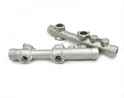

As a well - established supplier in the lost wax aluminum casting industry, I've had the privilege of witnessing firsthand the dynamic nature of this field. Lost wax aluminum casting is a highly versatile and widely used manufacturing process, but many factors can affect its production efficiency. In this blog post, I'll delve into these key factors and their implications for our operations.
1. Material Quality
The quality of the raw materials, especially the aluminum alloy, is of utmost importance. High - quality aluminum alloys have consistent chemical compositions and minimal impurities. For instance, an alloy with too many impurities can cause porosity in the final castings. During the solidification process, these impurities can act as nucleation sites for gas bubbles, leading to voids in the casting. When the casting has significant porosity, it often has to be re - worked or even scrapped, which directly reduces production efficiency.
We always source our aluminum from reliable suppliers. By ensuring a stable supply of high - quality materials, we can minimize the occurrence of casting defects related to material quality. This not only saves time on re - work but also reduces waste, allowing our production lines to run more smoothly.
2. Pattern Making
Pattern making is the first step in the lost wax casting process. A well - made pattern is the foundation for a high - quality casting. The dimensional accuracy of the pattern directly affects the final dimensions of the casting. Any errors in the pattern, such as incorrect sizing or shape deviations, can lead to non - conforming castings.
We use advanced CAD/CAM technologies to design and manufacture our patterns. This allows us to create highly accurate patterns with tight tolerances. Additionally, we pay close attention to the material used for patterns. Wax patterns, for example, need to have good flow properties and low shrinkage rates. By optimizing the pattern - making process, we can reduce the number of defective castings caused by pattern - related issues. You can learn more about our Silicon Sol Investment Casting process, which is closely related to pattern making.
3. Mold Preparation
The mold, or the investment shell, plays a crucial role in the lost wax casting process. The mold must have sufficient strength to withstand the pressure of the molten aluminum during pouring and the thermal stress during solidification. If the mold is too weak, it may crack or break, resulting in casting defects or even production stoppages.


We carefully control the mold - making process, including the selection of refractory materials and the application of multiple layers of ceramic slurry. Each layer of the mold has a specific function, such as providing strength, improving surface finish, and controlling the cooling rate. By optimizing the mold - making parameters, we can produce molds that are strong, durable, and have good thermal properties.
Moreover, the drying time of the mold is also critical. If the mold is not dried properly, it can absorb moisture, which can cause gas evolution during the pouring process and lead to porosity in the casting. We use precision drying equipment and strict drying schedules to ensure that the molds are completely dry before use.
4. Pouring Process
The pouring process is a delicate operation that requires precise control. The pouring temperature, pouring rate, and pouring location all have a significant impact on the quality of the casting and production efficiency.
The pouring temperature of the molten aluminum must be within a specific range. If the temperature is too low, the aluminum may solidify prematurely, leading to incomplete filling of the mold and defects such as cold shuts. On the other hand, if the temperature is too high, it can cause excessive oxidation of the aluminum, leading to increased slag formation and potential defects in the casting.
The pouring rate also needs to be carefully controlled. A too - fast pouring rate can cause turbulence in the molten aluminum, which can entrap air and lead to porosity. A too - slow pouring rate, however, can result in incomplete filling of the mold. We use automated pouring systems to accurately control the pouring temperature and rate, which helps us to produce high - quality castings consistently.
Furthermore, the pouring location in the mold is important. Pouring at the wrong location can cause uneven filling of the mold and lead to defects such as misruns or pour - related porosity. We conduct thorough simulations and experiments to determine the optimal pouring location for each casting design.
5. Heat Treatment
Heat treatment is often necessary to improve the mechanical properties of the lost wax aluminum castings. However, improper heat treatment can also have a negative impact on production efficiency.
If the heat - treatment process is not optimized, it can cause excessive distortion of the castings. This may require additional machining or even the rejection of the castings. We use advanced heat - treatment equipment and carefully designed heat - treatment cycles. These cycles are based on the specific alloy composition and the desired mechanical properties of the castings. By fine - tuning the heat - treatment parameters, we can minimize distortion and achieve the desired mechanical properties in a timely manner.
6. Machining and Finishing
After the casting process, machining and finishing operations are usually required to achieve the final dimensional accuracy and surface finish. The efficiency of these operations depends on the cutting tools, machining parameters, and the complexity of the casting design.
Using high - quality cutting tools can significantly improve the machining efficiency. We invest in advanced cutting tools that are designed for aluminum alloys. These tools have high cutting speeds, long tool life, and can produce good surface finishes. Additionally, we optimize the machining parameters such as cutting speed, feed rate, and depth of cut. By running machining tests on a regular basis, we can determine the most efficient machining parameters for each casting.
The complexity of the casting design also affects the machining time. Highly complex castings with intricate features require more machining operations and longer setup times. Therefore, we work closely with our customers during the design phase to simplify the casting design as much as possible without compromising the functionality. This helps to reduce the overall machining time and improve production efficiency.
7. Workforce Skills and Training
The skills and knowledge of the workforce are also critical in determining the production efficiency of lost wax aluminum casting. A well - trained workforce can operate the equipment more effectively, troubleshoot problems more quickly, and make better decisions during the production process.
We provide regular training programs for our employees. These programs cover a wide range of topics, including equipment operation, quality control, and safety procedures. By keeping our employees up - to - date with the latest technologies and best practices, we can improve the overall productivity of our production lines.
8. Equipment Maintenance
Regular and proper equipment maintenance is essential for the smooth operation of the lost wax aluminum casting process. Equipment breakdowns can cause significant production delays and increase costs.
We have a comprehensive equipment maintenance plan in place. Our maintenance team conducts regular inspections, preventive maintenance, and timely repairs on all the equipment, including furnaces, pattern - making machines, and molding equipment. By ensuring that the equipment is in good working condition, we can minimize unplanned downtime and maintain high production efficiency.
In conclusion, the production efficiency of lost wax aluminum casting is influenced by a multitude of factors, ranging from material quality and pattern making to workforce skills and equipment maintenance. As a supplier, we are constantly striving to optimize all these factors to improve our production efficiency, reduce costs, and provide high - quality castings to our customers. If you are interested in our Stainless Steel Investment Casting Parts or Stainless Steel Lost Wax Casting, we welcome you to contact us for procurement discussions. We are committed to providing you with the best solutions for your casting needs.
References
- Campbell, J. (2003). Castings. Butterworth - Heinemann.
-ASM Handbook Committee. (2008). ASM Handbook, Volume 15: Casting. ASM International. - Flemings, M. C. (1974). Solidification Processing. McGraw - Hill.