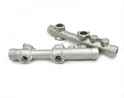

Shell mold casting is a highly precise and efficient manufacturing process that has gained significant popularity in various industries. As a leading supplier of shell mold casting services, we are committed to providing high - quality castings to meet the diverse needs of our customers. In this blog, we will explore what shell mold casting is and how it works.
Understanding Shell Mold Casting
Shell mold casting, also referred to as shell molding, is a metal casting process that involves creating a mold from a resin - coated sand mixture. The resulting mold, known as a shell mold, is a lightweight and thin - walled structure that provides excellent dimensional accuracy and surface finish for the cast parts.
The concept of shell mold casting dates back to the 1940s when it was developed as an alternative to traditional sand casting methods. Compared to conventional sand casting, shell mold casting offers several distinct advantages. One of the key benefits is its ability to produce complex shapes with high precision. The smooth surface of the shell mold reduces the need for extensive machining, which can save both time and cost in the production process. Additionally, shell mold casting can achieve a high level of repeatability, ensuring consistent quality across multiple batches of castings.
To learn more about the fundamental aspects of shell mold casting, visit What Is Shell Mold Casting.
The Components of Shell Mold Casting
Resin - Coated Sand
The primary material used in shell mold casting is resin - coated sand. The sand typically consists of fine particles, and it is mixed with a thermosetting resin. Common types of resins include phenol - formaldehyde resins, which provide good strength and heat resistance. The resin coating on the sand particles acts as a binder when heated, allowing the sand to solidify and form the shell mold.
Pattern
A pattern is a replica of the part that is to be cast. It is usually made from metal, wood, or plastic. The pattern is used to create the cavity in the shell mold. Patterns need to be precisely designed to ensure the accuracy of the final cast part. They may also incorporate features such as gates and runners, which facilitate the flow of molten metal into the mold.
Heating Equipment
Heating is a crucial step in shell mold casting. A variety of heating equipment can be used, such as ovens and heating plates. The heating process activates the resin in the resin - coated sand, causing it to harden and form the shell mold. The temperature and duration of heating are carefully controlled to ensure the proper curing of the resin and the formation of a strong and stable shell mold.
The Shell Mold Casting Process
The shell mold casting process can be divided into several key steps:
Pattern Preparation
The first step is to prepare the pattern. The pattern is cleaned and coated with a release agent to prevent the shell mold from sticking to it. The release agent can be a wax - based or a silicone - based product, depending on the type of resin used in the sand mixture.
Shell Mold Formation
Once the pattern is ready, it is heated to a specific temperature, usually around 175 - 250°C. The heated pattern is then placed in a flask or a box, and resin - coated sand is poured or blown over the pattern. The heat from the pattern causes the resin in the sand to melt and bond the sand particles together. This forms a thin shell around the pattern. The excess sand is then removed, and the shell is further cured by heating it in an oven to ensure complete hardening. For more detailed information on the process, check out Shell Mold Casting Process.
Assembly of Shell Molds
After the shell molds are formed, they are assembled to create a complete mold cavity. The two halves of the shell mold are carefully aligned and clamped together. Gates and runners may be added at this stage to allow the molten metal to flow into the mold cavity.
Melting and Pouring of Metal
The next step is to melt the metal. Commonly used metals in shell mold casting include cast iron, steel, aluminum, and bronze. The metal is melted in a furnace at the appropriate temperature for its type. Once the metal reaches the correct molten state, it is poured into the mold cavity through the gates and runners. The molten metal fills the cavity, taking the shape of the pattern.
Cooling and Solidification
After pouring, the molten metal begins to cool and solidify inside the shell mold. The cooling rate is an important factor that can affect the quality of the cast part. A controlled cooling process helps to minimize internal stresses and ensure uniform solidification.
Mold Removal and Finishing
Once the metal has completely solidified, the shell mold is broken away from the cast part. The cast part is then removed from the mold. It may undergo some finishing operations, such as trimming the excess metal from the gates and runners, and surface treatment to improve its appearance and performance.
Applications of Shell Mold Casting
Shell mold casting is widely used in various industries due to its ability to produce high - quality castings.
Automotive Industry
In the automotive industry, shell mold casting is used to manufacture engine components, transmission parts, and suspension components. The high precision and excellent surface finish of shell - molded parts make them suitable for applications where tight tolerances and reliable performance are required.
Aerospace Industry
The aerospace industry also benefits from shell mold casting. Components such as turbine blades, brackets, and structural parts are often produced using this process. The ability to create complex shapes with high accuracy is essential for aerospace applications, where weight reduction and performance optimization are critical.
Machinery and Equipment Manufacturing
In general machinery and equipment manufacturing, shell mold casting is used to produce gears, pulleys, and other mechanical parts. The process allows for the production of parts with consistent quality and good mechanical properties, which are important for the reliable operation of machinery.
Advantages of Choosing Our Shell Mold Casting Services
As a professional shell mold casting supplier, we offer several advantages to our customers.
Quality Assurance
We have a strict quality control system in place. Our experienced technicians and engineers monitor every step of the casting process, from pattern design to final finishing. We use advanced testing equipment to ensure that our castings meet or exceed the required industry standards.
Customization
We understand that different customers have different requirements. That's why we offer customized shell mold casting solutions. Whether you need a small - scale production run or a large - volume order, we can work with you to design and manufacture the cast parts that meet your specific needs.
Cost - Effectiveness
Our shell mold casting process is designed for efficiency, which helps to reduce production costs. By minimizing the need for extensive machining and achieving high levels of repeatability, we can offer competitive pricing without compromising on quality.
Contact Us for Your Shell Mold Casting Needs
If you are in the market for high - quality shell - molded castings, we invite you to contact us for procurement and洽谈. Our team of experts is ready to discuss your project requirements, provide detailed quotations, and offer technical support. We are committed to building long - term partnerships with our customers by delivering top - notch products and excellent service.


References
- Campbell, J. (2003). Castings. Butterworth - Heinemann.
- Kalpakjian, S., & Schmid, S. R. (2010). Manufacturing Engineering and Technology. Pearson Prentice Hall.
- Metals Handbook: Casting. (1988). ASM International.