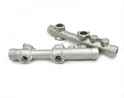

As a leading supplier of lost wax aluminum castings, I am often asked about the drilling processes involved in this intricate manufacturing method. Lost wax casting, also known as investment casting, is a centuries - old technique that has been refined over time to produce high - quality aluminum components with excellent dimensional accuracy and surface finish. In this blog, I will delve into the drilling processes for lost wax aluminum castings, providing an in - depth understanding of how we at our company ensure precision and efficiency in every step.
1. Pre - Drilling Preparation
Before the actual drilling process begins, a series of preparatory steps are crucial. First, we carefully inspect the lost wax aluminum castings. Any surface irregularities, burrs, or impurities can affect the drilling operation. We use advanced non - destructive testing methods, such as X - ray inspection, to detect internal defects within the casting. This ensures that the casting is of high quality and suitable for drilling.
Next, we select the appropriate drill bits. The choice of drill bits depends on several factors, including the hardness of the aluminum alloy, the size and depth of the holes to be drilled, and the required surface finish. For lost wax aluminum castings, high - speed steel (HSS) drill bits are commonly used due to their good cutting performance and cost - effectiveness. However, for more demanding applications, carbide - tipped drill bits may be preferred as they offer greater durability and can withstand higher cutting speeds.
We also set up the drilling machine. The machine must be properly calibrated to ensure accurate hole placement and consistent hole quality. The workpiece is securely clamped to prevent any movement during the drilling process, which could lead to misaligned holes or poor surface finish.
2. Drilling Operations
2.1 Center Drilling
The first step in the drilling process is often center drilling. This involves using a center drill to create a small, conical indentation at the location where the main hole will be drilled. Center drilling serves several important purposes. It helps to guide the main drill bit, preventing it from wandering off - center and ensuring accurate hole placement. Additionally, it reduces the risk of the drill bit breaking or chipping when it first makes contact with the casting.
2.2 Main Drilling
After center drilling, the main drilling operation takes place. The drill bit is gradually fed into the casting at a controlled rate, known as the feed rate. The feed rate is carefully selected based on the material properties of the aluminum casting, the size of the drill bit, and the cutting speed. A too - high feed rate can cause excessive tool wear, poor surface finish, and even damage to the casting, while a too - low feed rate can result in inefficient production and longer cycle times.
The cutting speed is another critical parameter. It refers to the speed at which the outer edge of the drill bit moves relative to the workpiece. The cutting speed is determined by the type of drill bit, the material of the casting, and the desired surface finish. For lost wax aluminum castings, a relatively high cutting speed can be used due to the good machinability of aluminum. However, it is important to balance the cutting speed with the feed rate to achieve optimal results.
During the drilling process, coolant is often used. Coolant helps to reduce friction and heat generation, which can extend the life of the drill bit and improve the surface finish of the holes. For lost wax aluminum castings, water - soluble coolants are commonly used as they are effective in cooling and lubricating the cutting area and are environmentally friendly.
2.3 Step Drilling
In some cases, step drilling may be required. This involves using a step drill bit to create holes with different diameters in a single operation. Step drilling is useful when the casting requires holes with varying sizes or when a countersunk hole is needed. The step drill bit has multiple cutting edges, each with a different diameter, allowing it to create a series of concentric holes in a single pass.
3. Post - Drilling Operations
After the drilling is completed, several post - drilling operations may be necessary.
3.1 Deburring
Deburring is an important step to remove any burrs or sharp edges that may have been created during the drilling process. Burrs can affect the functionality of the component and may pose a safety hazard. We use various deburring methods, such as manual deburring with files or abrasive pads, and automated deburring processes using deburring machines.
3.2 Hole Finishing
Depending on the requirements of the application, the holes may need to be finished to achieve a specific surface finish or dimensional accuracy. This can be done through processes such as reaming or honing. Reaming is a process that uses a reamer to slightly enlarge the hole and improve its dimensional accuracy and surface finish. Honing, on the other hand, is a more precise finishing process that uses abrasive stones to remove a small amount of material from the hole surface, resulting in a very smooth and accurate hole.
4. Quality Control
Throughout the drilling process, strict quality control measures are in place to ensure that the holes meet the required specifications. We use various inspection tools, such as calipers, micrometers, and coordinate measuring machines (CMMs), to measure the diameter, depth, and location of the holes. The surface finish of the holes is also inspected using surface roughness testers.
Any non - conforming holes are immediately identified and corrected. If a hole is found to be out of tolerance, we may re - drill the hole or use corrective machining operations to bring it within the acceptable range.
5. Applications and Advantages of Drilled Lost Wax Aluminum Castings
Drilled lost wax aluminum castings have a wide range of applications in various industries. In the automotive industry, they are used in engine components, transmission parts, and suspension systems. The high precision and good surface finish of the drilled holes ensure proper fit and function of these components, contributing to the overall performance and reliability of the vehicle.
In the aerospace industry, lost wax aluminum castings with drilled holes are used in aircraft structural components, hydraulic systems, and engine parts. The lightweight nature of aluminum combined with the ability to produce complex shapes through lost wax casting makes them an ideal choice for aerospace applications where weight reduction is crucial.
One of the main advantages of using lost wax casting for drilled components is the ability to produce complex geometries. Lost wax casting allows for the creation of intricate shapes and thin - walled sections that would be difficult or impossible to achieve using other manufacturing methods. The drilled holes can be accurately placed within these complex shapes, enabling the integration of multiple functions into a single component.
Another advantage is the excellent surface finish. Lost wax castings typically have a smooth surface finish, which reduces the need for extensive post - machining operations. The drilled holes also benefit from this smooth surface, resulting in better sealing and reduced friction in applications where the holes are used for fluid or gas flow.
If you are interested in Brass Investment Casting, Silicon Sol Investment Casting, or Stainless Steel Lost Wax Casting, we also have a wide range of solutions to meet your needs.
6. Conclusion
The drilling processes for lost wax aluminum castings are complex and require careful planning, precise execution, and strict quality control. From pre - drilling preparation to post - drilling finishing operations, every step is crucial to ensure the production of high - quality components with accurate hole placement and excellent surface finish.


As a supplier of lost wax aluminum castings, we are committed to providing our customers with the best - in - class products and services. Our experienced team of engineers and technicians uses the latest technology and manufacturing techniques to ensure that our drilled lost wax aluminum castings meet the highest standards of quality and performance.
If you are in need of high - quality lost wax aluminum castings with drilled holes, we invite you to contact us for procurement and further discussion. We look forward to working with you to meet your specific requirements.
References
- Kalpakjian, S., & Schmid, S. R. (2013). Manufacturing Engineering and Technology. Pearson.
- Groover, M. P. (2010). Fundamentals of Modern Manufacturing: Materials, Processes, and Systems. Wiley.
- ASM Handbook Committee. (2008). ASM Handbook Volume 15: Casting. ASM International.