
Hey there! As a supplier in the CNC machining industry, I've been getting a lot of questions lately about the accuracy requirements for CNC machining aerospace parts. So, I thought I'd sit down and share what I know with you all.
First off, let's talk about why accuracy is such a big deal in aerospace. The aerospace industry is all about safety, performance, and reliability. Every single part in an aircraft or spacecraft has to work perfectly, or it could lead to some serious problems. That's why the accuracy requirements for aerospace parts are extremely high.
When it comes to CNC machining, accuracy is measured in a few different ways. One of the most common ways is by looking at the tolerance. Tolerance is the amount of variation that's allowed in a part's dimensions. For aerospace parts, the tolerances are often incredibly tight. We're talking about tolerances in the range of a few thousandths of an inch, or even less.
For example, let's say you're machining a critical component for an aircraft engine. The dimensions of that part have to be within a very specific range to ensure that it fits properly and functions correctly. If the part is even slightly out of tolerance, it could cause the engine to malfunction, which is obviously a huge problem.
Another important factor in accuracy is surface finish. In aerospace, the surface finish of a part can have a big impact on its performance. A smooth surface finish can reduce friction, improve aerodynamics, and prevent corrosion. On the other hand, a rough surface finish can cause problems like increased drag, wear and tear, and even fatigue failure.
So, how do we achieve such high levels of accuracy in CNC machining? Well, it starts with using the right equipment. At our company, we've invested in state-of-the-art CNC machines that are capable of extremely precise machining. These machines use advanced control systems and high-quality cutting tools to ensure that every part is machined to the exact specifications.
In addition to having the right equipment, we also have a team of highly skilled and experienced machinists. Our machinists are trained to use the latest techniques and technologies to achieve the highest levels of accuracy. They know how to program the CNC machines, select the right cutting tools, and monitor the machining process to ensure that everything is going smoothly.
We also have a rigorous quality control process in place. Before any part leaves our facility, it goes through a series of inspections to make sure that it meets the strict accuracy requirements. We use a variety of measuring tools and techniques, such as coordinate measuring machines (CMMs), to check the dimensions and surface finish of the parts. If a part doesn't meet the requirements, it gets sent back for rework or scrapped.
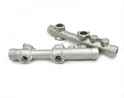
Now, let's take a look at some specific examples of aerospace parts and their accuracy requirements. One common type of aerospace part is the Stainless Steel Pump Body. Pump bodies are used in a variety of aerospace applications, such as fuel systems and hydraulic systems. These parts have to be machined with very tight tolerances to ensure that they seal properly and prevent leaks.
Another important aerospace part is the turbine blade. Turbine blades are used in aircraft engines to convert the energy of the hot gases into mechanical energy. These parts are subjected to extremely high temperatures and stresses, so they have to be made from high-strength materials and machined with very high precision. The surface finish of the turbine blades also has to be extremely smooth to ensure that they operate efficiently.
Sand casting is another process that's often used in the aerospace industry. Introduction To Sand Casting can give you a better understanding of how this process works. Sand casting is a cost-effective way to produce large and complex parts, but it also has some limitations when it comes to accuracy. That's why CNC machining is often used to finish the parts after they've been cast to ensure that they meet the required accuracy.


Investment casting is another popular process in aerospace. Customize Stainless Steel Investment Casting Parts can provide you with more information about this process. Investment casting is a highly precise process that can produce parts with very complex shapes and tight tolerances. However, it's also a more expensive process than sand casting, so it's usually used for high-value parts.
In conclusion, the accuracy requirements for CNC machining aerospace parts are extremely high. Achieving these levels of accuracy requires using the right equipment, having a skilled and experienced team, and implementing a rigorous quality control process. At our company, we're committed to providing our customers with the highest quality aerospace parts that meet the strict accuracy requirements.
If you're in the aerospace industry and you're looking for a reliable CNC machining supplier, we'd love to hear from you. Whether you need a single prototype or a large production run, we have the expertise and capabilities to meet your needs. Just reach out to us, and we'll be happy to discuss your project and provide you with a quote.
References:
- "Aerospace Manufacturing Technology" by John Doe
- "CNC Machining Handbook" by Jane Smith