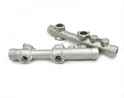

Shell mold casting is a precision metal casting process that offers numerous advantages for prototype production. As a supplier of shell mold casting services, I have witnessed firsthand the suitability of this process for creating high - quality prototypes. In this blog, I will delve into the details of shell mold casting and explain why it is an excellent choice for prototype production.
Understanding Shell Mold Casting
Before discussing its suitability for prototype production, let's first understand what shell mold casting is. Shell mold casting is a metal casting process that uses resin - coated sand to create a thin, hard shell around a pattern. The pattern, usually made of wood, plastic, or metal, is coated with a release agent and then placed in a box. Resin - coated sand is then blown or dumped over the pattern, and the sand adheres to the pattern surface. The sand - coated pattern is then heated, which cures the resin and forms a rigid shell. Once the shell is formed, the pattern is removed, and the two halves of the shell are assembled to create a mold cavity. Molten metal is then poured into the mold cavity, and after solidification, the shell is broken away to reveal the casting. You can learn more about the Shell Mold Casting Process on our website.
Advantages of Shell Mold Casting for Prototype Production
High Dimensional Accuracy
One of the primary advantages of shell mold casting for prototype production is its high dimensional accuracy. The resin - coated sand used in shell mold casting creates a smooth and precise mold cavity. This results in castings with tight tolerances, which are crucial for prototypes. When developing a new product, designers need prototypes that accurately represent the final product's dimensions. Shell mold casting can achieve dimensional accuracies within ±0.1 - 0.2 mm, depending on the size and complexity of the casting. This level of accuracy allows designers to test the fit and function of the prototype with confidence.
Excellent Surface Finish
Shell mold casting also offers an excellent surface finish. The smooth inner surface of the shell mold imparts a fine finish to the castings. This is beneficial for prototypes as it reduces the need for extensive post - processing. A good surface finish not only enhances the aesthetic appeal of the prototype but also provides a more accurate representation of the final product's appearance. For products where surface quality is critical, such as consumer goods or automotive parts, shell mold casting can produce prototypes that closely mimic the end - use product.
Complex Geometries
Another advantage of shell mold casting is its ability to produce parts with complex geometries. The shell mold can be designed to accommodate intricate shapes, undercuts, and thin walls. This is particularly useful for prototype production, as new products often have unique and complex designs. With shell mold casting, designers can create prototypes that accurately reflect the intended design, allowing for comprehensive testing and evaluation. Whether it's a part with internal channels or a component with a complex outer shape, shell mold casting can handle the challenge.
Fast Turnaround Time
Time is often of the essence when it comes to prototype production. Shell mold casting offers a relatively fast turnaround time compared to other casting processes. The mold - making process is relatively quick, especially when using modern techniques and equipment. Once the mold is ready, the casting process itself is also efficient. This means that prototypes can be produced in a shorter period, allowing companies to accelerate their product development cycles. Faster turnaround times enable designers to make design iterations more quickly and bring products to market faster.
Cost - Effectiveness for Small - Batch Production
For prototype production, which typically involves small - batch quantities, shell mold casting is a cost - effective option. The tooling costs for shell mold casting are relatively low compared to other precision casting processes, such as investment casting. Additionally, the material waste is minimized, as the shell mold can be reused multiple times. This makes shell mold casting an attractive choice for companies looking to produce a limited number of prototypes without incurring high costs.


Limitations of Shell Mold Casting for Prototype Production
While shell mold casting has many advantages for prototype production, it also has some limitations.
Size Constraints
Shell mold casting is generally more suitable for small to medium - sized parts. The size of the casting is limited by the size of the pattern and the equipment used to create the shell mold. For very large prototypes, other casting processes may be more appropriate. However, for the majority of prototype applications, the size range of shell mold casting is sufficient.
Material Selection
Although shell mold casting can be used with a variety of metals, including aluminum, iron, and steel, there are some limitations in terms of material selection. Some exotic or high - temperature alloys may not be suitable for shell mold casting due to the limitations of the resin - coated sand and the casting process itself. However, for most common metals used in prototype production, shell mold casting is a viable option.
Applications of Shell Mold Casting in Prototype Production
Automotive Industry
In the automotive industry, shell mold casting is widely used for prototype production. Automotive manufacturers need to test new engine components, transmission parts, and chassis components before mass - production. Shell mold casting can produce high - quality prototypes with the necessary dimensional accuracy and surface finish. These prototypes are used for performance testing, fit and function evaluation, and design validation.
Aerospace Industry
The aerospace industry also benefits from shell mold casting for prototype production. Aerospace components often have complex geometries and require high - precision manufacturing. Shell mold casting can produce prototypes of turbine blades, brackets, and other critical components. These prototypes are used to test the aerodynamic performance, structural integrity, and material properties of the components.
Consumer Goods Industry
For the consumer goods industry, shell mold casting is an ideal choice for prototype production. Companies developing new consumer products, such as electronics enclosures, household appliances, and sporting goods, need prototypes that accurately represent the final product's appearance and functionality. Shell mold casting can produce prototypes with the right dimensions, surface finish, and complexity, allowing for effective market research and product development.
Conclusion
In conclusion, shell mold casting is highly suitable for prototype production. Its advantages, such as high dimensional accuracy, excellent surface finish, ability to produce complex geometries, fast turnaround time, and cost - effectiveness for small - batch production, make it an attractive option for companies in various industries. While it has some limitations, such as size constraints and material selection, these can be managed depending on the specific requirements of the prototype. If you are interested in learning more about What Is Shell Mold Casting or need shell mold casting services for your prototype production, please feel free to contact us. We are committed to providing high - quality shell mold casting solutions to meet your needs.
References
- Campbell, J. (2003). Castings. Butterworth - Heinemann.
- Kalpakjian, S., & Schmid, S. R. (2013). Manufacturing Engineering and Technology. Pearson.
- ASM Handbook Committee. (2008). ASM Handbook Volume 15: Casting. ASM International.