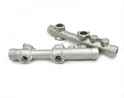

Hey there! I'm a supplier in the shell mold casting business, and today I wanna chat about the standards for shell mold casting products.
First off, let's briefly touch on what shell mold casting is. If you're curious and want more in - depth info, you can check out this link: What Is Shell Mold Casting. Shell mold casting is a process where a thin shell of sand mixed with a thermosetting resin is formed around a pattern. This shell serves as the mold for casting metal parts. And here's another useful link if you want to know about the process details: Shell Mold Casting Process.
Dimensional Accuracy
One of the most crucial standards for shell mold casting products is dimensional accuracy. Customers expect the parts they get to match the exact specifications they've provided. Even a tiny deviation can lead to problems when these parts are integrated into larger assemblies.
We use high - precision measuring tools like calipers, micrometers, and coordinate measuring machines (CMMs) to ensure that every single part we produce meets the required dimensions. For example, if a customer needs a part with a length of 50mm ± 0.1mm, we'll measure multiple times during the production process to make sure it falls within that tolerance range. Any part that doesn't meet these strict dimensional requirements is either re - worked or discarded.
Surface Finish
The surface finish of a shell mold casting product is also super important. A smooth surface finish not only looks good but also has practical benefits. It can reduce friction, improve the part's resistance to corrosion, and make it easier to clean.
We have different methods to achieve the desired surface finish. After the casting is removed from the mold, we might use sandblasting to remove any remaining sand and impurities on the surface. Then, depending on the customer's requirements, we can perform additional finishing processes like grinding or polishing. For parts that will be used in applications where a high - gloss finish is needed, we'll go the extra mile to make sure the surface is as smooth as possible.
Material Quality
The quality of the material used in shell mold casting is non - negotiable. We source our raw materials from reliable suppliers and conduct thorough quality checks before using them in production.
The chemical composition of the metal is carefully analyzed to ensure it meets the required standards. For example, if we're casting a steel part, we'll check the carbon, silicon, manganese, and other element contents to make sure they're within the specified range. This is important because the chemical composition affects the part's mechanical properties such as strength, hardness, and ductility.
We also test the mechanical properties of the cast parts. Tensile tests, hardness tests, and impact tests are some of the common methods we use. These tests help us ensure that the parts can withstand the stresses and loads they'll be subjected to in their intended applications.
Porosity and Defects
Porosity and other defects can significantly weaken a shell mold casting product. Porosity occurs when there are small holes or voids in the casting, which can be caused by factors like gas entrapment during the pouring process or improper mold design.
We have strict inspection procedures in place to detect and eliminate parts with porosity or other defects. Visual inspection is the first step. Our experienced workers carefully examine each part for any visible signs of defects. We also use non - destructive testing methods like X - ray inspection and ultrasonic testing to detect internal defects that might not be visible to the naked eye.


If a part has porosity or other defects, we'll try to determine the root cause. Sometimes, it might be a simple fix like adjusting the pouring temperature or changing the gating system in the mold. Other times, we might need to make more significant changes to the production process.
Mechanical Properties
As mentioned earlier, the mechanical properties of shell mold casting products are of great importance. The strength, hardness, and ductility of a part need to be appropriate for its intended application.
For example, if a part is going to be used in a high - stress application like an automotive engine component, it needs to have high strength and good fatigue resistance. On the other hand, a part used in a less - demanding application might require different mechanical properties.
We work closely with our customers to understand their specific requirements and then optimize the production process to achieve the desired mechanical properties. This might involve adjusting the alloy composition, heat treatment processes, or the cooling rate during casting.
Tolerance and Fit
Tolerance and fit are closely related to dimensional accuracy but deserve a separate mention. When multiple parts are assembled together, they need to fit properly. This means that each part's dimensions need to be within the specified tolerance range so that they can be assembled smoothly.
We pay close attention to the fit between mating parts. For example, if two parts are supposed to be press - fit together, we'll make sure that the dimensions of the parts are such that the press - fit is neither too loose nor too tight. This requires precise control over the manufacturing process and accurate measurement of each part.
Consistency
Consistency is key in the shell mold casting business. Customers expect every part they receive to be of the same high quality and meet the same standards.
We have a well - established quality management system in place to ensure consistency across all our products. Every step of the production process is documented, and we regularly review and improve our processes to eliminate any variations. This includes everything from the way we mix the sand and resin for the mold to the heat treatment process for the cast parts.
Environmental Considerations
In today's world, environmental considerations are also becoming an important standard for shell mold casting products. We're committed to reducing our environmental impact by using sustainable practices.
We try to minimize waste generation during the production process. For example, we recycle any unused sand and metal scraps. We also use energy - efficient equipment and processes to reduce our energy consumption. By doing so, we not only help the environment but also make our business more sustainable in the long run.
If you're in the market for high - quality shell mold casting products that meet all these strict standards, don't hesitate to reach out to us. We're always ready to have a chat about your specific needs and see how we can help you with your casting requirements. Whether you need a small batch of custom - made parts or a large - scale production run, we've got the expertise and resources to deliver top - notch products.
References
- ASM Handbook Volume 15: Casting
- "Foundry Technology" by R. D. Pehlke
So, that's a rundown of the standards for shell mold casting products from a supplier's perspective. I hope this blog has given you a better understanding of what goes into making high - quality shell mold castings.