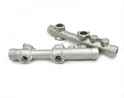

Hey there! As a supplier of Lost Wax Aluminum Casting, I've been getting a lot of questions about metal degassing methods. It's a crucial step in the lost wax aluminum casting process, and getting it right can make a huge difference in the quality of the final product. So, let's dive into the different metal degassing methods for lost wax aluminum casting.
Why Degassing is Important in Lost Wax Aluminum Casting
Before we jump into the methods, let's understand why degassing is so important. When we're casting aluminum using the lost wax method, the molten aluminum can absorb gases like hydrogen. These gases can cause porosity in the final casting, which weakens the part and can lead to failures in its intended application. By degassing the molten aluminum, we can reduce the gas content and improve the mechanical properties and overall quality of the casting.
Common Metal Degassing Methods
1. Rotary Degassing
Rotary degassing is one of the most popular methods for degassing molten aluminum. It involves using a rotating impeller that is submerged in the molten metal. As the impeller spins, it creates tiny bubbles of an inert gas, usually argon or nitrogen. These bubbles rise through the molten aluminum, and as they do, they capture the dissolved gases like hydrogen. The captured gases then float to the surface of the molten metal and are removed.
The advantage of rotary degassing is that it's very efficient. The rotating impeller creates a large number of small bubbles, which increases the surface area available for gas transfer. This means that more dissolved gases can be removed in a shorter amount of time. Another benefit is that it's a relatively simple process to control. You can adjust the speed of the impeller and the flow rate of the inert gas to optimize the degassing process.


2. Vacuum Degassing
Vacuum degassing is another effective method for removing gases from molten aluminum. In this process, the molten aluminum is placed in a vacuum chamber. The vacuum reduces the pressure above the molten metal, which causes the dissolved gases to come out of solution and form bubbles. These bubbles then rise to the surface of the molten metal and are removed.
One of the main advantages of vacuum degassing is that it can achieve very low gas levels in the molten aluminum. Since the vacuum creates a low-pressure environment, it forces the dissolved gases to leave the metal more effectively. However, vacuum degassing can be more expensive and complex than rotary degassing. It requires specialized equipment to create and maintain the vacuum, and the process can take longer.
3. Flux Degassing
Flux degassing involves adding a flux to the molten aluminum. The flux is a chemical compound that reacts with the dissolved gases in the metal. When the flux is added to the molten aluminum, it forms a layer on the surface of the metal. This layer traps the gases and helps to remove them from the molten metal.
Flux degassing is a relatively simple and inexpensive method. It can be used in combination with other degassing methods to improve the overall degassing efficiency. However, the choice of flux is important, as different fluxes have different properties and effectiveness. Some fluxes can also leave residues in the molten metal, which may need to be removed later.
Choosing the Right Degassing Method
So, how do you choose the right degassing method for your lost wax aluminum casting? Well, it depends on several factors.
- Quality Requirements: If you need a high-quality casting with very low gas content, vacuum degassing might be the best option. However, if the quality requirements are not as strict, rotary degassing or flux degassing could be sufficient.
- Production Volume: For high-volume production, rotary degassing is often a good choice because it's fast and efficient. If you have a low production volume, vacuum degassing might be too expensive, and flux degassing could be a more cost-effective option.
- Budget: As mentioned earlier, vacuum degassing requires specialized equipment, which can be expensive. Rotary degassing is more affordable, and flux degassing is the least expensive option.
Our Services as a Lost Wax Aluminum Casting Supplier
At our company, we have extensive experience in lost wax aluminum casting, and we use the latest degassing methods to ensure the highest quality of our products. Whether you need a small batch of custom parts or a large-scale production run, we can meet your needs.
We also offer a wide range of other casting services, such as Silicon Sol Investment Casting, Stainless Steel Investment Casting Parts, and Alloy Steel Lost Wax Casting. Our team of experts can work with you to determine the best casting method and degassing process for your specific application.
Conclusion
In conclusion, metal degassing is a critical step in the lost wax aluminum casting process. By choosing the right degassing method, you can improve the quality of your castings and ensure their performance in the intended application. Whether you're looking for high-quality, high-volume production or a custom solution for a specific project, we're here to help.
If you're interested in learning more about our lost wax aluminum casting services or have any questions about the degassing methods we use, don't hesitate to reach out. We'd love to discuss your project and see how we can work together to achieve your goals.
References
- Campbell, J. (2003). Castings. Butterworth-Heinemann.
- Davis, J. R. (Ed.). (2008). Aluminum and Aluminum Alloys. ASM International.
- Flemings, M. C. (1974). Solidification Processing. McGraw-Hill.