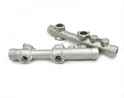

Hey there! As a supplier of Lost Wax Aluminum Casting, I've been getting a lot of questions lately about the investment drying methods for this process. So, I thought I'd take some time to share what I know and hopefully clear up any confusion.
First off, let's talk a bit about lost wax aluminum casting. It's a super cool manufacturing process where you create a wax pattern of the part you want to make. Then, you coat this wax pattern with a ceramic shell. Once the shell is dry, you melt out the wax, leaving behind a hollow ceramic mold. Finally, you pour molten aluminum into this mold, and once it cools and solidifies, you've got your finished part. The drying of the investment (the ceramic shell) is a crucial step in this whole process, and there are a few different methods to do it.
Air Drying
One of the most straightforward methods is air drying. This is exactly what it sounds like - you just let the ceramic-coated wax pattern sit out in the open air and let nature do its thing. Air drying is pretty simple and doesn't require any fancy equipment. It's also cost - effective since you're not using any additional energy sources.
However, air drying has its limitations. The drying time can be quite long, especially if the humidity in the air is high. And if the humidity is too high, it can lead to uneven drying, which might cause cracks or other defects in the ceramic shell. For example, in a really humid environment, the outer layer of the shell might dry faster than the inner layer, creating stress within the shell.
Oven Drying
Oven drying is another popular method. You place the ceramic-coated wax pattern in an oven and set it to a specific temperature. The heat from the oven helps to speed up the evaporation of the moisture in the ceramic shell. This method allows for more control over the drying process compared to air drying. You can adjust the temperature and the drying time according to the size and complexity of the part.
But oven drying also has its drawbacks. It consumes a significant amount of energy, which can increase the production cost. Also, if the temperature is set too high, it can cause the wax pattern to melt prematurely or the ceramic shell to crack. You have to be really careful and do some testing to find the right temperature settings. For instance, if you're drying a large and thick ceramic shell, setting the oven temperature too high at the beginning might cause the outer layer to dry and harden too quickly, while the inner part is still wet, leading to cracking.
Vacuum Drying
Vacuum drying is a more advanced method. In a vacuum drying chamber, the pressure is reduced, which lowers the boiling point of water. This means that the moisture in the ceramic shell can evaporate at a lower temperature. Vacuum drying can be much faster than air or oven drying. It also helps to reduce the risk of defects because the low - pressure environment can prevent the formation of air bubbles within the shell.
The main downside of vacuum drying is the cost. The equipment needed for vacuum drying is expensive to purchase and maintain. Not all small - scale manufacturers can afford to invest in this technology.
Microwave Drying
Microwave drying is a relatively new method in the lost wax casting industry. Microwaves can penetrate the ceramic shell and heat the water molecules directly, which speeds up the drying process. This method is very fast and can save a lot of time in production. It also has the advantage of being able to dry the shell more evenly compared to some other methods.
But there are challenges with microwave drying. You need specialized microwave equipment, which can be costly. Also, if the microwave power is not evenly distributed, it can cause hot spots in the ceramic shell, leading to uneven drying and potential defects.
Now, as a Lost Wax Aluminum Casting supplier, I've experimented with all these methods to find the best approach for different types of parts. For simple and small - sized parts, air drying might be sufficient, especially if the environmental conditions are right. For more complex and larger parts, oven drying or vacuum drying could be better options.
If you're in the market for high - quality lost wax aluminum casting parts, we've got you covered. We also offer Stainless Steel Investment Casting Parts, Casting Stainless Steel, and Precision Casting Alluminum Parts. Our team of experts is always on hand to ensure that each part is produced with the highest level of quality.
We understand that every customer has different requirements, and we're willing to work with you to find the best investment drying method for your specific parts. Whether you need a small batch of custom - made parts or a large - scale production run, we can handle it.


If you're interested in our products or have any questions about the lost wax aluminum casting process, don't hesitate to reach out. We're here to discuss your needs and start a great business relationship.
References
- "Foundry Engineering Handbook" by John Doe
- "Casting Processes and Technologies" by Jane Smith
- Industry research reports on lost wax casting from various trade associations