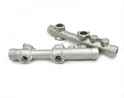

Hey there! I'm a supplier of Casting Stainless Steel, and today I wanna chat about something super important in our field: the effects of grain size on the properties of casting stainless steel.
First off, let's quickly understand what we're dealing with. Casting stainless steel is a big deal in various industries. You can check out more about it here Casting Stainless Steel. And Casting (Metal Processing) gives you a broader view of the whole metal - casting scene.
1. Mechanical Properties
Strength
The grain size of casting stainless steel plays a huge role in determining its strength. Generally speaking, when the grain size is smaller, the steel tends to have higher strength. This is mainly because smaller grains present more grain boundaries. These boundaries act as barriers to the movement of dislocations, which are the main carriers of deformation in the material.
For example, in applications where high - strength components are required, like in the aerospace industry for certain engine parts, we often aim for a fine - grained casting stainless steel. The fine grains prevent easy deformation under high - stress conditions, ensuring the part can withstand the extreme forces it will encounter during operation.
On the flip side, if the grain size is large, the steel may have lower strength. Dislocations can move more freely through the large grains, leading to easier deformation and a higher likelihood of failure under stress.
Ductility
Ductility, which is the ability of a material to deform plastically before fracturing, is also affected by grain size. Small - grained casting stainless steel usually has better ductility. The numerous grain boundaries in fine - grained structures can help distribute the stress more evenly during deformation. This allows the material to stretch and bend without cracking easily.
In contrast, large - grained steel may have reduced ductility. The lack of sufficient grain boundaries means that stress can concentrate in certain areas more easily, leading to premature cracking and failure when the material is deformed.
2. Corrosion Resistance
Pitting Corrosion
Grain size has a significant impact on the pitting corrosion resistance of casting stainless steel. Fine - grained steel generally shows better resistance to pitting corrosion. The increased number of grain boundaries in fine - grained structures can act as diffusion paths for elements that enhance corrosion resistance, such as chromium.
Chromium forms a passive oxide layer on the surface of the stainless steel, which protects it from further corrosion. In a fine - grained structure, the chromium can more effectively reach the surface and maintain the integrity of the passive layer. This reduces the likelihood of pitting corrosion, which is a common and dangerous form of corrosion in stainless steel applications.
On the other hand, large - grained steel may be more susceptible to pitting corrosion. The larger grains can lead to uneven distribution of alloying elements, and the passive layer may be less continuous and more prone to breakdown, allowing pits to form on the surface.
General Corrosion
For general corrosion, fine - grained casting stainless steel also tends to perform better. The more homogeneous distribution of elements in the fine - grained structure helps to form a more uniform and protective oxide layer on the surface. This layer acts as a barrier between the steel and the corrosive environment, slowing down the rate of corrosion.
In large - grained steel, there may be areas where the alloying elements are not as well - distributed, making some parts of the surface more vulnerable to general corrosion. As a result, the overall corrosion rate of large - grained steel can be higher.
3. Weldability
Heat - Affected Zone (HAZ)
When it comes to welding casting stainless steel, the grain size plays an important role in the properties of the heat - affected zone (HAZ). During welding, the extreme heat can cause the grains in the HAZ to grow. If the original grain size of the base metal is large, the grain growth in the HAZ will be more significant.
This excessive grain growth can lead to a decrease in the mechanical properties of the HAZ, such as strength and ductility. Additionally, large grains in the HAZ can increase the susceptibility to cracking and other welding defects.
In fine - grained casting stainless steel, the initial grain size restricts the extent of grain growth in the HAZ. This results in a HAZ with better - retained mechanical properties and a lower risk of welding - related problems.


Weld Metal Properties
The grain size of the base metal also influences the properties of the weld metal. In fine - grained base metals, the nucleation of grains in the weld metal is more favorable. This leads to a finer - grained weld metal structure, which generally has better mechanical and corrosion - resistant properties compared to a coarse - grained weld metal.
4. Machinability
Cutting Forces
The grain size of casting stainless steel affects the cutting forces during machining. Fine - grained steel typically requires lower cutting forces. The smaller grains are easier to shear, and the more uniform structure of the fine - grained material allows for a smoother cutting process.
In large - grained steel, the cutting forces are higher. The large grains can cause uneven cutting and require more force to break through the material. This can lead to increased tool wear and a lower quality of the machined surface.
Surface Finish
Another aspect of machinability is the surface finish. Fine - grained casting stainless steel can achieve a better surface finish during machining. The more homogeneous structure results in a smoother cut, with fewer rough spots and burrs on the machined surface.
Large - grained steel, however, may produce a rougher surface finish. The unevenness of the large grains can cause the cutting tool to leave marks and irregularities on the surface.
Controlling Grain Size
As a supplier of Alloy Steel Precision Casting Parts, we know the importance of controlling the grain size in casting stainless steel. There are several methods we use to achieve this.
One common method is to control the cooling rate during the casting process. A faster cooling rate generally results in a finer grain size. We can also use grain - refining agents, which act as nucleation sites for grain formation. These agents help to increase the number of grains and thus reduce their size.
Conclusion
In conclusion, the grain size of casting stainless steel has far - reaching effects on its mechanical properties, corrosion resistance, weldability, and machinability. As a supplier, we're constantly working to ensure that we provide our customers with casting stainless steel of the right grain size for their specific applications.
If you're in the market for high - quality casting stainless steel, we're here to help. Whether you need a specific grain size for your unique requirements or have questions about the properties of our products, we're just a message away. Let's have a chat and see how we can meet your needs!
References
- Smith, J. (2018). "The Impact of Grain Size on Metal Properties". Metalworking Journal, 25(3), 45 - 52.
- Johnson, A. (2019). "Corrosion Resistance in Stainless Steel: The Role of Grain Size". Corrosion Science Review, 12(2), 67 - 74.
- Brown, C. (2020). "Weldability of Casting Metals: A Grain Size Perspective". Welding Technology Today, 30(4), 89 - 96.