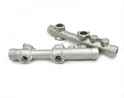

Hey there! I'm a supplier in the investment casting industry, and today I wanna talk about the standards for investment castings. Investment casting is a super cool process that allows us to create high - precision metal parts, but there are some key standards we gotta follow to make sure the end product is top - notch.
Dimensional Accuracy
One of the most important standards in investment casting is dimensional accuracy. You see, our customers rely on us to make parts that fit perfectly into their larger assemblies. Whether it's a tiny component for a medical device or a crucial part of an aerospace engine, getting the dimensions right is crucial.
We use state - of - the - art measurement tools like coordinate measuring machines (CMMs) to check the parts. These machines can measure the parts down to incredibly small fractions of a millimeter. The dimensional tolerance that we aim for in our Investment Casting Supplies varies depending on the application. For general industrial use, we might aim for a tolerance of around ±0.1 mm. But for really high - precision stuff like in the electronics or aerospace industries, we can go as low as ±0.05 mm or even less.
If the dimensions are off, it can cause all sorts of problems. The part might not fit properly, leading to assembly issues, and in some cases, it can even pose a safety risk. So, we take dimensional accuracy very seriously in our investment casting process.
Surface Finish
Another big standard is the surface finish of the castings. The surface finish affects not only the appearance of the part but also its functionality. A smooth surface finish can reduce friction, prevent corrosion, and improve the overall performance of the part.
We use different methods to achieve the desired surface finish. In the Investment Casting Shell Making process, the quality of the shell plays a huge role. A high - quality shell will result in a better surface finish on the casting. After the casting is made, we might also perform additional finishing operations like polishing or shot blasting.
The surface roughness is usually measured in microns. For some applications, a surface roughness of around 1.6 microns or less is required. For parts that need to have a really high - gloss finish, like decorative items or parts in high - end consumer products, we can further reduce the surface roughness to even less than 0.8 microns.
Material Quality
The quality of the material used in investment casting is also a major standard. We use a wide range of materials, including stainless steel, aluminum, brass, and various superalloys. Each material has its own set of properties, and we need to make sure that the material meets the requirements of the specific application.
Before we start the casting process, we carefully select the raw materials. We source them from reliable suppliers and conduct strict quality checks. We test the chemical composition of the materials to make sure it falls within the specified range. For example, when using stainless steel, the percentage of elements like chromium, nickel, and carbon needs to be within the required limits to ensure corrosion resistance and mechanical strength.
The mechanical properties of the material are also crucial. We need to ensure that the castings have the right strength, hardness, and ductility. This is especially important for parts that will be subjected to high stress or load, such as in automotive engines or heavy machinery.
Porosity and Internal Defects
Porosity and internal defects are common issues in investment casting, and having standards to control them is essential. Porosity can weaken the part, reduce its corrosion resistance, and affect its overall performance.
We use a combination of techniques to prevent and detect porosity and internal defects. During the Investment Casting Process, we carefully control the pouring temperature and speed. If the pouring temperature is too high, it can cause excessive gas formation, leading to porosity. If it's too low, the metal might not flow properly, resulting in incomplete filling and other defects.
Non - destructive testing methods like X - ray inspection and ultrasonic testing are used to detect internal defects. We set strict limits on the size and number of pores and other defects allowed in the castings. For critical applications, we might not tolerate any visible porosity or significant internal defects at all.
Heat Treatment and Post - Processing
Heat treatment is often an important step in investment casting to improve the mechanical properties of the parts. We have standards for the heat treatment process as well. The heating rate, soaking time, and cooling rate all need to be carefully controlled to achieve the desired results.
After heat treatment, post - processing operations like machining, welding, or coating might be required. We have standards for these operations too. For example, when machining, we need to ensure that the machining tolerances are maintained, and the surface finish is not affected negatively. When applying coatings, the thickness and adhesion of the coating need to meet the specified requirements.
Meeting Customer Requirements
Ultimately, the best way to define the standards for investment castings is to meet our customers' specific requirements. Every customer has different needs, and we work closely with them to understand their applications and come up with the right standards for their parts.
We conduct detailed engineering discussions with our customers at the beginning of the project. We share our expertise and experience, and they share their knowledge about the end - use of the parts. This collaborative approach helps us to create a set of standards that are tailored to each customer's needs.


Let's Talk Business!
If you're in the market for high - quality investment castings, I'd love to talk to you. Whether you're looking for parts with specific dimensional accuracy, surface finish, or material requirements, we've got the expertise and the standards in place to meet your needs. Just reach out, and we can start a discussion about your project. We're committed to providing you with the best investment casting solutions, and we're confident that we can exceed your expectations.
References
- ASM Handbook Volume 15: Casting
- Investment Casting Institute - Best Practices in Investment Casting