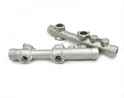

As a seasoned supplier in the field of Lost Wax Aluminum Casting, I've witnessed firsthand the pivotal role that different types of waxes play in this intricate manufacturing process. Lost Wax Aluminum Casting, also known as investment casting, is a time - honored technique that has been refined over centuries to produce high - precision metal parts. In this blog, I'll delve into the various types of waxes used in this process, their unique properties, and how they contribute to the overall quality of the final aluminum castings.
1. Pattern Wax
Pattern wax is the most fundamental type of wax used in lost wax aluminum casting. It serves as the base material for creating the initial patterns that will later be replicated in metal. Pattern waxes are formulated to have excellent flow properties, which allows them to fill even the most intricate mold cavities with ease. This is crucial because the accuracy of the pattern directly impacts the precision of the final casting.
One of the key characteristics of pattern wax is its low viscosity at the melting point. When heated, it becomes a fluid that can be injected into the mold under pressure. This ensures that every detail of the mold is accurately reproduced in the wax pattern. Moreover, pattern waxes are designed to have a low shrinkage rate during solidification. Shrinkage can cause dimensional inaccuracies in the pattern, which will be transferred to the final casting. By minimizing shrinkage, we can achieve a high level of dimensional stability in the cast parts.
Pattern waxes also need to have good surface finish properties. A smooth surface on the wax pattern translates to a smooth surface on the final casting. This is especially important for parts that require a high - quality aesthetic finish or for components where surface roughness can affect functionality.
2. Assembly Wax
Once the individual wax patterns are created, they need to be assembled into a tree - like structure called a wax assembly. Assembly wax is used for this purpose. It has a different set of properties compared to pattern wax. Assembly wax needs to have strong adhesive properties to securely bond the individual patterns together.
The melting point of assembly wax is carefully selected to be slightly lower than that of pattern wax. This allows the assembly wax to melt and flow when heated, while the pattern wax remains intact. This differential melting point is essential during the dewaxing process, where the wax assembly is heated to remove the wax from the ceramic mold. The assembly wax melts first, creating channels for the pattern wax to flow out, ensuring a complete removal of the wax from the mold.
Another important aspect of assembly wax is its flexibility. It should be able to withstand some handling and movement during the assembly process without cracking or breaking. This ensures that the wax assembly remains intact until it is ready to be invested in the ceramic mold.
3. Core Wax
In some lost wax aluminum casting applications, cores are required to create internal cavities or passages in the final casting. Core wax is used to make these cores. Core waxes are formulated to have high strength and rigidity. This is necessary because the cores need to maintain their shape during the casting process, even when subjected to the pressure of the molten aluminum.
Core waxes also need to have good thermal stability. They should not deform or melt prematurely during the casting process, as this can lead to defects in the internal structure of the casting. Additionally, core waxes are designed to be easily removable from the final casting. After the casting has solidified, the core wax can be removed through various methods, such as chemical dissolution or mechanical means.
The choice of core wax depends on the complexity of the core design and the requirements of the final casting. For example, for highly complex cores with thin walls, a core wax with excellent flow properties and high strength is required.
4. Gating Wax
Gating wax is used to create the gating system in the wax assembly. The gating system is responsible for guiding the molten aluminum into the mold cavity. Gating wax needs to have good flow characteristics to ensure that the molten metal can flow smoothly through the gates and into the mold.
It also needs to have sufficient strength to withstand the pressure of the molten aluminum during the casting process. If the gating wax is too weak, it can break or deform, causing the molten metal to flow unevenly or creating defects in the casting.
The design of the gating system, made with gating wax, is critical for the quality of the final casting. A well - designed gating system can help to minimize turbulence in the molten metal, reduce the formation of air bubbles, and ensure uniform filling of the mold cavity.


The Importance of Wax Selection in Lost Wax Aluminum Casting
The selection of the right wax for each stage of the lost wax aluminum casting process is of utmost importance. Using the wrong type of wax can lead to a variety of problems, such as dimensional inaccuracies, surface defects, and internal voids in the final casting.
For example, if a pattern wax with a high shrinkage rate is used, the final casting will be smaller than the desired dimensions. Similarly, if the assembly wax does not have strong adhesive properties, the wax assembly can come apart during handling or the dewaxing process, resulting in a failed casting.
As a Lost Wax Alluminum Casting supplier, we have extensive experience in selecting the appropriate waxes for different casting projects. We work closely with our customers to understand their specific requirements and choose the waxes that will best meet those needs.
How Waxes Impact the Overall Casting Process
The properties of the waxes used in lost wax aluminum casting have a significant impact on the entire casting process. The melting and solidification characteristics of the waxes determine the time and temperature requirements for each step of the process.
During the wax injection process, the flow properties of the pattern wax affect the injection pressure and speed. If the wax has poor flow properties, higher injection pressures may be required, which can increase the risk of mold damage or the formation of flash on the wax pattern.
In the dewaxing process, the melting points of the different waxes determine the heating schedule. The assembly wax needs to melt first to create channels for the pattern wax to flow out. If the melting points are not properly matched, the wax may not be completely removed from the mold, leading to defects in the final casting.
Conclusion
In conclusion, the different types of waxes used in lost wax aluminum casting each play a crucial role in the process. Pattern wax, assembly wax, core wax, and gating wax all have unique properties that are tailored to their specific functions. As a Lost Wax Alluminum Casting supplier, we understand the importance of using the right waxes to achieve high - quality castings.
If you are in need of high - precision aluminum castings, whether for Casting (Metal Processing) or Silicon Sol Investment Casting, we are here to help. Our team of experts can work with you to select the appropriate waxes and optimize the casting process to meet your exact specifications. Contact us today to start a discussion about your casting requirements and explore how we can provide you with the best solutions.
References
- Campbell, J. (2003). Castings. Butterworth - Heinemann.
- Flemings, M. C. (1974). Solidification Processing. McGraw - Hill.
- Kou, S. (2003). Welding Metallurgy. Wiley - Interscience.