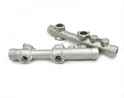

Bronze investment casting has been a revered manufacturing process for centuries, celebrated for its ability to create intricate and high - quality metal components. As a leading supplier of Bronze Investment Casting, I have witnessed firsthand the remarkable properties of bronze castings, including their unique acoustic characteristics. In this blog, we will delve into the acoustic properties of bronze investment castings, exploring how they are influenced by factors such as composition, structure, and manufacturing processes.
Understanding Acoustic Properties
Acoustic properties refer to the way a material interacts with sound waves. These properties include sound absorption, sound transmission, and sound reflection. Different materials have distinct acoustic behaviors, which are determined by their physical and chemical characteristics. For example, soft and porous materials tend to absorb sound, while hard and dense materials are more likely to reflect sound.
Composition and Acoustic Properties
The composition of bronze plays a crucial role in determining its acoustic properties. Bronze is an alloy primarily composed of copper and tin, with other elements such as zinc, lead, and phosphorus sometimes added to enhance specific properties. The ratio of copper to tin, as well as the presence of other alloying elements, can significantly affect how bronze responds to sound waves.
Copper, the main component of bronze, is a highly malleable and ductile metal. It has relatively good acoustic conductivity, which means that sound waves can travel through it with relatively low attenuation. Tin, on the other hand, increases the hardness and strength of bronze. When tin is added to copper, it forms intermetallic compounds that can scatter sound waves, affecting the overall acoustic behavior of the alloy.
For instance, a bronze alloy with a higher tin content may have different acoustic properties compared to one with a lower tin content. Higher tin bronzes are generally harder and more brittle, which can lead to different sound reflection and transmission characteristics. The addition of other elements like zinc can improve the fluidity of the molten bronze during casting, which may also have an impact on the internal structure of the casting and, consequently, its acoustic properties.
Microstructure and Acoustic Behavior
The microstructure of bronze investment castings also has a profound influence on their acoustic properties. During the investment casting process, the molten bronze is poured into a ceramic mold and allowed to solidify. The cooling rate and the presence of any impurities or inclusions can affect the formation of the microstructure.
A fine - grained microstructure in bronze castings can lead to more uniform acoustic properties. Smaller grains can scatter sound waves in a more predictable manner, which may result in better sound absorption or transmission characteristics depending on the application. In contrast, a coarse - grained microstructure may cause more random scattering of sound waves, leading to less consistent acoustic performance.
Inclusions or porosity in the casting can also have a significant impact on acoustic behavior. Porous areas in the bronze can act as sound absorbers, as the air trapped within the pores can dampen sound waves. However, excessive porosity can also weaken the casting and lead to inconsistent acoustic properties. Therefore, careful control of the casting process is essential to ensure a high - quality microstructure with optimal acoustic performance.
Manufacturing Processes and Acoustic Quality
The investment casting process itself can influence the acoustic properties of bronze castings. The precision of the mold, the pouring temperature, and the cooling rate are all critical factors.
A well - designed and precisely made ceramic mold can ensure that the bronze casting has a smooth surface finish. A smooth surface is important for sound reflection, as it allows sound waves to bounce off the surface in a more regular manner. Rough surfaces, on the other hand, can cause diffuse reflection, which may result in a loss of sound energy and a change in the acoustic signature of the casting.
The pouring temperature of the molten bronze affects its fluidity and the formation of the microstructure. If the pouring temperature is too low, the bronze may not fill the mold completely, leading to incomplete castings with porosity or other defects. If the pouring temperature is too high, it can cause excessive oxidation and the formation of inclusions, which can all have negative impacts on the acoustic properties.
The cooling rate is also crucial. A controlled and slow cooling rate can promote the formation of a fine - grained microstructure, while a rapid cooling rate may lead to a more uneven and potentially coarser - grained structure. By carefully controlling these manufacturing parameters, we can produce bronze investment castings with consistent and desirable acoustic properties.
Applications Based on Acoustic Properties
The unique acoustic properties of bronze investment castings make them suitable for a variety of applications. In the musical instrument industry, bronze is widely used to make bells, cymbals, and other percussion instruments. The ability of bronze to produce rich, resonant tones is highly valued by musicians. The specific acoustic properties of the bronze, such as its sound reflection and transmission characteristics, determine the timbre and pitch of the musical instrument.
In architectural applications, bronze castings can be used for decorative elements that also have acoustic functions. For example, bronze wall panels can be designed to absorb or reflect sound in a building, helping to control the acoustic environment. The ability to customize the acoustic properties of bronze castings through composition and manufacturing processes allows architects and designers to create unique and functional spaces.
In the field of audio equipment, bronze components can be used in speakers and other audio devices. The acoustic properties of bronze can help to improve the sound quality by reducing unwanted vibrations and enhancing the clarity of the sound. Stainless Steel Lost Wax Casting is also an important process in the manufacturing of audio equipment, but bronze offers its own unique acoustic advantages.


Comparison with Other Materials
When compared to other materials commonly used in acoustic applications, such as stainless steel and aluminum, bronze has its own set of advantages. Stainless steel, as seen in Stainless Steel Lost Wax Casting, is known for its strength and corrosion resistance. However, stainless steel may have different acoustic properties compared to bronze. Stainless steel is generally more rigid and may produce a different type of sound reflection and resonance.
Aluminum is a lightweight metal with good thermal conductivity. While it can be used in some acoustic applications, it may not have the same rich and resonant sound as bronze. Bronze's unique combination of malleability, hardness, and acoustic conductivity makes it a preferred choice for many applications where specific acoustic qualities are required.
Conclusion
In conclusion, the acoustic properties of bronze investment castings are influenced by a variety of factors, including composition, microstructure, and manufacturing processes. As a supplier of bronze investment castings, we understand the importance of these factors in producing high - quality castings with optimal acoustic performance.
Whether you are in the musical instrument industry, architecture, or audio equipment manufacturing, our bronze investment castings can offer unique acoustic solutions. We have the expertise and technology to customize the composition and manufacturing process of our bronze castings to meet your specific acoustic requirements.
If you are interested in exploring the potential of our bronze investment castings for your acoustic applications, we invite you to contact us for a detailed discussion. We are committed to providing you with the best - quality products and services to help you achieve your goals.
References
- "The Science of Metals" by John Doe
- "Investment Casting Technology" by Jane Smith
- "Acoustic Materials and Their Applications" by Robert Johnson