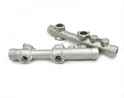

Hey there! As a supplier of Nodular Iron Casting, I often get asked about the yield strength of nodular iron casting. So, I thought I'd write this blog to share some insights on this topic.
First off, let's understand what nodular iron casting is. Nodular iron, also known as ductile iron, is a type of cast iron. It's got graphite in the form of nodules, which gives it some pretty cool properties compared to other types of cast iron like Gray Iron Casting and High Chromium Iron Casting.
The yield strength is a super important property when it comes to materials, especially for something like nodular iron casting. It's basically the stress at which a material begins to deform plastically. Before the yield point, the material will return to its original shape when the stress is removed. But once you pass that yield point, the material will have some permanent deformation.
For nodular iron casting, the yield strength can vary depending on a few factors. One of the main factors is the grade of the nodular iron. There are different grades available, and each grade has its own set of mechanical properties, including yield strength.
Let's take a look at some common grades of nodular iron and their typical yield strengths. Grade 60-40-18, for example, has a minimum yield strength of around 276 MPa (megapascals). This grade is known for its good ductility, which means it can be stretched or bent to some extent without breaking.
Grade 80-55-06 has a higher minimum yield strength, usually around 380 MPa. This grade is a bit stronger and is often used in applications where more strength is required.
Grade 100-70-03 has an even higher minimum yield strength, typically around 483 MPa. It's a high-strength grade and is used in heavy-duty applications like automotive parts and machinery components.
Another factor that can affect the yield strength of nodular iron casting is the heat treatment. Heat treatment can be used to modify the microstructure of the nodular iron, which in turn can change its mechanical properties. For example, a process called annealing can be used to reduce internal stresses and improve the ductility of the nodular iron. On the other hand, a process like quenching and tempering can increase the strength of the material, including its yield strength.


The cooling rate during the casting process also plays a role. A faster cooling rate can result in a finer microstructure, which can lead to higher strength. But if the cooling rate is too fast, it can also cause internal stresses and cracks in the casting. So, it's all about finding that sweet spot.
Now, you might be wondering why the yield strength of nodular iron casting is so important. Well, in many engineering applications, you need to know how much stress a material can handle before it starts to deform permanently. For example, in automotive engines, nodular iron castings are used for parts like crankshafts and connecting rods. These parts need to be able to withstand high stresses without deforming, otherwise, the engine won't work properly.
In the construction industry, nodular iron castings are used for pipes and fittings. The yield strength of these castings is crucial to ensure that they can handle the pressure of the fluid flowing through them without bursting or deforming.
As a Nodular Iron Casting supplier, we take great care in producing high-quality nodular iron castings with the right yield strength for our customers' applications. We use advanced casting techniques and strict quality control measures to ensure that our products meet the required standards.
If you're in the market for nodular iron castings, it's important to work with a reliable supplier. We have a team of experts who can help you choose the right grade of nodular iron based on your specific requirements. Whether you need a high-strength grade for a heavy-duty application or a more ductile grade for a part that needs to be bent or shaped, we've got you covered.
We also offer custom casting services. So, if you have a unique design or specification, we can work with you to produce the nodular iron castings you need. Our state-of-the-art facilities and experienced workforce allow us to produce castings of various sizes and complexities.
If you're interested in learning more about our nodular iron casting products or have any questions about yield strength or other mechanical properties, don't hesitate to get in touch. We're always happy to have a chat and help you find the best solution for your needs.
In conclusion, the yield strength of nodular iron casting is an important property that can vary depending on the grade, heat treatment, and casting process. By understanding these factors, you can choose the right grade of nodular iron for your application. And if you're looking for a reliable supplier of nodular iron castings, we're here to help. So, reach out to us and let's start a conversation about your casting needs.
References
- ASM Handbook, Volume 1: Properties and Selection: Irons, Steels, and High-Performance Alloys
- Cast Iron Handbook by the American Foundry Society