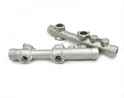

Hey there! As a supplier of casting stainless steel, I'm super excited to take you on a journey through how this amazing material is made. It's not just a process; it's a blend of art and science that results in high - quality products used in countless industries.
Starting with the Basics: What is Casting Stainless Steel?
Before we dive into the manufacturing process, let's quickly talk about what casting stainless steel is. Stainless steel is an alloy made primarily of iron, with at least 10.5% chromium. This chromium forms a thin, invisible layer of chromium oxide on the surface, which protects the steel from rust and corrosion. Casting, on the other hand, is the process of pouring molten metal into a mold to create a specific shape. So, casting stainless steel is all about using stainless steel in the casting process to make parts with various shapes and sizes.
The Pattern Creation
The first step in making casting stainless steel is creating a pattern. This pattern is an exact replica of the final part we want to make. We can make patterns from different materials like wood, plastic, or even metal. For complex shapes, we often use wax patterns. Wax is great because it can be easily shaped and melted away later in the process.
Once we have the pattern, we need to make a mold around it. There are different types of molds, but one of the most common methods is investment casting, also known as lost - wax casting. You can learn more about Stainless Steel Investment Casting and Stainless Steel Lost Wax Casting on our website.
Making the Mold
In the investment casting process, we coat the wax pattern with a ceramic slurry. This slurry is made up of fine ceramic particles suspended in a liquid. We dip the wax pattern into the slurry multiple times, letting each layer dry before applying the next one. As the layers build up, they form a hard ceramic shell around the wax pattern.
After the ceramic shell is thick enough, we heat it in a furnace. The heat melts the wax, which drains out of the shell through small holes we've made. This leaves behind a hollow ceramic mold in the exact shape of the final part.


Melting the Stainless Steel
Now it's time to melt the stainless steel. We use a furnace to heat the stainless steel until it turns into a molten liquid. The temperature in the furnace can reach up to 1600 degrees Celsius (about 2912 degrees Fahrenheit). Different grades of stainless steel have different melting points, so we need to control the temperature carefully to ensure the steel melts properly.
We also add other elements to the molten steel to get the desired properties. For example, adding nickel can improve the corrosion resistance and toughness of the steel. Adding molybdenum can enhance its strength and resistance to pitting corrosion.
Pouring the Molten Steel
Once the stainless steel is fully molten and has the right composition, we're ready to pour it into the ceramic mold. We use a ladle or a pouring system to carefully pour the molten steel into the mold. It's important to pour the steel quickly and smoothly to avoid air bubbles and ensure the mold is completely filled.
After pouring, we let the steel cool and solidify inside the mold. The cooling rate is crucial because it affects the microstructure and properties of the final part. We can control the cooling rate by using different methods, such as air cooling, water quenching, or furnace cooling.
Removing the Mold and Finishing the Part
Once the steel has solidified, we break the ceramic mold to remove the part. This part is called the casting. But it's not ready to use yet. It usually has some rough edges, excess material, and surface imperfections.
We use various machining and finishing processes to clean up the casting. We might use grinding, sanding, or machining operations to remove the excess material and get the part to the exact dimensions and surface finish we need. We can also perform heat treatments to improve the mechanical properties of the part, such as its hardness and strength.
Quality Control
Throughout the entire process, we have strict quality control measures in place. We use non - destructive testing methods like ultrasonic testing, X - ray testing, and magnetic particle testing to check for internal defects in the castings. We also perform dimensional inspections to ensure the parts meet the required specifications.
Other Types of Casting
Besides investment casting, there are other methods to cast stainless steel. One of them is sand casting. In sand casting, we use a sand mold instead of a ceramic one. Sand casting is suitable for making larger and simpler parts. Another method is die casting, which is used for high - volume production of small, complex parts. We also offer Alloy Steel Precision Casting Parts using these different casting techniques.
Why Choose Our Casting Stainless Steel?
As a supplier, we pride ourselves on producing high - quality casting stainless steel parts. We have a team of experienced engineers and technicians who ensure every step of the process is carried out with precision. We use the latest technology and equipment to guarantee the best results.
Our casting stainless steel parts are used in a wide range of industries, including automotive, aerospace, medical, and food processing. Whether you need a small, intricate part or a large, heavy - duty component, we can meet your needs.
Let's Do Business!
If you're in the market for casting stainless steel parts, we'd love to hear from you. We can work with you to understand your specific requirements and provide you with the best solutions. Whether you have a prototype design or a large - scale production order, we're here to help. Just reach out to us, and we'll start the conversation about your casting needs.
References
- "Stainless Steel: A Practical Guide" by R. A. Cottis
- "Casting Processes and Materials" by P. C. Powell
So, that's the story of how casting stainless steel is made. It's a complex but fascinating process that results in some truly amazing products. If you have any questions or want to learn more, feel free to drop us a line.