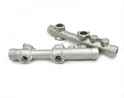

Investment casting, also known as lost-wax casting, is a centuries-old manufacturing process that has evolved significantly over time. As a leading supplier in the investment casting industry, I've witnessed firsthand the crucial role that materials play in the shell-making phase of this intricate process. In this blog post, I'll delve into the various materials used for shell making in investment casting, exploring their properties, applications, and advantages.
Understanding the Investment Casting Process
Before we dive into the materials, let's briefly review the investment casting process. You can learn more about it by visiting Investment Casting Process. The process begins with the creation of a wax pattern, which is an exact replica of the final part. Multiple wax patterns are typically attached to a central wax sprue to form a pattern tree. This tree is then dipped into a ceramic slurry, which adheres to the wax surfaces. After each dip, the pattern is coated with a refractory stucco material to build up successive layers of the ceramic shell. Once the shell is thick enough, it is heated to melt and remove the wax, leaving behind a hollow ceramic mold. Molten metal is then poured into the mold, filling the cavity and taking the shape of the original wax pattern. After the metal solidifies, the ceramic shell is broken away, revealing the finished casting.
Key Materials for Shell Making
1. Ceramic Slurry
The ceramic slurry is the foundation of the shell-making process. It consists of fine ceramic powders suspended in a liquid binder. The choice of ceramic powder depends on several factors, including the casting alloy, the desired surface finish, and the mechanical properties of the final part.
- Silica (SiO₂): Silica is one of the most commonly used ceramic powders in investment casting. It is available in various forms, such as fused silica, crystalline silica, and colloidal silica. Fused silica has a low coefficient of thermal expansion, which helps to minimize cracking during the heating and cooling cycles of the casting process. Crystalline silica, on the other hand, is more cost-effective and provides good strength and thermal stability. Colloidal silica is often used as a binder in the slurry, as it forms a strong bond between the ceramic particles and the wax pattern.
- Zircon (ZrSiO₄): Zircon is another popular ceramic powder for shell making. It has excellent thermal shock resistance, high refractoriness, and low reactivity with molten metals. Zircon is often used in the face coat of the shell, which is the layer that comes into direct contact with the molten metal. The face coat made of zircon provides a smooth surface finish and helps to prevent metal penetration into the shell.
- Alumina (Al₂O₃): Alumina is a high-strength ceramic material with good thermal conductivity and chemical stability. It is commonly used in the backup coats of the shell, which provide structural support and help to prevent the shell from cracking during the casting process. Alumina can also be used in combination with other ceramic powders to improve the overall properties of the shell.
2. Refractory Stucco
The refractory stucco is applied to the ceramic slurry after each dip to build up the thickness and strength of the shell. It consists of coarse ceramic particles that provide a rough surface for the next layer of slurry to adhere to.


- Silica Sand: Silica sand is a widely used refractory stucco material. It is inexpensive, readily available, and has good thermal stability. Silica sand comes in different grain sizes, which can be selected based on the desired thickness and porosity of the shell.
- Zircon Sand: Zircon sand is a high-quality refractory stucco material that offers excellent thermal shock resistance and chemical stability. It is often used in the face coat and the first few backup coats of the shell to provide a smooth surface finish and prevent metal penetration.
- Alumina Sand: Alumina sand is a strong and durable refractory stucco material that is commonly used in the backup coats of the shell. It provides good structural support and helps to improve the overall strength and integrity of the shell.
3. Binders
Binders are used to hold the ceramic particles together in the slurry and to ensure that the shell adheres to the wax pattern. There are several types of binders available for investment casting, each with its own advantages and disadvantages.
- Colloidal Silica: As mentioned earlier, colloidal silica is a popular binder in investment casting. It is a stable suspension of silica particles in water, which forms a strong bond between the ceramic particles and the wax pattern. Colloidal silica has good film-forming properties and provides a smooth surface finish to the shell.
- Ethyl Silicate: Ethyl silicate is another commonly used binder in investment casting. It is a clear, colorless liquid that hydrolyzes in water to form silica gel. Ethyl silicate has good adhesion properties and provides a strong bond between the ceramic particles and the wax pattern. However, it requires careful handling and storage, as it is flammable and can react with moisture in the air.
- Sodium Silicate: Sodium silicate is a cost-effective binder that is often used in the backup coats of the shell. It is a water-soluble compound that forms a strong bond between the ceramic particles when dried. However, sodium silicate can leave a residue on the surface of the casting, which may require additional cleaning and finishing operations.
Advantages of Different Materials
Each material used in shell making offers unique advantages that make it suitable for specific applications.
- Silica-based Materials: Silica-based materials, such as silica sand and colloidal silica, are widely used in investment casting due to their low cost, good availability, and excellent thermal stability. They are suitable for a variety of casting alloys, including aluminum, steel, and stainless steel. Silica-based materials also provide a smooth surface finish and good dimensional accuracy.
- Zircon-based Materials: Zircon-based materials, such as zircon sand and zircon powder, offer superior thermal shock resistance and chemical stability compared to silica-based materials. They are particularly suitable for casting high-temperature alloys, such as nickel-based superalloys and titanium alloys. Zircon-based materials also provide a very smooth surface finish and excellent mold filling characteristics.
- Alumina-based Materials: Alumina-based materials, such as alumina sand and alumina powder, are known for their high strength, hardness, and thermal conductivity. They are often used in the backup coats of the shell to provide structural support and improve the overall mechanical properties of the casting. Alumina-based materials are also suitable for casting large and complex parts.
Considerations for Material Selection
When selecting materials for shell making, it is important to consider several factors, including:
- Casting Alloy: The choice of casting alloy has a significant impact on the selection of shell materials. Different alloys have different melting points, chemical compositions, and reactivity with the shell materials. For example, high-temperature alloys require shell materials with excellent thermal shock resistance and chemical stability, while non-ferrous alloys may require materials that provide a smooth surface finish and good mold filling characteristics.
- Surface Finish: The desired surface finish of the final casting is another important consideration. Fine-grained ceramic powders and smooth stucco materials are typically used to achieve a high-quality surface finish, while coarser materials may be used for parts with less stringent surface requirements.
- Mechanical Properties: The mechanical properties of the final casting, such as strength, hardness, and ductility, can also influence the choice of shell materials. Materials with high strength and thermal conductivity are often used to improve the mechanical properties of the casting and to reduce the risk of cracking and distortion.
- Cost: Cost is always a factor in any manufacturing process. The cost of shell materials can vary significantly depending on the type of ceramic powder, the binder, and the stucco material used. It is important to balance the cost of the materials with the quality and performance of the final casting.
Conclusion
The choice of materials for shell making in investment casting is a critical decision that can have a significant impact on the quality, performance, and cost of the final casting. As a supplier in the investment casting industry, I understand the importance of selecting the right materials for each application. By using high-quality ceramic powders, binders, and stucco materials, we can ensure that our customers receive castings with excellent surface finish, dimensional accuracy, and mechanical properties. If you are interested in learning more about investment casting or are looking for a reliable supplier for your casting needs, please visit Investment Casting Supplies to explore our range of products and services. You can also visit What Is Investment Casting to gain a deeper understanding of the investment casting process. We are always happy to discuss your specific requirements and provide customized solutions to meet your needs. Contact us today to start a conversation about your next investment casting project.
References
- Campbell, J. (2008). Castings. Butterworth-Heinemann.
- Flemings, M. C. (1974). Solidification Processing. McGraw-Hill.
- Ruddle, K. (2009). Investment Casting: A Practical Guide. Elsevier.