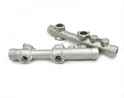

As a dedicated supplier of Ductile Iron Casting, I'm thrilled to take you on a detailed journey through the production process of this remarkable material. Ductile iron, also known as nodular cast iron, offers a unique combination of strength, ductility, and toughness, making it a popular choice in various industries. In this blog post, we'll explore each step involved in creating high - quality ductile iron castings.
Raw Material Selection
The first and crucial step in the production of ductile iron casting is the selection of raw materials. We carefully choose the base iron, which typically contains a specific percentage of carbon, silicon, and other elements. The carbon content is usually around 3 - 4%, and silicon is around 1 - 3%. These elements play a vital role in determining the final properties of the ductile iron.
We also source high - quality alloying elements. Magnesium is one of the most important additives in ductile iron production. It is responsible for transforming the graphite flakes in gray iron into spherical nodules, which gives ductile iron its unique ductility. Other alloying elements such as nickel, copper, and molybdenum may also be added in controlled amounts to enhance specific properties like corrosion resistance, wear resistance, and strength. For more information on different types of iron casting, you can visit our pages on Nodular Iron Casting and Gray Iron Casting.
Melting Process
Once the raw materials are selected, they are loaded into a furnace for melting. Induction furnaces are commonly used in our production facilities due to their high efficiency, precise temperature control, and ability to melt a wide range of metals. The furnace is heated to a temperature of around 1400 - 1500°C (2552 - 2732°F), where the raw materials are completely melted and homogenized.
During the melting process, we continuously monitor the chemical composition of the molten iron using advanced analytical techniques such as spectroscopy. This ensures that the iron meets the required specifications for ductile iron production. Any necessary adjustments to the chemical composition are made by adding the appropriate alloying elements at this stage.
Nodularization and Inoculation
After the molten iron reaches the desired temperature and chemical composition, it is transferred to a ladle for nodularization and inoculation. Nodularization is the process of adding magnesium to the molten iron to transform the graphite flakes into spherical nodules. This is typically done by using magnesium - based alloys or pure magnesium in the form of wire or pellets.
Inoculation is a complementary process that involves adding inoculants such as ferrosilicon to the molten iron. Inoculants help to promote the formation of graphite nodules and improve the mechanical properties of the ductile iron. The amount of magnesium and inoculant added is carefully controlled based on the specific requirements of the casting and the characteristics of the molten iron.
Molding
While the molten iron is being prepared, the molds are also being made. There are several molding methods available, but we often use sand molding due to its flexibility and cost - effectiveness. In sand molding, a pattern of the desired casting is made, usually from wood or plastic. The pattern is then placed in a flask, and sand is packed around it to create a mold cavity.
The sand used in the molding process is a special mixture that has good refractory properties, high strength, and good permeability. After the sand is packed around the pattern, the pattern is removed, leaving a cavity in the shape of the casting. Cores may also be used in the mold to create internal features such as holes or passages in the casting.
Pouring
Once the mold is ready and the molten iron has undergone nodularization and inoculation, the pouring process begins. The molten iron is carefully poured into the mold cavity using a ladle or a pouring system. The pouring speed and temperature are critical factors that can affect the quality of the casting. A slow pouring speed may result in incomplete filling of the mold, while a high pouring temperature can cause defects such as shrinkage and porosity.
During the pouring process, we also take precautions to prevent the formation of slag and other impurities in the casting. This may involve using filters or skimming the surface of the molten iron to remove any unwanted materials.
Solidification and Cooling
After the molten iron is poured into the mold, it begins to solidify. The solidification process is a complex one that involves the formation of a solid - liquid interface and the growth of crystals. The rate of solidification affects the microstructure and mechanical properties of the casting.
We carefully control the cooling rate of the casting to ensure that it solidifies uniformly and develops the desired microstructure. This may involve using cooling channels in the mold or applying external cooling methods such as water spraying. Once the casting has solidified, it is allowed to cool to room temperature in the mold.
Shakeout and Cleaning
After the casting has cooled sufficiently, it is removed from the mold in a process called shakeout. This is usually done by mechanical means such as vibrating the mold or using a knockout machine. Once the casting is removed from the mold, it is cleaned to remove any sand, slag, or other impurities that may be adhering to its surface.
Cleaning methods may include shot blasting, sandblasting, or chemical cleaning. Shot blasting is a common method where small metal shots are propelled at high speed onto the surface of the casting to remove any unwanted materials. Sandblasting uses sand particles instead of metal shots, and chemical cleaning involves using chemicals to dissolve or remove the impurities.
Heat Treatment
Heat treatment is often performed on ductile iron castings to further improve their mechanical properties. The most common heat treatment processes for ductile iron include annealing, normalizing, quenching, and tempering.
Annealing is a process of heating the casting to a specific temperature and then slowly cooling it to relieve internal stresses and improve ductility. Normalizing involves heating the casting to a higher temperature and then air - cooling it to refine the grain structure and improve strength. Quenching and tempering are used to achieve high strength and hardness in the casting.
Machining and Finishing
After heat treatment, the casting may undergo machining to achieve the final dimensions and surface finish. Machining operations such as turning, milling, drilling, and grinding are used to remove any excess material and create the required features on the casting.
Finishing operations such as painting, plating, or coating may also be performed to improve the appearance and corrosion resistance of the casting. The choice of finishing method depends on the specific application of the casting and the customer's requirements.
Quality Control
Throughout the entire production process, strict quality control measures are in place to ensure that the ductile iron castings meet the highest standards. We use a variety of inspection techniques such as visual inspection, dimensional inspection, and non - destructive testing (NDT).
Visual inspection is used to detect any surface defects such as cracks, porosity, or inclusions. Dimensional inspection is performed using precision measuring instruments to ensure that the casting meets the specified dimensions. NDT methods such as ultrasonic testing, magnetic particle testing, and X - ray testing are used to detect internal defects that may not be visible to the naked eye.
Conclusion
The production process of ductile iron casting is a complex and multi - step one that requires careful control and attention to detail at every stage. From raw material selection to finishing and quality control, each step plays a crucial role in determining the final quality and performance of the casting.


As a leading supplier of Ductile Iron Casting, we are committed to providing our customers with high - quality castings that meet their specific requirements. If you are in need of ductile iron castings for your project, we invite you to contact us for a detailed discussion about your needs. Our team of experts is ready to assist you in selecting the right casting solution and ensuring a smooth procurement process.
References
- Metals Handbook: Castings, ASM International
- Ductile Iron Castings: Design and Applications, American Foundry Society
- Iron Castings Handbook, Cast Metals Federation