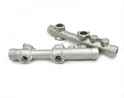

Yo, folks! As a supplier in the Shell Mold Casting Process game, I've seen my fair share of challenges. One of the most pesky issues that often pops up is the hot tear problem. In this blog, I'm gonna break down what the hot tear problem is in the shell mold casting process and how we can prevent it.
What is the Hot Tear Problem?
First things first, let's talk about what hot tears are. Hot tears, also known as hot cracks, are defects that occur during the solidification stage of the casting process. They look like narrow, irregular cracks on the surface or inside the casting. These cracks form when the casting is still in a semi - solid state, and the stresses within the material are too high for it to withstand.
In the Shell Mold Casting Process, which you can learn more about Shell Mold Casting Process, the mold plays a crucial role. The shell mold is made by coating sand with a resin binder and then baking it to form a hard shell. When the molten metal is poured into the shell mold, it starts to solidify. But here's the catch: as the metal cools and solidifies, it shrinks. If the mold restricts this shrinkage too much, or if there are uneven cooling rates in different parts of the casting, hot tears can form.
There are a few factors that can contribute to the hot tear problem. One is the chemical composition of the metal. Some alloys are more prone to hot tearing than others. For example, alloys with a wide freezing range (the difference between the liquidus and solidus temperatures) are more likely to develop hot tears because they spend more time in the semi - solid state, where they are more vulnerable to cracking.
Another factor is the design of the casting. Complex shapes with sharp corners or sudden changes in cross - section can create stress concentrations, making it easier for hot tears to form. Also, the gating and riser system in the mold can affect the flow of molten metal and the cooling pattern. If the gating system is not designed properly, it can cause uneven filling and cooling, leading to hot tears.
How to Prevent the Hot Tear Problem
Now that we know what causes hot tears, let's talk about how to prevent them. As a Shell Mold Casting Process supplier, I've got a few tricks up my sleeve.
1. Optimize the Metal Composition
One of the first steps is to choose the right metal alloy. We need to select alloys that have a narrow freezing range and good fluidity. By working with metallurgists, we can adjust the chemical composition of the alloy to reduce its susceptibility to hot tearing. For example, adding certain elements like titanium or zirconium to some alloys can refine the grain structure, making the metal more resistant to cracking.
2. Improve the Casting Design
The design of the casting is crucial. We should avoid sharp corners and sudden changes in cross - section. Instead, we can use fillets and radii to smooth out the transitions. This helps to distribute the stress more evenly during solidification and reduces the likelihood of hot tears.
We also need to pay attention to the gating and riser system. A well - designed gating system ensures that the molten metal fills the mold evenly and at the right speed. It should also allow for proper venting to remove any gases that might get trapped in the mold. The risers, on the other hand, are used to supply additional molten metal to the casting as it shrinks during solidification. By placing the risers in the right locations, we can ensure that the casting has enough metal to compensate for shrinkage and prevent hot tears.
3. Control the Cooling Rate
Controlling the cooling rate is another important aspect of preventing hot tears. We can use different techniques to achieve this. One method is to use chills in the mold. Chills are made of materials with high thermal conductivity, such as copper or iron. By placing chills in strategic locations in the mold, we can increase the cooling rate in those areas and promote more uniform solidification.
We can also adjust the pouring temperature of the molten metal. If the pouring temperature is too high, the metal will take longer to solidify, increasing the risk of hot tearing. On the other hand, if the pouring temperature is too low, the metal may not flow properly, leading to other defects. So, we need to find the right balance.


4. Improve the Mold Design
The shell mold itself can also be optimized to prevent hot tears. We can use a mold with a more flexible design that allows for some movement during the shrinkage of the casting. This can reduce the stress on the casting and prevent hot tears. Also, we can use coatings on the inside of the shell mold to reduce the friction between the mold and the casting, which can also help to prevent hot tears.
Why It Matters
You might be wondering, why is it so important to prevent hot tears? Well, hot tears can seriously affect the quality and performance of the casting. A casting with hot tears is more likely to fail under stress, which can lead to safety issues in applications where the casting is used. It can also increase the production cost because defective castings need to be scrapped or repaired.
As a Shell Mold Casting Process supplier, our goal is to provide high - quality castings to our customers. By preventing hot tears, we can ensure that our castings meet the required standards and specifications. This not only helps our customers but also builds trust in our brand.
Conclusion
In conclusion, the hot tear problem in the Shell Mold Casting Process is a real challenge, but it's not insurmountable. By understanding the causes of hot tears and implementing the right prevention measures, we can produce high - quality castings with minimal defects.
If you're in the market for shell mold castings and want to avoid the headache of hot tears, we're here to help. We've got the expertise and experience to handle all your casting needs. Whether you need a simple or complex casting, we can work with you to design the right solution and prevent hot tears from occurring. So, if you're interested in our Shell Mold Casting Process or want to learn more about What Is Shell Mold Casting, don't hesitate to reach out. Let's start a conversation and see how we can work together to get you the best castings possible.
References
- "Foundry Technology" by John Campbell
- "Casting, Forming and Welding" by P. N. Rao