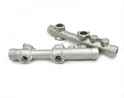

Investment casting is a precise manufacturing process that can produce complex and high - quality parts. As a brass investment casting supplier, we often encounter questions regarding the heat treatment process after brass investment casting. This blog aims to delve into the details of the heat treatment of brass castings, exploring its significance, common methods, and effects on the final product.
The Significance of Heat Treatment for Brass Investment Castings
Heat treatment is a critical step in the post - casting process. Brass, an alloy of copper and zinc, can have its mechanical properties, microstructure, and corrosion resistance significantly enhanced through appropriate heat treatment. In the process of investment casting, the as - cast brass parts may have residual stresses, uneven microstructures, and insufficient mechanical properties. Heat treatment helps to relieve these residual stresses, refine the grain structure, and improve the overall performance of the part.
Residual stresses can occur during the solidification of the molten brass in the investment mold. These stresses can lead to warping, cracking, or premature failure of the parts in service. By performing heat treatment, we can reduce these residual stresses, thereby increasing the dimensional stability of the castings.
Moreover, the mechanical properties such as hardness, strength, and ductility of brass can be tailored to meet the specific requirements of different applications through heat treatment. For example, in applications where high strength is needed, heat treatment can be used to increase the hardness and strength of the brass castings. On the other hand, for applications that require good formability or impact resistance, the ductility of the brass can be improved through proper heat treatment.
Common Heat Treatment Processes for Brass Investment Castings
Annealing
Annealing is one of the most common heat treatment processes for brass. There are two main types of annealing for brass: full annealing and stress - relief annealing.
Full Annealing: This process involves heating the brass casting to a temperature above its recrystallization temperature (usually around 600 - 700°C for brass), holding it at this temperature for a certain period of time to allow complete recrystallization, and then slowly cooling it. Full annealing results in a soft, ductile brass with a uniform, fine - grained microstructure. It is often used for parts that need to be further machined or formed, as the improved ductility makes machining and forming operations easier.


Stress - Relief Annealing: Stress - relief annealing is carried out at a lower temperature, typically around 260 - 370°C. The purpose of this process is to relieve the residual stresses in the brass casting without significantly affecting its microstructure or mechanical properties. The casting is heated to the specified temperature, held for a sufficient time to allow the stresses to relax, and then cooled slowly. This process is crucial for maintaining the dimensional stability of the castings, especially for parts with high precision requirements.
Solution Treatment and Aging
Solution treatment and aging can be used to improve the strength and hardness of brass. In the solution treatment step, the brass casting is heated to a high temperature (usually above 700°C) to dissolve all the alloying elements in a single - phase solid solution. After that, the casting is rapidly quenched in water or oil to retain the high - temperature phase at room temperature. This quenched structure is usually supersaturated and unstable.
Subsequent aging treatment involves heating the quenched casting to a lower temperature (around 150 - 300°C) for a certain period. During aging, the alloying elements precipitate out of the supersaturated solid solution, forming a fine - dispersed second - phase particles. These particles impede the movement of dislocations in the brass matrix, thereby increasing the strength and hardness of the material.
Effects of Heat Treatment on the Properties of Brass Investment Castings
Mechanical Properties
As mentioned above, heat treatment can significantly change the mechanical properties of brass castings. Annealing can improve the ductility of brass, making it more suitable for bending, stretching, and other forming operations. For example, a fully annealed brass casting can have an elongation percentage that is much higher than that of an as - cast brass part.
On the contrary, solution treatment and aging can increase the strength and hardness of brass. The precipitation of the second - phase particles during aging provides effective strengthening mechanisms, including precipitation strengthening and dispersion strengthening. In some applications, such as gears or fasteners, the increased strength and hardness obtained through heat treatment are essential for ensuring the reliable performance of the parts.
Microstructure
Heat treatment can also alter the microstructure of brass castings. Full annealing leads to the formation of a fine - grained, equiaxed microstructure, which is more stable and uniform compared to the as - cast microstructure. The refining of the grain structure can improve the mechanical properties and corrosion resistance of the brass.
During solution treatment and aging, the precipitation of the second - phase particles changes the distribution of alloying elements in the brass matrix. This not only affects the mechanical properties but also has an impact on the electrical and thermal conductivity of the brass.
Corrosion Resistance
The corrosion resistance of brass can be improved through heat treatment. Annealing can relieve the residual stresses in the casting, which are often the initiation sites for corrosion. A stress - free brass casting is less prone to stress - corrosion cracking, a common form of corrosion in brass.
In addition, the formation of a uniform and fine - grained microstructure through heat treatment can enhance the passivation ability of brass. The passive film on the surface of brass is more stable and protective in a well - heat - treated casting, reducing the rate of corrosion in various environments.
Our Capabilities as a Brass Investment Casting Supplier
As a professional brass investment casting supplier, we have extensive experience in heat treating brass castings. We are equipped with advanced heat treatment equipment, including high - temperature furnaces and precise temperature control systems. Our technical team can customize the heat treatment process according to the specific requirements of different brass alloys and part applications.
We also provide a wide range of related investment casting services, such as Bronze Investment Casting, Silicon Sol Investment Casting, and Alloy Steel Investment Casting Products. Our commitment to quality and customer satisfaction drives us to continuously improve our manufacturing processes and service levels.
Conclusion
The heat treatment process after brass investment casting is of great importance for improving the performance and quality of the castings. Through annealing, solution treatment, and aging, we can tailor the mechanical properties, microstructure, and corrosion resistance of brass to meet the diverse needs of different applications. As a reliable brass investment casting supplier, we are dedicated to providing high - quality heat - treated brass castings and related services.
If you are interested in our brass investment casting products or have specific requirements for heat - treated brass parts, please feel free to contact us for procurement and further discussions. We look forward to collaborating with you to achieve your project goals.
References
- ASM Handbook Volume 4: Heat Treating.
- Metals Handbook Desk Edition, Third Edition.
- "Heat Treatment of Nonferrous Alloys" by various authors in the field of metallurgy.