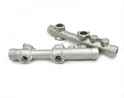

Brass investment castings are a popular choice in various industries due to their unique combination of properties, including their hardness. As a supplier of brass investment castings, I've had the privilege of working closely with these remarkable materials and understand the importance of their hardness in different applications. In this blog post, I'll delve into what the hardness of brass investment castings entails, how it's measured, and why it matters.
Understanding Brass and Its Composition
Brass is an alloy primarily composed of copper and zinc. The proportion of these two elements can vary, which significantly impacts the properties of the brass, including its hardness. Other elements, such as lead, tin, and aluminum, may also be added in small quantities to enhance specific characteristics like machinability, corrosion resistance, or strength.
The base metals, copper and zinc, bring their own inherent properties to the alloy. Copper is known for its excellent electrical and thermal conductivity, as well as its ductility. Zinc, on the other hand, increases the strength and hardness of the brass. The interaction between these elements during the investment casting process results in a material with a wide range of possible hardness values.
The Investment Casting Process and Its Impact on Hardness
Investment casting, also known as lost-wax casting, is a precision manufacturing process that allows for the production of complex-shaped parts with high accuracy and surface finish. The process involves creating a wax pattern of the desired part, coating it with a ceramic shell, melting out the wax, and then pouring molten brass into the resulting mold.
During the cooling process of the molten brass in the mold, the rate of cooling plays a crucial role in determining the hardness of the final casting. A faster cooling rate generally leads to a finer grain structure, which can increase the hardness of the brass. Conversely, a slower cooling rate results in a coarser grain structure, which may reduce the hardness but can improve other properties such as ductility.
Measuring the Hardness of Brass Investment Castings
There are several methods to measure the hardness of brass investment castings, each with its own advantages and applications. The most commonly used methods include the Brinell hardness test, the Rockwell hardness test, and the Vickers hardness test.
The Brinell hardness test involves pressing a hardened steel or tungsten carbide ball into the surface of the brass casting under a specified load for a certain period. The diameter of the indentation left on the surface is then measured, and the Brinell hardness number (BHN) is calculated based on the load and the size of the indentation. This test is suitable for measuring the hardness of large or thick castings.
The Rockwell hardness test uses a diamond cone or a hardened steel ball indenter to make an indentation on the surface of the brass casting. The depth of the indentation is measured, and the Rockwell hardness number is determined. There are different scales for the Rockwell test, depending on the type of indenter and the load applied. This test is quick and relatively easy to perform, making it a popular choice in industrial settings.
The Vickers hardness test uses a square-based diamond pyramid indenter to make an indentation on the surface of the brass casting. The diagonal lengths of the indentation are measured, and the Vickers hardness number (HV) is calculated. This test is more accurate than the Brinell and Rockwell tests for measuring the hardness of small or thin parts, as well as for materials with a non-uniform structure.
Factors Affecting the Hardness of Brass Investment Castings
In addition to the cooling rate during the casting process, several other factors can affect the hardness of brass investment castings. The composition of the brass alloy is one of the most significant factors. As mentioned earlier, the proportion of copper and zinc, as well as the presence of other alloying elements, can have a direct impact on the hardness. For example, increasing the zinc content generally increases the hardness of the brass, up to a certain point.
The heat treatment of the brass casting after it has been cast can also modify its hardness. Annealing, for instance, is a heat treatment process that involves heating the casting to a specific temperature and then slowly cooling it. This process can relieve internal stresses in the casting and reduce its hardness, making it more ductile. Quenching, on the other hand, involves rapid cooling of the heated casting, which can increase its hardness but may also make it more brittle.
The presence of impurities or defects in the brass casting can also affect its hardness. Impurities such as sulfur or phosphorus can reduce the ductility and increase the brittleness of the brass, which may indirectly affect its hardness. Defects such as porosity or inclusions can also create weak points in the casting, which can lead to inconsistent hardness measurements.
Importance of Hardness in Brass Investment Castings
The hardness of brass investment castings is an important property that affects their performance in various applications. In applications where wear resistance is critical, such as in gears, bearings, and valve components, a higher hardness is generally preferred. A harder brass casting can withstand the friction and abrasion associated with these applications, resulting in a longer service life.
In applications where the casting needs to be machined, the hardness of the brass can also impact the machining process. A brass casting with the appropriate hardness can be machined more easily and efficiently, reducing the cost and time of production. However, if the brass is too hard, it can cause excessive tool wear and increase the difficulty of machining.
In some applications, such as in electrical connectors, the hardness of the brass casting needs to be balanced with other properties such as conductivity and ductility. A casting that is too hard may not be able to conform to the required shape or make a good electrical connection, while a casting that is too soft may not be able to withstand the mechanical stresses.
Our Offerings as a Brass Investment Casting Supplier
As a supplier of brass investment castings, we understand the importance of hardness and its impact on the performance of our products. We have a team of experienced engineers and technicians who are well-versed in the investment casting process and can control the hardness of our castings to meet the specific requirements of our customers.
We use high-quality brass alloys and state-of-the-art equipment to ensure the consistency and quality of our castings. Our investment casting process allows us to produce complex-shaped parts with precise dimensions and excellent surface finish. We also offer a range of heat treatment options to modify the hardness and other properties of our castings according to our customers' needs.
In addition to brass investment castings, we also offer Lost Wax Alluminum Casting, Lost Wax Precision Casting Parts, and Stainless Steel Precision Casting Parts. Our diverse product range allows us to serve a wide range of industries, including automotive, aerospace, electronics, and plumbing.
Contact Us for Your Brass Investment Casting Needs
If you're looking for high-quality brass investment castings with the right hardness for your specific application, we'd love to hear from you. Our team of experts can work with you to understand your requirements, provide technical support, and offer customized solutions. Whether you need a small batch of prototype parts or a large production run, we have the capabilities and experience to meet your needs.


Contact us today to discuss your brass investment casting project and start a partnership that will deliver the best results for your business.
References
- ASM Handbook Volume 2: Properties and Selection: Nonferrous Alloys and Special-Purpose Materials. ASM International.
- Metals Handbook: Properties and Selection - Nonferrous Alloys and Pure Metals. American Society for Metals.
- Investment Casting Handbook: Engineering, Design, and Manufacturing. W. M. Pellini and E. C. Closs.