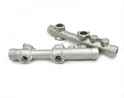

As a supplier specializing in What Is Investment Casting, I've witnessed firsthand the intricate dance of variables that contribute to the success of the investment casting process. One such variable that often goes under the radar but holds significant sway is the shell thickness. In this blog post, I'll delve into the effects of shell thickness on investment casting, exploring its impact on various aspects of the process and the final product.
Understanding Investment Casting
Before we dive into the effects of shell thickness, let's briefly recap what investment casting is. Investment casting, also known as lost-wax casting, is a manufacturing process in which a wax pattern is coated with a ceramic shell. Once the shell is hardened, the wax is melted out, leaving a cavity in the shape of the desired part. Molten metal is then poured into the cavity, and after it solidifies, the ceramic shell is broken away to reveal the finished part. You can learn more about the Investment Casting Process on our website.
The Role of the Shell in Investment Casting
The ceramic shell plays a crucial role in investment casting. It serves as a mold for the molten metal, providing the shape and dimensions of the final part. Additionally, the shell must withstand the high temperatures and pressures associated with pouring molten metal. The shell also affects the surface finish and dimensional accuracy of the cast part.
Effects of Shell Thickness on Investment Casting
1. Dimensional Accuracy
One of the primary effects of shell thickness is on the dimensional accuracy of the cast part. A thicker shell can provide more support to the molten metal during the pouring process, reducing the likelihood of distortion or shrinkage. This is particularly important for complex or thin-walled parts, where dimensional accuracy is critical. However, if the shell is too thick, it can also cause problems. For example, a thick shell may take longer to heat up and cool down, which can lead to uneven solidification and dimensional variations in the cast part.
2. Surface Finish
The shell thickness can also have a significant impact on the surface finish of the cast part. A thinner shell allows for better heat transfer between the molten metal and the shell, resulting in a smoother surface finish. This is because the rapid cooling of the metal helps to prevent the formation of surface defects such as porosity or rough spots. On the other hand, a thicker shell can insulate the molten metal, slowing down the cooling process and potentially leading to a rougher surface finish.
3. Casting Integrity
The integrity of the cast part is another important consideration when it comes to shell thickness. A thicker shell can provide better protection against cracking or other defects during the casting process. This is because the shell can absorb some of the stress and pressure associated with pouring molten metal, reducing the likelihood of damage to the part. However, if the shell is too thick, it can also make it more difficult to remove the shell from the cast part after solidification. This can lead to additional processing steps and potential damage to the part.
4. Production Efficiency
Shell thickness can also affect the production efficiency of the investment casting process. A thinner shell can be applied more quickly and with less material, reducing the overall production time and cost. Additionally, a thinner shell may require less energy to heat up and cool down, further improving production efficiency. However, it's important to balance the benefits of a thinner shell with the potential drawbacks, such as reduced dimensional accuracy or surface finish.
Optimizing Shell Thickness
Given the complex relationship between shell thickness and investment casting, it's important to optimize the shell thickness for each specific application. This requires a thorough understanding of the part design, the material being cast, and the casting process parameters.
1. Part Design
The design of the part plays a crucial role in determining the optimal shell thickness. Complex or thin-walled parts may require a thicker shell to provide adequate support during the casting process. On the other hand, simple or thick-walled parts may be able to tolerate a thinner shell.


2. Material Selection
The material being cast also affects the optimal shell thickness. Different materials have different melting points, viscosities, and thermal properties, which can influence the behavior of the molten metal during the casting process. For example, a high-temperature alloy may require a thicker shell to withstand the higher temperatures and pressures associated with pouring.
3. Casting Process Parameters
The casting process parameters, such as the pouring temperature, the pouring rate, and the cooling rate, also play a role in determining the optimal shell thickness. These parameters can affect the flow of the molten metal, the solidification rate, and the overall quality of the cast part. By carefully controlling these parameters, it's possible to optimize the shell thickness for each specific application.
Conclusion
In conclusion, the shell thickness is a critical factor in investment casting, affecting the dimensional accuracy, surface finish, casting integrity, and production efficiency of the cast part. By understanding the effects of shell thickness and optimizing it for each specific application, we can ensure the highest quality and performance of our investment cast parts. As a What Is Investment Casting supplier, we have the expertise and experience to help our customers achieve the best results in their investment casting projects. If you're interested in learning more about our investment casting services or have any questions about shell thickness or other aspects of investment casting, please don't hesitate to contact us. We'd be happy to discuss your specific needs and provide you with a customized solution.
References
- Campbell, J. (2008). Castings. Butterworth-Heinemann.
- Flemings, M. C. (1974). Solidification Processing. McGraw-Hill.
- Kalpakjian, S., & Schmid, S. R. (2014). Manufacturing Engineering and Technology. Pearson.