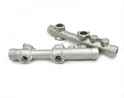

As a seasoned provider of shell mold casting services, I've witnessed firsthand the transformative power of this manufacturing process. Shell mold casting is a precision metalworking technique that offers exceptional accuracy, surface finish, and dimensional stability. In this blog post, I'll delve into the intricacies of shell mold casting and explore various quality - improvement approaches that can elevate the performance and reliability of your castings.
Understanding Shell Mold Casting
Shell mold casting is a specialized form of sand casting that utilizes a thin, hardened shell of resin - coated sand to create the mold cavity. This process begins with the preparation of a pattern, which is typically made of metal or plastic. The pattern is heated and then coated with a thin layer of resin - coated sand. The sand adheres to the pattern, forming a shell. The shell is then baked to harden the resin, after which it is removed from the pattern. Multiple shells are assembled to create the complete mold cavity, into which molten metal is poured. For a more in - depth look at the process, you can visit Shell Mold Casting Process.
One of the key advantages of shell mold casting is its ability to produce complex shapes with high precision. The thin shell allows for intricate details and tight tolerances, making it suitable for a wide range of applications, from automotive components to aerospace parts. Additionally, the smooth surface finish of shell - molded castings reduces the need for secondary machining operations, saving time and cost.


Quality - Improvement Approaches
1. Material Selection
The choice of materials plays a crucial role in the quality of shell mold castings. For the shell material, high - quality resin - coated sand with consistent properties is essential. The resin should have good flowability, adhesion, and heat resistance to ensure a uniform and defect - free shell. When it comes to the casting metal, selecting the appropriate alloy is vital. Factors such as strength, ductility, corrosion resistance, and thermal properties must be considered based on the intended application of the casting. For example, if the casting will be used in a high - temperature environment, an alloy with excellent heat resistance should be chosen.
2. Pattern Design and Preparation
The pattern is the foundation of the shell mold casting process. A well - designed pattern can significantly improve the quality of the final casting. The pattern should be designed with proper draft angles to facilitate easy removal from the shell. It should also be free of any sharp edges or corners that could cause stress concentrations in the casting. Additionally, the surface finish of the pattern should be smooth to ensure a smooth surface finish on the casting.
Before using the pattern, it is important to inspect it for any defects or damage. Minor imperfections in the pattern can be transferred to the casting, so any issues should be corrected promptly. Regular cleaning and maintenance of the pattern can also extend its lifespan and ensure consistent casting quality.
3. Process Control
Maintaining strict process control is essential for achieving high - quality shell mold castings. This includes controlling the temperature, time, and pressure at each stage of the process. For example, during the shell - making process, the temperature of the pattern and the sand - resin mixture must be carefully regulated to ensure proper curing of the resin. If the temperature is too low, the resin may not cure completely, resulting in a weak shell. On the other hand, if the temperature is too high, the resin may over - cure, causing the shell to become brittle.
Similarly, the pouring temperature of the molten metal is critical. If the metal is poured too hot, it can cause thermal stress in the casting and lead to defects such as cracking. If the metal is poured too cold, it may not fill the mold cavity completely, resulting in incomplete castings.
4. Mold Assembly and Handling
Proper mold assembly is crucial for ensuring the integrity of the casting. The individual shell segments must be accurately aligned and securely fastened together to prevent any leakage of molten metal. Any gaps or misalignments in the mold can cause flash or other defects in the casting.
During handling, the mold should be treated with care to avoid any damage. Rough handling can cause cracks or other defects in the shell, which can affect the quality of the casting. It is also important to store the molds in a clean and dry environment to prevent contamination.
5. Quality Inspection
Regular quality inspection is an integral part of the shell mold casting process. Non - destructive testing methods such as ultrasonic testing, X - ray inspection, and magnetic particle inspection can be used to detect internal defects in the castings. Visual inspection can also be used to check for surface defects such as porosity, cracks, and inclusions.
Inspection should be carried out at multiple stages of the process, from the shell - making stage to the final casting. By detecting and addressing defects early, the overall quality of the castings can be improved, and the number of rejected parts can be reduced.
Real - World Examples
Let's take a look at some real - world examples of how these quality - improvement approaches have been implemented to enhance the quality of shell mold castings. In the automotive industry, a manufacturer was experiencing issues with porosity in their engine components produced through shell mold casting. By implementing a more rigorous material selection process and improving the process control during pouring, they were able to significantly reduce the porosity levels in the castings. This not only improved the performance and reliability of the engine components but also reduced the number of warranty claims.
In the aerospace sector, a company was looking to improve the surface finish and dimensional accuracy of their turbine blades. Through better pattern design and more precise mold assembly techniques, they were able to achieve tighter tolerances and a smoother surface finish on the blades. This resulted in improved aerodynamic performance and reduced maintenance requirements.
Conclusion
Shell mold casting is a highly versatile and precise manufacturing process that offers numerous benefits. However, to achieve the highest quality castings, it is essential to implement effective quality - improvement approaches. By focusing on material selection, pattern design, process control, mold assembly, and quality inspection, manufacturers can produce shell mold castings that meet the most demanding requirements.
If you're in the market for high - quality shell mold castings, I invite you to reach out for a procurement discussion. We have the expertise and experience to provide you with customized solutions that meet your specific needs. Whether you're looking for a small - batch production or a large - scale manufacturing project, we can deliver the quality and reliability you expect.
References
- Smith, J. (2018). Advanced Shell Mold Casting Techniques. Metal Casting Journal, 25(3), 45 - 52.
- Johnson, R. (2019). Quality Control in Shell Mold Casting. Manufacturing Review, 32(2), 67 - 74.
- Brown, A. (2020). Material Selection for Shell Mold Castings. Materials Science and Engineering, 45(1), 89 - 96.