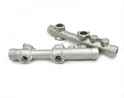

As a seasoned supplier of lost wax aluminum castings, I've witnessed firsthand the intricate dance of factors that influence the mechanical properties of these castings. Lost wax casting, also known as investment casting, is a versatile manufacturing process that allows for the production of complex and high - precision parts. In the case of aluminum castings, understanding the factors affecting their mechanical properties is crucial for delivering products that meet or exceed our customers' expectations.
1. Chemical Composition of Aluminum Alloy
The chemical composition of the aluminum alloy is the fundamental factor that determines the mechanical properties of lost wax aluminum castings. Different alloying elements are added to pure aluminum to enhance specific properties. For example, copper is often added to increase strength and hardness. Aluminum - copper alloys, such as the 2000 series, offer high strength but may have reduced corrosion resistance compared to other alloys.
Magnesium is another important alloying element. It improves the strength - to - weight ratio of aluminum castings and enhances corrosion resistance. Aluminum - magnesium alloys, like the 5000 series, are widely used in applications where lightweight and corrosion resistance are critical, such as in the marine and automotive industries.
Silicon is commonly added to aluminum alloys to improve fluidity during the casting process. This is especially important in lost wax casting, where the molten metal needs to fill intricate molds. Aluminum - silicon alloys, such as the 4000 series, also have good wear resistance and low coefficient of thermal expansion. For more information on different types of casting processes, you can visit our Stainless Steel Investment Casting page.
2. Casting Process Parameters
Melting and Pouring Temperature
The melting and pouring temperature of the aluminum alloy significantly affects the mechanical properties of the castings. If the melting temperature is too low, the alloy may not reach a fully molten state, leading to incomplete filling of the mold and the formation of porosity. On the other hand, if the melting temperature is too high, it can cause excessive oxidation of the alloy, which may result in the formation of oxide inclusions in the casting.
The pouring temperature also plays a crucial role. A proper pouring temperature ensures good fluidity of the molten metal, allowing it to fill the mold cavity completely. However, if the pouring temperature is too high, it can lead to hot cracking in the casting, which can significantly reduce its mechanical strength.
Cooling Rate
The cooling rate during the solidification of the casting is another important factor. A fast cooling rate generally results in a finer grain structure, which improves the strength and hardness of the casting. However, a very fast cooling rate can also lead to the formation of internal stresses in the casting, which may cause distortion or cracking.
Conversely, a slow cooling rate allows for the formation of larger grains, which may reduce the strength of the casting but can improve its ductility. Controlling the cooling rate is a delicate balance that requires careful consideration of the specific requirements of the casting.
3. Heat Treatment
Heat treatment is a powerful tool for modifying the mechanical properties of lost wax aluminum castings. There are several types of heat treatment processes commonly used for aluminum castings, including solution heat treatment, aging, and annealing.
Solution heat treatment involves heating the casting to a specific temperature and holding it there for a certain period to dissolve the alloying elements in the aluminum matrix. This is followed by rapid quenching to retain the dissolved elements in a supersaturated solid solution. Solution heat treatment can significantly improve the strength and hardness of the casting.
Aging is a process that involves heating the solution - heat - treated casting to a lower temperature and holding it there for a specific time. During aging, the supersaturated solid solution decomposes, and fine precipitates form, which further strengthen the casting. There are two types of aging: natural aging and artificial aging. Natural aging occurs at room temperature, while artificial aging is carried out at elevated temperatures.


Annealing is a heat treatment process used to relieve internal stresses in the casting and improve its ductility. It involves heating the casting to a specific temperature and then slowly cooling it. Annealing can be used to reduce the hardness of the casting and make it more machinable.
4. Defects in Castings
The presence of defects in lost wax aluminum castings can have a significant impact on their mechanical properties. Some common defects include porosity, shrinkage, and inclusions.
Porosity is the presence of small holes or voids in the casting. It can be caused by gas entrapment during the casting process, improper gating and risering design, or excessive moisture in the mold. Porosity reduces the density of the casting and can act as stress concentrators, leading to a decrease in strength and fatigue resistance.
Shrinkage occurs when the molten metal contracts during solidification. If the shrinkage is not properly compensated for, it can result in the formation of shrinkage cavities in the casting. Shrinkage cavities can significantly reduce the mechanical strength of the casting, especially in areas where the load is concentrated.
Inclusions are foreign materials that are present in the casting. They can be oxide inclusions, sand particles, or other contaminants. Inclusions can act as crack initiation sites and reduce the ductility and toughness of the casting. To learn more about high - quality casting parts, check out our Stainless Steel Precision Casting Parts page.
5. Design of the Casting
The design of the lost wax aluminum casting also affects its mechanical properties. The shape and thickness of the casting can influence the cooling rate and the distribution of internal stresses. For example, thick sections of the casting may cool more slowly than thin sections, leading to a non - uniform grain structure and the formation of internal stresses.
The presence of sharp corners and sudden changes in cross - section can act as stress concentrators, increasing the likelihood of cracking. Therefore, it is important to design the casting with smooth transitions and rounded corners to minimize stress concentrations.
The gating and risering system design is also crucial. A well - designed gating system ensures that the molten metal fills the mold cavity evenly and without turbulence, while a proper risering system provides a source of molten metal to compensate for shrinkage during solidification.
Conclusion
In conclusion, the mechanical properties of lost wax aluminum castings are influenced by a variety of factors, including the chemical composition of the alloy, casting process parameters, heat treatment, the presence of defects, and the design of the casting. As a supplier of lost wax aluminum castings, we understand the importance of carefully controlling these factors to produce high - quality castings that meet the specific requirements of our customers.
If you are in the market for high - quality lost wax aluminum castings or other casting products such as Brass Investment Casting, we invite you to contact us for a detailed discussion about your project. Our team of experts is ready to work with you to ensure that you get the best possible casting solution for your needs.
References
- Campbell, J. (2003). Castings. Butterworth - Heinemann.
- Davis, J. R. (Ed.). (2001). Aluminum and Aluminum Alloys. ASM International.
- Kalpakjian, S., & Schmid, S. R. (2010). Manufacturing Engineering and Technology. Pearson.