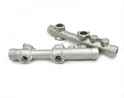

As a seasoned supplier of Casting Stainless Steel, I've witnessed firsthand the critical role that dimensional accuracy plays in the success of our products. Dimensional accuracy is not just a technical specification; it's the cornerstone of functionality, performance, and customer satisfaction. In this blog, I'll delve into the various factors that can affect the dimensional accuracy of casting stainless steel, drawing on my years of experience in the industry.
1. Pattern Design and Manufacturing
The journey of achieving dimensional accuracy begins with the pattern. Patterns are used to create the mold cavity, and any inaccuracies in the pattern will be transferred to the final casting.
- Material Selection: The choice of pattern material is crucial. Materials like wood, plastic, or metal each have their own properties that can influence dimensional stability. For example, wood can absorb moisture, leading to swelling or warping, which can cause dimensional variations in the casting. On the other hand, metals are more dimensionally stable but can be more expensive and difficult to machine.
- Machining Tolerances: During pattern manufacturing, the machining process must be carefully controlled to ensure that the pattern meets the required dimensional tolerances. Even small deviations in the pattern can result in significant differences in the final casting. Advanced machining techniques, such as CNC machining, can help achieve high precision in pattern making.
- Shrinkage Allowance: Stainless steel shrinks as it cools from the molten state to a solid. The pattern must be designed with an appropriate shrinkage allowance to compensate for this shrinkage. The shrinkage rate can vary depending on the specific grade of stainless steel, the casting process, and the size and shape of the casting. Incorrect shrinkage allowance can lead to castings that are either too large or too small.
2. Mold Making
The mold is the container that holds the molten stainless steel during the casting process. The quality of the mold and the way it is made can have a significant impact on the dimensional accuracy of the casting.
- Mold Material and Properties: Different mold materials, such as sand, ceramic, or investment casting shells, have different thermal properties and shrinkage characteristics. These properties can affect how the molten stainless steel solidifies and can lead to dimensional changes in the casting. For example, sand molds are porous and can allow some of the molten metal to seep into the sand, which can cause surface roughness and dimensional variations.
- Mold Preparation: The mold must be prepared carefully to ensure that it is clean, dry, and free of any defects. Any contaminants or imperfections in the mold can affect the flow of the molten stainless steel and can lead to casting defects. Additionally, the mold must be properly vented to allow gases to escape during the casting process. If the gases are not allowed to escape, they can cause porosity in the casting, which can affect its dimensional accuracy.
- Mold Assembly: In some casting processes, multiple mold components are assembled to form the final mold. The assembly process must be precise to ensure that the mold cavity has the correct dimensions. Any misalignment or gaps between the mold components can result in casting defects and dimensional inaccuracies.
3. Casting Process
The casting process itself is a complex operation that involves many variables that can affect the dimensional accuracy of the casting.
- Pouring Temperature: The temperature at which the molten stainless steel is poured into the mold is critical. If the pouring temperature is too high, the molten metal may have a lower viscosity, which can cause it to flow more easily and can lead to overfilling or distortion of the mold cavity. On the other hand, if the pouring temperature is too low, the molten metal may solidify too quickly, which can cause incomplete filling of the mold and can lead to casting defects.
- Pouring Rate: The rate at which the molten stainless steel is poured into the mold can also affect the dimensional accuracy of the casting. A slow pouring rate can allow the molten metal to solidify before it fills the entire mold cavity, while a fast pouring rate can cause turbulence and splashing, which can lead to casting defects and dimensional variations.
- Solidification Rate: The rate at which the molten stainless steel solidifies in the mold can have a significant impact on its dimensional accuracy. A slow solidification rate can allow the metal to shrink more uniformly, which can result in a more accurate casting. However, a slow solidification rate can also increase the risk of porosity and other casting defects. On the other hand, a fast solidification rate can reduce the risk of porosity but can also cause internal stresses in the casting, which can lead to dimensional changes over time.
4. Heat Treatment
Heat treatment is often used to improve the mechanical properties of casting stainless steel. However, the heat treatment process can also affect the dimensional accuracy of the casting.
- Thermal Expansion and Contraction: During heat treatment, the casting is heated to a high temperature and then cooled. This heating and cooling process can cause the casting to expand and contract, which can lead to dimensional changes. The amount of thermal expansion and contraction depends on the specific grade of stainless steel, the heat treatment process, and the size and shape of the casting.
- Residual Stresses: Heat treatment can also introduce residual stresses in the casting. These residual stresses can cause the casting to deform over time, which can affect its dimensional accuracy. Proper heat treatment techniques, such as annealing or stress relieving, can help reduce the residual stresses and minimize the dimensional changes.
5. Post - Casting Operations
After the casting is removed from the mold, it may undergo various post - casting operations, such as machining, grinding, and finishing. These operations can also affect the dimensional accuracy of the casting.
- Machining Tolerances: Machining operations, such as turning, milling, and drilling, must be carefully controlled to ensure that the casting meets the required dimensional tolerances. The cutting tools used in machining can wear over time, which can lead to dimensional variations. Additionally, the machining process can generate heat, which can cause thermal expansion and contraction of the casting, leading to dimensional changes.
- Surface Finishing: Surface finishing operations, such as grinding and polishing, can also affect the dimensional accuracy of the casting. These operations can remove a small amount of material from the surface of the casting, which can change its dimensions. Care must be taken to ensure that the surface finishing process does not remove too much material and affect the overall dimensions of the casting.
Conclusion
As a Casting Stainless Steel supplier, we understand the importance of dimensional accuracy in our products. By carefully controlling the factors discussed above, from pattern design to post - casting operations, we can ensure that our castings meet the highest standards of dimensional accuracy.
If you are in the market for high - quality Stainless Steel Investment Casting Parts, we are here to provide you with the best solutions. Our Silicon Sol Investment Casting process and Aluminum Investment Casting capabilities ensure precision and reliability in every casting. We invite you to contact us for a detailed discussion on your specific requirements and to explore how we can meet your needs.


References
- Campbell, J. (2003). Castings. Butterworth - Heinemann.
- Kalpakjian, S., & Schmid, S. R. (2010). Manufacturing Engineering and Technology. Pearson.
-ASM Handbook Committee. (2008). ASM Handbook, Volume 15: Casting. ASM International.