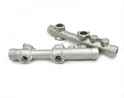

Hey there! As a supplier in the investment casting industry, I've seen firsthand the unique challenges that come with investment casting of titanium alloys. In this blog, I'm gonna share some of these challenges based on my experiences and knowledge.
First off, let's quickly talk about what investment casting is. If you're not sure, you can check out this link: What Is Investment Casting. It's a super cool manufacturing process that can create complex and precise parts. And for more details on the process itself, head over to Investment Casting Process.
Now, let's dig into the challenges of investment casting titanium alloys.
High Reactivity
Titanium alloys are highly reactive at high temperatures. When we're doing the casting process, the molten titanium can react with the mold materials. For example, it can react with the ceramic molds we often use. This reaction can lead to the formation of a layer of titanium oxide or other compounds on the surface of the casting. This not only affects the surface quality of the final product but can also change the chemical composition of the titanium alloy in the affected area.
To deal with this, we have to be really careful about the mold materials we choose. We need to use special ceramics that have a low reactivity with titanium. But these special ceramics are often more expensive and harder to work with. Also, we have to control the casting environment very precisely. We usually do the casting in an inert gas atmosphere, like argon, to minimize the contact between the molten titanium and oxygen or other reactive gases in the air.
High Melting Point
Titanium alloys have a very high melting point, typically around 1600 - 1700°C (2912 - 3092°F). This means we need a lot of energy to melt the titanium and keep it in a molten state during the casting process. The high temperatures also put a lot of stress on our melting equipment. The crucibles and furnaces we use have to be able to withstand these extreme temperatures without breaking down or contaminating the titanium.
Another issue related to the high melting point is the solidification process. When the molten titanium starts to cool and solidify, it can shrink a lot. This shrinkage can cause internal stresses and defects in the casting, like cracks and porosity. To manage this, we have to design the casting process carefully. We might use things like chills or risers to control the cooling rate and ensure a more uniform solidification.
Difficult Machining
Even after we've successfully cast a titanium alloy part, we often still need to do some machining to get it to the final shape and dimensions. But machining titanium alloys is no easy task. Titanium is a very tough and ductile material, which means it can be difficult to cut. The cutting tools wear out quickly because of the high cutting forces and the heat generated during the machining process.
We also have to be careful about the cutting parameters. If we cut too fast or with too much force, we can cause the material to overheat, which can lead to changes in its microstructure and properties. To machine titanium alloys effectively, we need to use special cutting tools made from materials like carbide or ceramic. And we have to use the right cutting speeds, feeds, and depths to minimize tool wear and ensure a good surface finish.
Cost
All of these challenges add up to a high cost for investment casting of titanium alloys. The special mold materials, the high energy consumption for melting, the expensive cutting tools for machining, and the extra quality control measures all contribute to the overall cost. This can make titanium alloy castings less competitive compared to castings made from other materials, especially for applications where cost is a major factor.
To try and reduce the cost, we're always looking for ways to optimize our processes. We're constantly researching new mold materials that are more cost - effective and have better performance. We're also working on improving the energy efficiency of our melting equipment. And we're looking into new machining techniques that can reduce the tool wear and increase the productivity.
Quality Control
Ensuring the quality of titanium alloy castings is crucial. Because of the challenges we've discussed, there's a higher risk of defects in the castings. These defects can range from surface imperfections to internal cracks and porosity. To detect these defects, we use a variety of non - destructive testing methods, like ultrasonic testing, X - ray testing, and dye penetrant testing.
But these testing methods are not only time - consuming but also expensive. And even with these tests, it's not always possible to detect every single defect. We also have to do mechanical testing to ensure that the castings meet the required mechanical properties, like strength and ductility. This means we have to take samples from the castings and test them in a laboratory.
Design Limitations
The properties of titanium alloys and the investment casting process itself can also put some limitations on the design of the parts we can make. For example, because of the high shrinkage during solidification, it's difficult to make parts with very thin walls or complex internal structures. The internal stresses caused by the shrinkage can lead to cracks in these areas.
Also, the high reactivity of titanium with mold materials can limit the shape and size of the parts. We might have to avoid sharp corners or undercuts in the design to make sure the mold can be made properly and the casting can be removed without damage.
Despite all these challenges, investment casting of titanium alloys still has a lot of advantages. Titanium alloys are known for their high strength - to - weight ratio, excellent corrosion resistance, and good biocompatibility. These properties make them ideal for applications in aerospace, medical, and automotive industries.
If you're in the market for high - quality titanium alloy investment castings, I'd love to have a chat with you. We've been working in this field for a long time and have developed some effective solutions to overcome these challenges. We can provide you with castings that meet your specific requirements in terms of quality, design, and cost.


References
- Campbell, J. (2008). Castings. Butterworth - Heinemann.
- Schwenk, A., & Leyens, C. (Eds.). (2003). Titanium and Titanium Alloys: Fundamentals and Applications. Wiley - VCH.
- Davis, J. R. (Ed.). (1994). Titanium: A Technical Guide. ASM International.