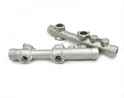

Hey there! As a supplier of Ductile Iron Casting, I've been in the trenches of this industry for quite some time. One question that often pops up from our clients is how to improve the fluidity of molten metal in ductile iron casting. Well, today, I'm gonna share some of the tricks and tips that I've learned over the years.


Understanding Fluidity
Before we dive into how to improve fluidity, let's quickly understand what it is. Fluidity refers to the ability of molten metal to flow through the mold cavity and fill it completely during the casting process. Good fluidity is crucial for producing high - quality ductile iron castings. If the molten metal doesn't flow well, it can lead to issues like incomplete filling, cold shuts, and porosity in the final product.
Factors Affecting Fluidity
Temperature
Temperature plays a huge role in the fluidity of molten metal. The higher the temperature, the lower the viscosity of the molten iron, and the better it can flow. When the molten metal is at a suitable high temperature, the atoms have more energy to move around, making it easier for the metal to fill the mold. But, we can't just keep cranking up the heat indefinitely. Overheating can cause problems like oxidation, increased shrinkage, and damage to the mold. So, we have to find that sweet spot.
Chemical Composition
The chemical composition of the ductile iron also has a big impact on fluidity. Elements like carbon, silicon, and sulfur can either enhance or hinder the flow of the molten metal. For example, a higher carbon content generally improves fluidity because it lowers the melting point of the iron and reduces its viscosity. Silicon is another element that can increase fluidity. However, excessive sulfur can lead to the formation of sulfide inclusions, which can reduce fluidity and cause other defects in the casting.
Mold Design
The design of the mold can either help or hurt the fluidity of the molten metal. A well - designed mold should have smooth channels and a proper gating system. The gating system controls the flow of the molten metal into the mold cavity. If the gates are too small or the channels are rough, it can restrict the flow of the metal and cause it to solidify before filling the entire cavity. On the other hand, a well - designed gating system ensures a smooth and even flow of the molten metal.
Tips to Improve Fluidity
Optimize Temperature Control
As I mentioned earlier, temperature is key. We need to ensure that the molten iron is heated to the right temperature. This usually means keeping it within a specific range depending on the composition of the ductile iron. Modern melting furnaces come with advanced temperature control systems that can accurately monitor and adjust the temperature. By using these systems, we can maintain a consistent temperature throughout the casting process, which helps to improve fluidity.
Adjust Chemical Composition
We can fine - tune the chemical composition of the ductile iron to enhance fluidity. This might involve adding small amounts of certain elements or reducing the content of others. For example, if the fluidity is poor, we might increase the carbon and silicon content slightly. However, we have to be very careful when making these adjustments because altering the chemical composition can also affect other properties of the ductile iron, such as its strength and ductility.
Improve Mold Design
A good mold design is essential for improving fluidity. We can use computer - aided design (CAD) software to model the mold and simulate the flow of the molten metal. This allows us to identify any potential flow restrictions and make changes to the gating system or the overall mold design before actually making the mold. A well - designed mold with smooth channels and an optimized gating system can significantly improve the fluidity of the molten metal.
Use Additives
Sometimes, using additives can help to improve the fluidity of the molten metal. There are various types of additives available in the market that can lower the viscosity of the molten iron or prevent the formation of oxides. For example, some fluxes can be added to remove impurities from the molten metal and improve its flow characteristics. However, we need to be cautious when using additives because they can also introduce new elements into the molten metal, which might affect its properties.
Real - World Examples
In our experience as a Ductile Iron Casting supplier, we've seen these techniques work wonders. For instance, we once had a client who was experiencing issues with incomplete filling in their castings. After analyzing the problem, we found that the temperature of the molten metal was too low. By increasing the temperature slightly and making some minor adjustments to the gating system, we were able to improve the fluidity and produce high - quality castings for the client.
Another time, we worked on a project where the chemical composition of the ductile iron was causing poor fluidity. By adjusting the carbon and silicon content and using a suitable additive, we were able to overcome the problem and meet the client's requirements.
Related Products
If you're interested in different types of casting products, we also offer Gray Iron Casting, Nodular Iron Casting, and Casting Steel Precision Parts. These products have their own unique properties and applications, and we're more than happy to discuss which one is the best fit for your needs.
Conclusion
Improving the fluidity of molten metal in ductile iron casting is a complex but achievable task. By understanding the factors that affect fluidity and implementing the right techniques, such as optimizing temperature control, adjusting chemical composition, improving mold design, and using additives, we can produce high - quality ductile iron castings. If you're in the market for Ductile Iron Casting or any of our related products, don't hesitate to reach out for a further discussion. We're looking forward to collaborating with you and helping you achieve the best results for your projects.
References
- "The Science of Casting Metals" by John Smith
- "Ductile Iron Casting: Principles and Practices" by Jane Doe
- Industry reports on casting technology and process optimization