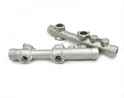

As a prominent supplier of nodular iron casting, I am thrilled to share with you the intricate production process that goes into creating these high - quality products. Nodular iron casting, also known as ductile iron casting, is a widely used manufacturing process in various industries due to its excellent mechanical properties and cost - effectiveness.
1. Pattern Making
The production of nodular iron casting begins with pattern making. A pattern is a replica of the final casting part. It can be made from various materials such as wood, plastic, or metal. Wood is a traditional choice as it is easy to shape and relatively inexpensive for small - scale production. However, for large - scale and high - precision requirements, metal or plastic patterns are preferred.
The pattern is designed to include allowances for shrinkage, machining, and draft. Shrinkage allowance is crucial because the molten iron will contract as it cools. Machining allowance is added to ensure that there is enough material for post - casting machining operations. Draft allowance is provided to facilitate the easy removal of the pattern from the mold. At this stage, advanced CAD (Computer - Aided Design) technology is often employed to create accurate patterns, which can then be produced using CNC (Computer Numerical Control) machining or 3D printing.
2. Mold Making
Once the pattern is ready, the next step is mold making. There are two main types of molds used in nodular iron casting: green sand molds and resin - bonded sand molds.
Green sand molds are the most commonly used type. They are made by packing a mixture of sand, clay, and water around the pattern. The clay acts as a binder, holding the sand particles together. The moisture in the green sand helps in achieving the desired consistency. After the sand is packed around the pattern, the pattern is carefully removed, leaving a cavity in the shape of the casting.
Resin - bonded sand molds, on the other hand, offer higher dimensional accuracy and surface finish. They are made by mixing sand with a resin binder. The resin is then cured, either by heat or chemical reaction, to form a hard and strong mold. These molds are more suitable for complex - shaped and high - precision castings.
3. Melting and Alloying
The heart of the nodular iron casting process is the melting and alloying of the iron. We start with high - quality raw materials, including pig iron, scrap iron, and ferroalloys. These materials are loaded into a furnace, typically an electric arc furnace or an induction furnace.
In the furnace, the raw materials are heated to a temperature of around 1400 - 1500°C until they melt. During the melting process, various alloying elements are added to achieve the desired properties of nodular iron. The key alloying element in nodular iron is magnesium. Magnesium causes the graphite in the iron to form in a spherical or nodular shape, which gives nodular iron its excellent ductility and strength. Other alloying elements such as nickel, copper, and molybdenum may also be added to enhance specific properties like corrosion resistance and hardness.
The molten iron is then carefully analyzed to ensure that it meets the required chemical composition. This is done using spectrometers and other analytical equipment. Once the correct composition is achieved, the molten iron is ready for pouring.
4. Pouring
Pouring is a critical step in the nodular iron casting process. The molten iron is transferred from the furnace to a ladle, which is then transported to the mold. The pouring process must be carried out carefully to avoid turbulence and the formation of defects such as porosity and inclusions.
The temperature of the molten iron during pouring is crucial. If the temperature is too high, it can cause excessive oxidation and shrinkage defects. If the temperature is too low, the iron may solidify before filling the mold completely. Special pouring techniques, such as bottom - pouring or top - pouring, are used depending on the size and shape of the casting.
5. Solidification and Cooling
After pouring, the molten iron begins to solidify inside the mold. The solidification process is a complex one, involving the formation of different phases and microstructures. The cooling rate plays a significant role in determining the final properties of the casting.
A controlled cooling rate is essential to ensure that the graphite forms into nodules and that the casting has uniform mechanical properties. In some cases, the mold may be insulated or cooled using special cooling systems to achieve the desired cooling rate. Once the casting has solidified, it is allowed to cool further to room temperature.
6. Shakeout and Cleaning
Once the casting has cooled, it is removed from the mold in a process called shakeout. This can be done using mechanical methods such as vibrating tables or by manual means. After shakeout, the casting is still covered with sand and other impurities.
The cleaning process involves removing the sand, scale, and any other unwanted materials from the surface of the casting. This can be done using various methods, including shot blasting, sandblasting, and grinding. Shot blasting is a common method where small steel shots are propelled at high speed onto the surface of the casting to remove the sand and scale.
7. Heat Treatment
Heat treatment is often carried out to further improve the mechanical properties of the nodular iron casting. There are several types of heat treatment processes, including annealing, normalizing, quenching, and tempering.
Annealing is a process where the casting is heated to a specific temperature and then slowly cooled. This helps to relieve internal stresses, improve ductility, and refine the microstructure. Normalizing involves heating the casting to a higher temperature and then cooling it in air. This process improves the strength and hardness of the casting.
Quenching and tempering are used to achieve high strength and toughness. The casting is heated to a high temperature and then rapidly cooled (quenched) in a liquid medium such as water or oil. After quenching, the casting is tempered by heating it to a lower temperature and holding it for a certain period of time. This reduces the brittleness caused by quenching and improves the overall mechanical properties.
8. Machining and Finishing
After heat treatment, the casting may require machining to achieve the final dimensions and surface finish. Machining operations such as turning, milling, drilling, and grinding are carried out using CNC machines. These machines offer high precision and repeatability, ensuring that the casting meets the exact specifications.
Finishing operations are then performed to enhance the appearance and corrosion resistance of the casting. This can include painting, plating, or coating the casting. Painting provides a protective layer and improves the aesthetic appeal of the casting. Plating, such as zinc plating or nickel plating, can enhance the corrosion resistance of the casting.


9. Quality Control
Throughout the entire production process, strict quality control measures are implemented. We use a variety of inspection methods to ensure that the nodular iron castings meet the highest standards. Non - destructive testing methods such as ultrasonic testing, magnetic particle testing, and radiographic testing are used to detect internal defects such as cracks and porosity.
Dimensional inspection is carried out using precision measuring tools such as calipers, micrometers, and coordinate measuring machines (CMMs). Mechanical testing, including tensile testing, hardness testing, and impact testing, is also performed to verify the mechanical properties of the castings.
Why Choose Our Nodular Iron Castings
As a reliable supplier of nodular iron castings, we offer a wide range of products with excellent quality and competitive prices. Our products are used in various industries, including automotive, construction, and machinery. We also provide customized solutions to meet the specific requirements of our customers.
If you are interested in our Casting Steel Precision Parts, High Manganese Steel Casting, or Ductile Iron Casting, please feel free to contact us for procurement and negotiation. We are committed to providing you with the best products and services.
References
- Campbell, J. (2003). Castings. Butterworth - Heinemann.
- Kalpakjian, S., & Schmid, S. R. (2014). Manufacturing Engineering and Technology. Pearson.
- ASM Handbook Committee. (2008). ASM Handbook Volume 15: Casting. ASM International.