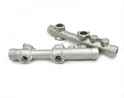

As a supplier of What Is Investment Casting, I often get asked about the production efficiency of investment casting. In this blog post, I'll delve into what production efficiency in investment casting means, the factors that influence it, and how we, as a supplier, strive to optimize it for our clients.
Understanding Production Efficiency in Investment Casting
Production efficiency in investment casting refers to the ability to produce high - quality castings in the most cost - effective and timely manner. It encompasses various aspects, including the utilization of raw materials, the speed of the casting process, and the quality control measures in place.


The Investment Casting Process is a complex multi - step procedure. It starts with the creation of a wax pattern, which is then coated with a ceramic shell. After the shell is hardened, the wax is melted out, leaving a cavity in the shape of the desired part. Molten metal is then poured into this cavity, and once it solidifies, the ceramic shell is broken away to reveal the casting.
Factors Affecting Production Efficiency
1. Pattern Making
The first step in investment casting is pattern making. The time and resources spent on creating accurate wax patterns can significantly impact production efficiency. If the pattern - making process is slow or prone to errors, it can delay the entire casting process. Modern techniques such as 3D printing for wax patterns have improved efficiency in recent years. 3D printing allows for rapid prototyping and the creation of complex geometries with high precision, reducing the time required for pattern making.
2. Shell Building
The shell - building process involves coating the wax pattern with multiple layers of ceramic slurry and stucco. The thickness and quality of the shell are crucial for a successful casting. A thicker shell may provide better dimensional accuracy but can also increase the time required for shell building and the subsequent dewaxing and pouring processes. On the other hand, a thin shell may lead to casting defects. Balancing these factors is essential for optimizing production efficiency.
3. Metal Pouring and Solidification
The pouring of molten metal into the ceramic shell and its subsequent solidification is another critical stage. The temperature of the molten metal, the pouring speed, and the cooling rate all affect the quality and production time of the casting. If the metal is poured too quickly, it can cause turbulence and result in defects such as porosity. Slow pouring, however, can increase the overall production time. Similarly, improper cooling rates can lead to internal stresses and cracking in the casting.
4. Quality Control
Quality control is an integral part of investment casting. Inspections at various stages of the process, such as pattern inspection, shell inspection, and final casting inspection, are necessary to ensure that the castings meet the required specifications. However, excessive or inefficient quality control procedures can slow down production. Implementing automated inspection systems can help improve efficiency by quickly identifying defects and reducing the need for manual inspection.
How Our Company Optimizes Production Efficiency
As a What Is Investment Casting supplier, we have implemented several strategies to enhance production efficiency.
1. Advanced Technology Adoption
We have invested in state - of - the - art equipment and technologies. For pattern making, we use 3D printing technology, which allows us to quickly produce complex wax patterns with high accuracy. This reduces the lead time for pattern creation and enables us to start the casting process sooner. In addition, we have automated our shell - building process, ensuring consistent shell quality and reducing the time required for manual labor.
2. Process Optimization
We continuously analyze and optimize our casting processes. By monitoring and adjusting parameters such as metal pouring temperature, speed, and cooling rates, we can produce high - quality castings in a shorter time. We also use simulation software to predict the behavior of molten metal during pouring and solidification, allowing us to make adjustments before the actual casting process.
3. Skilled Workforce
Our team consists of highly skilled and experienced technicians and engineers. They are trained to operate our advanced equipment and follow strict quality control procedures. Their expertise enables us to quickly identify and solve problems that may arise during the casting process, minimizing downtime and ensuring smooth production.
4. Supply Chain Management
Efficient supply chain management is crucial for production efficiency. We have established long - term partnerships with reliable suppliers of raw materials such as wax, ceramic, and metals. This ensures a stable supply of high - quality materials, reducing the risk of production delays due to material shortages.
Benefits of High Production Efficiency for Our Clients
High production efficiency in investment casting offers several benefits to our clients.
1. Shorter Lead Times
By optimizing our production processes, we can reduce the time required to produce castings. This means that our clients can receive their orders faster, which is particularly important for industries with tight production schedules.
2. Cost Savings
Efficient production processes result in lower production costs. We can pass on these cost savings to our clients in the form of more competitive pricing. This allows our clients to reduce their overall manufacturing costs without compromising on the quality of the castings.
3. Consistent Quality
Our focus on quality control during the production process ensures that our clients receive castings that meet or exceed their specifications. High - quality castings reduce the need for rework and scrap, further saving our clients time and money.
Conclusion
Production efficiency in investment casting is a complex but achievable goal. By understanding the factors that affect efficiency and implementing strategies such as advanced technology adoption, process optimization, and supply chain management, we can produce high - quality castings in a cost - effective and timely manner.
If you are in need of investment casting services, we invite you to contact us for a detailed discussion on your requirements. Our team is ready to provide you with customized solutions and high - quality castings. Let's work together to meet your investment casting needs.
References
- Campbell, J. (2003). Castings. Butterworth - Heinemann.
- Dantzig, G. B., & Thapa, M. N. (1997). Linear programming 1: Introduction. Springer Science & Business Media.
- Flemings, M. C. (1974). Solidification processing. McGraw - Hill.