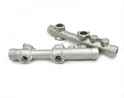

Hey there! As a supplier of Nodular Iron Casting, I'm super excited to chat with you about its mechanical properties. Nodular Iron Casting, also known as ductile iron casting, has become a go - to material in many industries, and for good reasons. Let's dig into what makes it so special.
1. Tensile Strength
One of the most important mechanical properties of Nodular Iron Casting is its tensile strength. Tensile strength refers to the maximum stress that a material can withstand while being stretched or pulled before breaking. Nodular Iron Casting has a relatively high tensile strength compared to other cast irons. This is mainly because of the unique graphite structure in it. In nodular iron, the graphite is in the form of tiny spheres (nodules) rather than the flake - like shape found in gray iron. These nodules act as stress - relieving agents, allowing the material to better resist the forces trying to pull it apart.


For example, in applications where components are subjected to high pulling or stretching forces, like in automotive suspension systems or heavy - duty machinery, Nodular Iron Casting can hold up well. Its high tensile strength ensures that parts won't break easily under normal operating conditions, which in turn increases the reliability and lifespan of the equipment. You can find more details about Nodular Iron Casting on our Nodular Iron Casting page.
2. Ductility
Ductility is another remarkable property of Nodular Iron Casting. It's the ability of a material to deform plastically under tensile stress without fracturing. In simple terms, it means that nodular iron can be stretched and bent to a certain extent without breaking. This is a huge advantage over brittle materials like some types of cast iron.
The spherical graphite nodules in nodular iron play a key role in its ductility. They prevent the rapid propagation of cracks, allowing the material to deform gradually. This property is extremely useful in applications where parts need to undergo some form of deformation during manufacturing or in service. For instance, in the production of pipes, nodular iron can be bent and shaped to fit different installation requirements. And in earthquake - prone areas, structures made with Nodular Iron Casting can better withstand ground movements due to their ductility.
3. Impact Resistance
When it comes to impact resistance, Nodular Iron Casting really shines. Impact resistance is the ability of a material to absorb energy when struck by a sudden force. The combination of its high tensile strength and ductility gives nodular iron excellent impact - absorbing capabilities.
In industries such as mining and construction, where equipment is often exposed to high - impact forces from falling rocks or heavy machinery collisions, Nodular Iron Casting is a top choice. Components made from nodular iron can withstand these impacts without shattering, which helps to reduce downtime and maintenance costs. Compared to other materials like High Manganese Steel Casting or High Chromium Iron Casting, nodular iron offers a good balance between cost and impact - resistance performance.
4. Fatigue Resistance
Fatigue resistance is crucial for materials that are subjected to repeated loading and unloading cycles. Nodular Iron Casting has good fatigue - resistant properties. The spherical graphite nodules in nodular iron act as barriers to crack initiation and propagation under cyclic loading.
In applications like engine components, which experience thousands or even millions of loading cycles during their lifetime, Nodular Iron Casting can maintain its integrity for a long time. This reduces the risk of sudden failures due to fatigue, which is especially important for safety - critical applications. The fatigue - resistant nature of nodular iron also contributes to the overall durability of the equipment, saving money on replacements and repairs in the long run.
5. Hardness
The hardness of Nodular Iron Casting can be adjusted through heat treatment processes. Hardness is a measure of a material's resistance to indentation, scratching, or wear. Depending on the specific application requirements, nodular iron can be made harder or softer.
For applications where wear resistance is a priority, such as in the production of gears or bearings, the hardness of nodular iron can be increased through heat treatment. On the other hand, if a more ductile and less brittle material is needed, the hardness can be reduced. This flexibility in adjusting hardness makes Nodular Iron Casting suitable for a wide range of applications.
6. Machinability
Machinability is an important consideration for manufacturers. Nodular Iron Casting generally has good machinability. The presence of graphite nodules in the iron matrix helps to lubricate the cutting tool during machining operations, reducing tool wear and improving the surface finish of the machined parts.
This means that manufacturers can produce complex - shaped components with relative ease and at a lower cost. Whether it's turning, milling, drilling, or grinding, nodular iron can be machined efficiently, which is a big plus for industries that require high - precision parts.
Why Choose Our Nodular Iron Casting?
As a supplier, we take pride in providing high - quality Nodular Iron Casting products. We have strict quality control measures in place to ensure that each casting meets the required mechanical property standards. Our experienced team uses advanced manufacturing techniques to produce nodular iron castings with consistent quality.
We understand that different customers have different needs, so we offer customized solutions. Whether you need a small - batch production of a unique component or a large - scale order for a standard part, we can handle it. Our goal is to provide you with the best - value Nodular Iron Casting products that meet your specific requirements.
If you're in the market for Nodular Iron Casting, we'd love to have a chat with you. We can discuss your project in detail, answer any questions you may have, and provide you with a competitive quote. Don't hesitate to reach out to us for procurement and further discussions. We're here to help you make the right choice for your business.
References
- ASM Handbook Volume 1: Properties and Selection: Irons, Steels, and High - Performance Alloys
- Ductile Iron Society Technical Publications
- Various research papers on the mechanical properties of nodular iron casting from industry - related journals