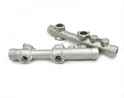

As a seasoned provider of shell mold casting services, I've witnessed firsthand the intricate dance between various factors that contribute to the success of the casting process. One such crucial element is mold temperature, which can significantly influence the quality, efficiency, and overall outcome of shell mold casting. In this blog post, I'll delve into the impact of mold temperature on shell mold casting, drawing from my experience in the industry and the latest scientific research.
Understanding Shell Mold Casting
Before we explore the role of mold temperature, let's briefly review what shell mold casting is. What Is Shell Mold Casting is a precision casting process that involves creating a thin, hard shell around a pattern, which is then used to form the mold cavity. This shell is typically made from a mixture of resin-coated sand, which is heated to cure and harden it. The pattern is removed, and molten metal is poured into the mold cavity to create the desired part.
The Shell Mold Casting Process offers several advantages over other casting methods, including high dimensional accuracy, excellent surface finish, and the ability to produce complex shapes with thin walls. However, achieving these benefits requires careful control of various process parameters, including mold temperature.
The Impact of Mold Temperature on Shell Mold Casting
1. Shell Formation and Strength
The mold temperature plays a critical role in the formation and strength of the shell. When the resin-coated sand is heated, the resin begins to cure, binding the sand particles together to form a solid shell. The rate of curing is highly dependent on the mold temperature. If the mold temperature is too low, the curing process may be incomplete, resulting in a weak and brittle shell that is prone to cracking and breaking during handling and casting. On the other hand, if the mold temperature is too high, the resin may cure too quickly, leading to a shell with poor mechanical properties and a rough surface finish.
Optimal mold temperature ensures that the resin cures uniformly and completely, resulting in a strong, durable shell that can withstand the pressures and temperatures of the casting process. This is particularly important for casting complex shapes and thin-walled parts, where the shell needs to maintain its integrity without deforming or collapsing.
2. Metal Flow and Filling
Mold temperature also affects the flow and filling of the molten metal in the mold cavity. When the mold is at the right temperature, the molten metal can flow smoothly and evenly through the gating system and into the mold cavity, filling all the intricate details of the part. A higher mold temperature reduces the viscosity of the molten metal, allowing it to flow more easily and fill thin sections without premature solidification.
Conversely, a low mold temperature can cause the molten metal to solidify too quickly, leading to incomplete filling, cold shuts, and other casting defects. Cold shuts occur when two streams of molten metal meet and fail to fuse properly, resulting in a visible line or crack on the surface of the casting. These defects can compromise the structural integrity and functionality of the part, leading to costly rework or rejection.
3. Solidification and Cooling
Once the molten metal has filled the mold cavity, the mold temperature continues to influence the solidification and cooling process. The rate of solidification affects the grain structure and mechanical properties of the casting. A higher mold temperature slows down the solidification rate, allowing the metal to form a coarser grain structure, which can improve the ductility and toughness of the casting. However, it can also lead to longer cycle times and increased energy consumption.
On the other hand, a lower mold temperature accelerates the solidification rate, resulting in a finer grain structure and improved mechanical properties such as hardness and strength. However, rapid solidification can also cause internal stresses and shrinkage defects, such as porosity and shrinkage cavities. These defects can weaken the casting and reduce its fatigue life.
Balancing the mold temperature to achieve the desired solidification rate is essential for producing high-quality castings with optimal mechanical properties. This often requires careful consideration of the type of metal being cast, the part geometry, and the specific requirements of the application.
4. Surface Finish and Dimensional Accuracy
The mold temperature can also have a significant impact on the surface finish and dimensional accuracy of the casting. A uniform mold temperature helps to ensure that the molten metal solidifies evenly, resulting in a smooth and consistent surface finish. In contrast, uneven mold temperature can cause variations in the solidification rate, leading to surface defects such as roughness, porosity, and hot tears.
Dimensional accuracy is also affected by the mold temperature. Thermal expansion and contraction of the mold and the casting during the heating and cooling process can cause dimensional changes. By controlling the mold temperature, these dimensional changes can be minimized, ensuring that the final casting meets the required specifications.
Controlling Mold Temperature in Shell Mold Casting
To achieve the desired impact of mold temperature on shell mold casting, it is essential to have a reliable and accurate temperature control system in place. This typically involves using heating elements, such as electric heaters or gas burners, to maintain the mold at the optimal temperature. The temperature can be monitored and adjusted using thermocouples or other temperature sensors, which provide real-time feedback to the control system.
In addition to controlling the mold temperature during the shell formation and casting process, it is also important to consider the preheating and cooling stages. Preheating the mold to the appropriate temperature before pouring the molten metal helps to ensure a smooth and uniform filling process. Cooling the mold at a controlled rate after casting helps to minimize internal stresses and prevent cracking and other defects.
Conclusion
As a shell mold casting provider, I understand the critical role that mold temperature plays in the success of the casting process. By carefully controlling the mold temperature, we can optimize shell formation, improve metal flow and filling, enhance solidification and cooling, and achieve superior surface finish and dimensional accuracy. This not only results in high-quality castings that meet or exceed our customers' expectations but also improves the efficiency and productivity of our operations.
If you're in the market for shell mold casting services and are looking for a reliable partner who understands the importance of mold temperature and other process parameters, I encourage you to reach out to us. We have the expertise, experience, and state-of-the-art equipment to deliver exceptional castings for a wide range of applications. Contact us today to discuss your casting needs and let's work together to bring your ideas to life.


References
- Campbell, J. (2008). Castings. Butterworth-Heinemann.
- Dossett, J. H., & Reutzel, E. W. (2012). Manufacturing Processes and Materials for Engineers. CRC Press.
- Flemings, M. C. (1974). Solidification Processing. McGraw-Hill.