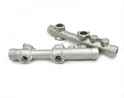

Hey there! As a supplier of Ductile Iron Casting, I often get asked about the density of ductile iron casting. So, I thought I'd write this blog to share some insights on this topic.
First off, let's understand what ductile iron casting is. Ductile iron, also known as nodular cast iron or spheroidal graphite iron, is a type of cast iron. It's got graphite in it that's in the form of spherical nodules, unlike the flake - shaped graphite in gray cast iron. This unique structure gives ductile iron some pretty cool properties like high strength, good ductility, and excellent impact resistance. You can learn more about Nodular Iron Casting on our website.
Now, let's talk about density. Density is basically how much mass is packed into a given volume. For ductile iron casting, the density typically ranges from about 7.1 to 7.4 grams per cubic centimeter (g/cm³). But why does it vary within this range? Well, a few factors come into play.
One of the main factors is the chemical composition of the ductile iron. Different elements are added during the casting process to achieve specific properties. For example, adding nickel can increase the strength and corrosion resistance of the ductile iron. But these elements have different atomic masses, which in turn affect the overall density of the casting. If there's a higher proportion of heavier elements, the density will be on the higher end of the range.
The casting process itself also has an impact on density. During casting, things like the cooling rate can matter a lot. If the ductile iron cools too quickly, it might form some internal voids or porosity. These voids are essentially empty spaces, and when there are more of them, the overall mass per unit volume (i.e., density) goes down. On the other hand, a well - controlled casting process with a proper cooling rate can result in a more dense and uniform casting.
Another aspect is the heat treatment that the ductile iron casting undergoes. Heat treatment can change the microstructure of the iron. For instance, annealing can relieve internal stresses and make the structure more homogeneous. This can sometimes lead to a slight change in density as the atoms within the material rearrange themselves.

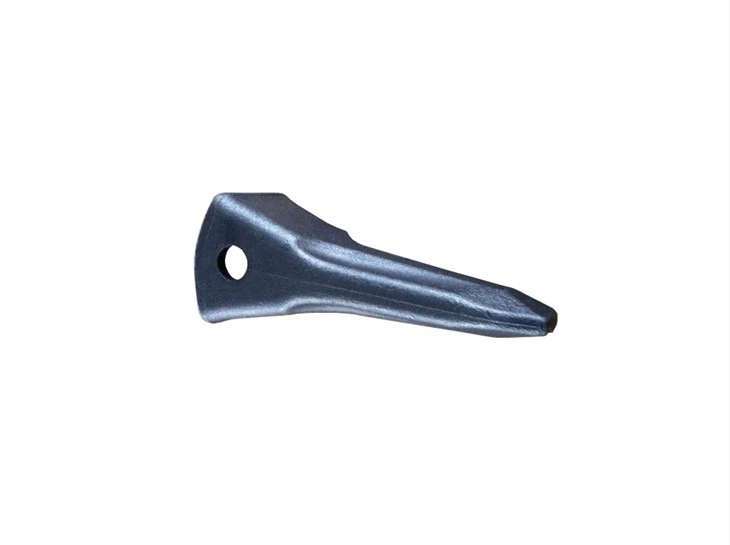
So, why is knowing the density of ductile iron casting important? Well, for one, it's crucial in design and engineering. Engineers need to know the density when they're calculating things like the weight of a component. If you're building a machine or a structure, you need to make sure that the parts made from ductile iron casting won't be too heavy or too light for the intended application.
In the manufacturing process, density can also be an indicator of quality. A casting with a density outside the expected range might have some internal defects. By measuring the density, manufacturers can quickly identify if there are any issues with the casting and take corrective actions.
Now, compared to other types of castings, how does ductile iron casting stack up in terms of density? Let's take High Manganese Steel Casting as an example. High manganese steel casting usually has a density in the range of about 7.7 to 8.0 g/cm³. So, it's generally denser than ductile iron casting. This difference in density can be a deciding factor when choosing between the two materials for a particular application. If weight is a concern, ductile iron might be a better choice.
As a supplier of Ductile Iron Casting, we take great care in ensuring the quality of our castings. We use advanced testing methods to measure the density of our products. This helps us maintain consistency and meet the high - quality standards that our customers expect.
We have a team of experts who are constantly working on improving our casting processes. They're always looking for ways to optimize the chemical composition and the casting parameters to get the best possible density and other properties for our ductile iron castings.
If you're in the market for ductile iron casting, you'll want to consider the density along with other factors like strength, ductility, and cost. At our company, we can provide you with detailed information about the density and other characteristics of our products. We can also work with you to customize the castings according to your specific requirements.
Whether you need small, precision parts or large, heavy - duty components, we've got the expertise and the facilities to deliver high - quality ductile iron castings. Our goal is to be your reliable partner in all your casting needs.
So, if you're interested in learning more about our ductile iron casting products or have any questions about density or other aspects, don't hesitate to reach out. We're here to have a chat, answer your queries, and discuss how we can work together to meet your procurement needs.
References:
- "The Science of Casting Metals" - A general reference on casting processes and material properties.
- "Handbook of Ductile Iron" - A comprehensive guide on the properties and applications of ductile iron.