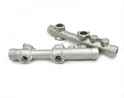

Hey there! As a supplier of Bronze Investment Casting, I'm super stoked to chat with you about the finishing operations done on bronze investment castings. It's a fascinating process that really brings these castings to life.
First off, let's talk a bit about what bronze investment casting is. If you're curious to learn more, you can check out our Bronze Investment Casting page. It's a precision manufacturing process where molten bronze is poured into a ceramic mold created from a wax pattern. Once the bronze solidifies, the mold is broken away, leaving behind the casting. But that's just the beginning. There are several finishing operations that are crucial to making the castings ready for their final use.
One of the first steps in finishing is cleaning. After the casting is removed from the mold, it's covered in ceramic mold material and other debris. We use a variety of methods to clean it up. One common method is shot blasting. We blast the casting with small metal or ceramic shots. This not only removes the remaining mold material but also gives the surface a nice, uniform finish. It's like giving the casting a good scrub! Another option is chemical cleaning. We soak the casting in a special chemical solution that dissolves the unwanted material. This method is great for getting into all the nooks and crannies of the casting.
Next up is grinding and machining. The casting might have some rough edges or excess material that need to be removed. Grinding is used to smooth out the surface and remove any bumps or ridges. We use different types of grinding wheels depending on the specific requirements of the casting. For more precise shaping and sizing, we turn to machining. This includes operations like milling, turning, and drilling. Milling is used to create flat surfaces or cut slots, while turning is used to create cylindrical shapes. Drilling, of course, is for making holes. These machining operations are essential for ensuring that the casting meets the exact specifications of our customers. You can see some of the products that go through these processes on our Investment Casting Products page.
Heat treatment is another important finishing operation. Bronze castings can benefit greatly from heat treatment. There are different types of heat treatments, such as annealing, quenching, and tempering. Annealing is used to relieve internal stresses in the casting and improve its machinability. We heat the casting to a specific temperature and then cool it slowly. Quenching, on the other hand, involves heating the casting and then rapidly cooling it. This can increase the hardness of the bronze. Tempering is often done after quenching to reduce the brittleness and improve the toughness of the casting. Heat treatment really helps to enhance the mechanical properties of the bronze, making it more durable and reliable.
Surface finishing is also a key part of the process. We want the bronze castings to not only function well but also look good. There are several ways to achieve a great surface finish. One popular method is polishing. We use abrasive materials to buff the surface of the casting until it shines. This gives the bronze a smooth, reflective finish that's really eye - catching. Another option is plating. We can plate the bronze with other metals like nickel or chrome. This not only adds a decorative touch but also provides additional corrosion resistance. For a more rustic or antique look, we can apply a patina. A patina is a chemical coating that changes the color of the bronze over time, giving it an aged appearance.
Inspection is an ongoing process throughout the finishing operations. We carefully examine each casting to make sure it meets our quality standards. We use a variety of inspection tools, such as calipers, micrometers, and coordinate measuring machines (CMMs). Calipers and micrometers are used to measure the dimensions of the casting to ensure they are within the specified tolerances. CMMs are more advanced and can measure the shape and position of features on the casting with high precision. Any casting that doesn't meet the standards is either reworked or discarded.
Now, let's talk about silicon sol investment casting, which is related to our bronze investment casting process. Silicon sol is often used in the creation of the ceramic mold. It provides a more precise and high - quality mold, which in turn leads to better - quality castings. You can find more information about this on our Silicon Sol Investment Casting page.
All these finishing operations are done with great care and attention to detail. We understand that our customers rely on us to provide high - quality bronze investment castings for their various applications. Whether it's for the automotive industry, the aerospace industry, or any other field, we're committed to delivering products that meet and exceed expectations.
If you're in the market for bronze investment castings, we'd love to have a chat with you. We can discuss your specific requirements, provide you with samples, and give you a quote. Our team of experts is always ready to help you find the best solution for your needs. Don't hesitate to reach out and start the conversation about your next project.


References
- "Investment Casting Handbook" - A comprehensive guide on investment casting processes and techniques.
- "Bronze Alloys: Properties and Applications" - A book that details the characteristics and uses of different bronze alloys.