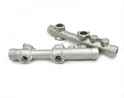

Investment casting, also known as lost-wax casting, is a precision manufacturing process that has been used for centuries to create complex and high-quality metal parts. As a leading supplier of What Is Investment Casting, we understand the importance of a well-designed gating system in the investment casting process. A gating system is a crucial component that controls the flow of molten metal into the mold cavity, ensuring the proper filling and solidification of the casting. In this blog post, we will explore the different types of gating systems used in investment casting and their respective advantages and applications.
1. Top Gating System
The top gating system is one of the simplest and most commonly used gating systems in investment casting. In this system, the molten metal is poured directly into the top of the mold cavity through a sprue. The sprue is a vertical channel that connects the pouring basin to the mold cavity. From the sprue, the molten metal flows down into the mold cavity, filling it from the top down.
Advantages
- Simple Design: The top gating system has a straightforward design, which makes it easy to manufacture and implement.
- High Filling Speed: Since the molten metal is poured directly into the top of the mold cavity, it can fill the cavity quickly, reducing the risk of premature solidification.
- Good Feeding: The top gating system allows for good feeding of the casting, as the molten metal can flow freely into the mold cavity and compensate for shrinkage during solidification.
Applications
- Shallow and Wide Castings: The top gating system is suitable for shallow and wide castings, where the molten metal can easily flow into the mold cavity without the need for complex gating arrangements.
- Castings with Low Dimensional Tolerances: This gating system is also suitable for castings with low dimensional tolerances, as the high filling speed can help to minimize the formation of defects such as porosity and shrinkage.
2. Bottom Gating System
The bottom gating system is another commonly used gating system in investment casting. In this system, the molten metal is poured into the mold cavity through a sprue located at the bottom of the mold. The sprue is connected to a runner system, which distributes the molten metal evenly into the mold cavity.
Advantages
- Reduced Turbulence: The bottom gating system helps to reduce turbulence during the filling process, as the molten metal enters the mold cavity from the bottom and flows upwards. This reduces the risk of entraining air and other impurities in the casting.
- Improved Filling Uniformity: The runner system in the bottom gating system helps to distribute the molten metal evenly into the mold cavity, ensuring uniform filling and reducing the risk of hot spots and shrinkage.
- Good Feeding: Similar to the top gating system, the bottom gating system also allows for good feeding of the casting, as the molten metal can flow freely into the mold cavity and compensate for shrinkage during solidification.
Applications
- Deep and Narrow Castings: The bottom gating system is suitable for deep and narrow castings, where the molten metal needs to flow upwards against gravity. The reduced turbulence and improved filling uniformity make this gating system ideal for such castings.
- Castings with High Dimensional Tolerances: This gating system is also suitable for castings with high dimensional tolerances, as the uniform filling and feeding can help to ensure the accuracy of the final casting.
3. Step Gating System
The step gating system is a combination of the top and bottom gating systems. In this system, the molten metal is poured into the mold cavity through a series of steps or levels. The first step is usually located at the top of the mold cavity, and the subsequent steps are located at lower levels. The molten metal flows from one step to the next, filling the mold cavity gradually.
Advantages
- Reduced Turbulence and Air Entrapment: The step gating system helps to reduce turbulence and air entrapment during the filling process, as the molten metal flows in a controlled manner from one step to the next.
- Good Feeding and Filling: This gating system allows for good feeding and filling of the casting, as the molten metal can flow freely into the mold cavity and compensate for shrinkage during solidification.
- Suitable for Complex Castings: The step gating system is suitable for complex castings with irregular shapes and varying wall thicknesses, as it can ensure uniform filling and feeding of the entire casting.
Applications
- Complex and Irregularly Shaped Castings: The step gating system is ideal for complex and irregularly shaped castings, where the traditional top or bottom gating systems may not be sufficient to ensure proper filling and feeding.
- Castings with High Quality Requirements: This gating system is also suitable for castings with high quality requirements, as the reduced turbulence and air entrapment can help to minimize the formation of defects such as porosity and inclusions.
4. Tangential Gating System
The tangential gating system is a specialized gating system used for castings with circular or cylindrical shapes. In this system, the molten metal is poured into the mold cavity tangentially to the circumference of the casting. The tangential flow of the molten metal creates a swirling motion, which helps to distribute the metal evenly around the circumference of the casting.
Advantages
- Uniform Filling: The tangential gating system ensures uniform filling of the casting, as the swirling motion of the molten metal helps to distribute the metal evenly around the circumference of the casting.
- Reduced Turbulence: This gating system also helps to reduce turbulence during the filling process, as the tangential flow of the molten metal minimizes the formation of eddies and vortices.
- Good Feeding: The tangential gating system allows for good feeding of the casting, as the swirling motion of the molten metal can help to compensate for shrinkage during solidification.
Applications
- Circular and Cylindrical Castings: The tangential gating system is suitable for circular and cylindrical castings, such as pipes, tubes, and rings, where uniform filling and feeding are essential.
- Castings with High Dimensional Accuracy: This gating system is also suitable for castings with high dimensional accuracy, as the uniform filling and feeding can help to ensure the accuracy of the final casting.
5. Horizontal Gating System
The horizontal gating system is a gating system where the molten metal is poured into the mold cavity horizontally. This gating system is commonly used for large and flat castings, where the molten metal can flow easily into the mold cavity without the need for complex gating arrangements.
Advantages
- Simple Design: The horizontal gating system has a simple design, which makes it easy to manufacture and implement.
- Reduced Turbulence: This gating system helps to reduce turbulence during the filling process, as the molten metal flows horizontally into the mold cavity.
- Good Feeding: The horizontal gating system allows for good feeding of the casting, as the molten metal can flow freely into the mold cavity and compensate for shrinkage during solidification.
Applications


- Large and Flat Castings: The horizontal gating system is suitable for large and flat castings, such as plates, sheets, and panels, where the molten metal can easily flow into the mold cavity without the need for complex gating arrangements.
- Castings with Low Dimensional Tolerances: This gating system is also suitable for castings with low dimensional tolerances, as the reduced turbulence and good feeding can help to minimize the formation of defects such as porosity and shrinkage.
Conclusion
In conclusion, the choice of gating system in investment casting depends on various factors, such as the shape, size, and complexity of the casting, as well as the desired quality and dimensional tolerances. As a leading supplier of What Is Investment Casting, we have extensive experience in designing and implementing different types of gating systems to meet the specific requirements of our customers. If you are interested in learning more about the investment casting process and the different types of gating systems, please visit our website Investment Casting Process or contact us to discuss your project requirements. We look forward to working with you to create high-quality investment castings that meet your needs.
References
- Campbell, J. (2003). Castings. Butterworth-Heinemann.
- Flemings, M. C. (1974). Solidification Processing. McGraw-Hill.
- Pehlke, R. D. (1967). Principles of Metal Casting. Addison-Wesley.