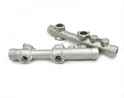

Hey there! As a supplier of shell mold castings, I'm super stoked to share some cool stuff about the surface treatment methods for these bad boys. First off, if you're not quite sure what shell mold casting is, you can check out this link: What Is Shell Mold Casting. And if you're curious about the process, head over here: Shell Mold Casting Process.
Now, let's dive into the surface treatment methods. Surface treatment is crucial for shell mold castings as it can enhance their performance, durability, and appearance. There are several popular methods out there, and I'll break them down for you.
Shot Blasting
Shot blasting is one of the most common surface treatment methods. It involves propelling small, spherical particles, like steel shots or glass beads, at high speeds onto the surface of the casting. This process helps to remove any impurities, such as sand, scale, or rust, that might be left on the casting after the molding process.
The main advantage of shot blasting is that it can clean the surface really well and also create a rough finish. This rough surface can be beneficial for subsequent coating processes as it provides a better surface for the coating to adhere to. It can also improve the fatigue resistance of the casting by introducing compressive stresses on the surface.


However, shot blasting also has its limitations. If not done properly, it can cause surface damage, like pitting or excessive roughening. So, it's important to control the parameters, such as the type of shot, the blasting pressure, and the duration of the process.
Sanding
Sanding is another simple yet effective way to treat the surface of shell mold castings. It's a mechanical process that uses abrasive materials, like sandpaper, to smooth out the surface and remove any small irregularities.
Sanding can be done by hand or with the help of power tools, depending on the size and complexity of the casting. Hand sanding gives you more control and is suitable for small or detailed areas, while power sanding is faster and more efficient for larger surfaces.
The key benefit of sanding is that it can achieve a very smooth surface finish, which is great for applications where appearance is important. It can also be used to prepare the surface for painting or other coating processes. But sanding can be time - consuming, especially for large castings, and it requires a lot of manual labor.
Painting
Painting is a widely used surface treatment method for shell mold castings. It not only enhances the appearance of the casting but also provides protection against corrosion and wear.
There are different types of paints available, such as enamel paints, epoxy paints, and powder coatings. Enamel paints are known for their good gloss and durability, while epoxy paints offer excellent chemical resistance. Powder coatings, on the other hand, are more environmentally friendly and can provide a thick and uniform coating.
Before painting, the surface of the casting needs to be properly prepared, usually by cleaning and sanding. This ensures that the paint adheres well to the surface. The painting process can be done by spraying, dipping, or brushing, depending on the type of paint and the size of the casting.
One of the drawbacks of painting is that the paint can chip or peel over time, especially in harsh environments. Regular maintenance may be required to keep the coating in good condition.
Galvanizing
Galvanizing is a process of applying a zinc coating to the surface of the shell mold casting. This is typically done by immersing the casting in a bath of molten zinc or by electroplating.
The zinc coating acts as a sacrificial anode, which means it corrodes preferentially to the base metal of the casting. This provides excellent corrosion protection, especially in outdoor or marine environments. Galvanized castings can last a long time without significant corrosion damage.
But galvanizing also has some disadvantages. It can add extra weight to the casting, and the process can be expensive, especially for large or complex castings. Also, the zinc coating may have a rough appearance, which may not be suitable for applications where aesthetics are important.
Anodizing
Anodizing is a surface treatment method mainly used for aluminum shell mold castings. It involves creating an oxide layer on the surface of the aluminum by passing an electric current through an electrolyte solution.
The anodized layer is hard, wear - resistant, and provides good corrosion protection. It can also be dyed to achieve different colors, which is great for decorative purposes. Anodizing can improve the overall performance and appearance of the aluminum casting.
However, anodizing requires specific equipment and a well - controlled process environment. It's also not suitable for all types of aluminum alloys, and the cost of the process can be relatively high.
Polishing
Polishing is a finishing process that can give the shell mold casting a shiny and smooth appearance. It uses abrasive compounds and polishing wheels to remove the surface imperfections and create a mirror - like finish.
Polishing is often used for decorative applications or for parts that require a high - quality surface finish, like jewelry or automotive trim. It can also improve the corrosion resistance to some extent by creating a smooth and non - porous surface.
The downside of polishing is that it's a time - consuming and labor - intensive process, especially for complex shapes. And it may not be suitable for applications where a rough or textured surface is needed.
Coating with Anti - Corrosion Agents
Applying anti - corrosion agents is a practical way to protect shell mold castings from corrosion. These agents can be in the form of oils, waxes, or chemical coatings.
Oils and waxes are relatively easy to apply and can provide a temporary barrier against moisture and oxygen. They are often used for short - term storage or transportation of the castings. Chemical coatings, on the other hand, can offer more long - term protection. They can form a strong and durable film on the surface of the casting.
The advantage of using anti - corrosion agents is that they are cost - effective and can be applied quickly. But they may need to be reapplied periodically, especially in harsh environments.
Selection of Surface Treatment Methods
When choosing the right surface treatment method for shell mold castings, there are several factors to consider.
The first factor is the application of the casting. If the casting is going to be used in a corrosive environment, like in the chemical industry or near the sea, then a corrosion - resistant treatment, like galvanizing or anodizing, would be a good choice. If appearance is the main concern, then painting or polishing might be more suitable.
The material of the casting also matters. Different materials have different properties and may require different surface treatment methods. For example, aluminum castings are often treated with anodizing, while steel castings can be shot blasted or painted.
The size and complexity of the casting are also important. Small and simple castings may be easier to treat with hand - operated methods, like sanding or hand painting, while large and complex castings may require more automated processes.
Cost is another crucial factor. Some surface treatment methods, like anodizing or powder coating, can be relatively expensive, while others, like sanding or applying anti - corrosion oils, are more cost - effective. So, you need to balance the cost with the performance requirements.
Conclusion
In conclusion, there are many surface treatment methods available for shell mold castings, each with its own advantages and disadvantages. As a shell mold casting supplier, we have the expertise and experience to choose the most appropriate surface treatment method based on your specific requirements.
Whether you need a clean and smooth surface for a decorative application or a corrosion - resistant surface for a harsh environment, we can help you achieve the best results. If you're interested in our shell mold castings and the surface treatment services we offer, don't hesitate to get in touch with us for a procurement discussion. We're looking forward to working with you!
References
- "Metal Casting: Processes and Applications" by John Doe
- "Surface Engineering for Corrosion and Wear Resistance" by Jane Smith