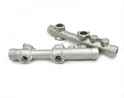

Investment casting, also known as lost-wax casting, is a highly versatile and precise manufacturing process that allows for the production of complex and detailed parts with excellent surface finish and dimensional accuracy. As an Investment Casting supplier, I understand the importance of machining requirements after investment casting to ensure the final product meets the desired specifications and quality standards. In this blog post, I will discuss the key machining requirements after investment casting and how they contribute to the overall success of the manufacturing process.
Understanding Investment Casting
Before delving into the machining requirements, it is essential to have a basic understanding of the investment casting process. Investment casting involves creating a wax pattern of the desired part, which is then coated with a ceramic shell. The wax is melted out, leaving a cavity in the ceramic shell. Molten metal is poured into the cavity, filling it and taking the shape of the original wax pattern. Once the metal solidifies, the ceramic shell is broken away, revealing the cast part.
Investment casting offers several advantages, including the ability to produce parts with intricate geometries, thin walls, and fine details. It also provides excellent surface finish and dimensional accuracy, reducing the need for extensive machining. However, some machining operations are still necessary to achieve the final dimensions, surface finish, and functionality of the part.
For more information about investment casting, you can visit What Is Investment Casting. To learn about the investment casting supplies we offer, check out Investment Casting Supplies. And for a detailed overview of the investment casting process, visit Investment Casting Process.
Machining Requirements After Investment Casting
1. Surface Finish Improvement
Although investment casting can produce parts with a relatively smooth surface finish, additional machining may be required to achieve the desired surface roughness. Surface finish is crucial for several reasons, including aesthetics, corrosion resistance, and the ability to form a proper seal or fit with other components.
Common machining operations used to improve surface finish include grinding, polishing, and lapping. Grinding is a precision machining process that uses an abrasive wheel to remove small amounts of material from the surface of the part, resulting in a smooth and flat finish. Polishing involves using abrasive compounds and polishing wheels to further refine the surface, reducing surface roughness and enhancing the appearance of the part. Lapping is a similar process that uses a lapping plate and abrasive slurry to achieve an extremely smooth and flat surface finish.
2. Dimensional Accuracy
While investment casting can achieve high dimensional accuracy, some parts may require additional machining to meet the exact specifications. Machining operations such as turning, milling, and drilling are commonly used to achieve the desired dimensions and tolerances.


Turning is a machining process that involves rotating the part while a cutting tool removes material from the outer diameter. It is used to create cylindrical shapes, such as shafts and bushings. Milling is a versatile machining process that uses a rotating cutting tool to remove material from the surface of the part. It can be used to create flat surfaces, slots, and complex geometries. Drilling is a process used to create holes in the part, which may be required for assembly or to accommodate other components.
3. Feature Creation
Investment casting may not be able to create all the features required for a part, such as threads, keyways, or internal passages. Machining operations are necessary to add these features to the cast part.
Threading is a process used to create threads on the part, which can be used for fastening or to mate with other threaded components. Keyways are slots machined into the part to accommodate keys, which are used to transmit torque between shafts and other components. Internal passages, such as coolant channels or fluid passages, may require specialized machining techniques, such as electrical discharge machining (EDM) or electrochemical machining (ECM), to create the desired shape and size.
4. Deburring and Edge Finishing
After investment casting, the part may have burrs, sharp edges, or flash, which are unwanted projections of material that can affect the functionality and safety of the part. Deburring and edge finishing operations are necessary to remove these burrs and sharp edges and to create a smooth and rounded edge.
Deburring can be done manually using hand tools, such as files and sandpaper, or using automated deburring machines. Edge finishing operations, such as chamfering and rounding, are used to create a smooth and beveled edge, which can improve the appearance of the part and prevent damage to other components during assembly.
5. Heat Treatment and Surface Hardening
Some parts may require heat treatment or surface hardening to improve their mechanical properties, such as hardness, strength, and wear resistance. Heat treatment involves heating the part to a specific temperature and then cooling it at a controlled rate to achieve the desired microstructure and properties. Surface hardening techniques, such as carburizing, nitriding, and induction hardening, are used to increase the hardness and wear resistance of the surface of the part.
After heat treatment or surface hardening, additional machining may be required to remove any distortion or scale that may have occurred during the process and to restore the dimensional accuracy and surface finish of the part.
Factors Affecting Machining Requirements
Several factors can affect the machining requirements after investment casting, including the part design, material properties, and the intended application of the part.
1. Part Design
The complexity of the part design can significantly impact the machining requirements. Parts with intricate geometries, thin walls, or internal features may require more extensive machining operations to achieve the desired dimensions and functionality. Additionally, parts with tight tolerances or specific surface finish requirements may also require more precise machining.
2. Material Properties
The material used for investment casting can also affect the machining requirements. Different materials have different machining characteristics, such as hardness, ductility, and machinability. Harder materials may require more aggressive machining techniques and specialized cutting tools, while softer materials may be more easily machined but may also be more prone to deformation.
3. Intended Application
The intended application of the part will also determine the machining requirements. Parts that are used in high-stress applications, such as aerospace or automotive components, may require more precise machining and higher-quality surface finishes to ensure their reliability and performance. On the other hand, parts used in less critical applications may have more relaxed machining requirements.
Conclusion
As an Investment Casting supplier, I understand the importance of machining requirements after investment casting to ensure the final product meets the desired specifications and quality standards. Surface finish improvement, dimensional accuracy, feature creation, deburring and edge finishing, and heat treatment are all important machining operations that may be required after investment casting.
By carefully considering the part design, material properties, and intended application, we can determine the most appropriate machining processes and techniques to achieve the best results. Our team of experienced engineers and machinists is dedicated to providing high-quality investment casting and machining services to meet the needs of our customers.
If you are interested in learning more about our investment casting and machining services or have a specific project in mind, please feel free to contact us. We would be happy to discuss your requirements and provide you with a detailed quote.
References
- ASM Handbook, Volume 16: Machining, ASM International
- Machinery's Handbook, Industrial Press Inc.
- Manufacturing Engineering and Technology, S. Kalpakjian and S. R. Schmid