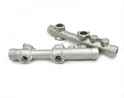

Hey there! As a supplier of gray iron casting, I've been knee - deep in this industry for quite some time. Today, I'm gonna break down the machining characteristics of gray iron casting for you.
1. Good Machinability
One of the most notable things about gray iron casting is its excellent machinability. Gray iron contains graphite flakes. These graphite flakes act as built - in lubricants during the machining process. When a cutting tool is working on gray iron, the graphite flakes can reduce the friction between the tool and the workpiece. This means that you can use relatively lower cutting forces compared to other metals.
For example, when you're turning a gray iron part on a lathe, the tool can glide through the material more smoothly. You won't have to push as hard on the tool, which not only makes the machining process easier but also extends the life of the cutting tool. This is a huge plus for manufacturers because it reduces tool wear and replacement costs.
2. Surface Finish
Gray iron casting can achieve a pretty good surface finish after machining. The graphite flakes in gray iron have a kind of self - chip - breaking property. During the cutting process, the chips break into small pieces easily, which helps prevent chip - related issues like chip jamming or poor surface finish caused by long, stringy chips.
When you're milling a gray iron surface, you'll notice that the finished surface looks clean and smooth. You don't have to spend a lot of extra time on secondary finishing operations like grinding in many cases. This is a great advantage, especially when you're looking to produce parts with a high - quality surface finish quickly and cost - effectively.
3. Dimensional Stability
Gray iron has good dimensional stability during machining. It has a relatively low coefficient of thermal expansion. This means that when heat is generated during the machining process (and let's face it, there's always some heat when you're cutting metal), the gray iron part won't expand or contract too much.
Let's say you're boring a hole in a gray iron casting. The heat from the boring operation won't cause the casting to warp or change its dimensions significantly. This allows for more accurate machining and better control over the final part dimensions. You can be more confident that the part you machine will meet the required tolerances.
4. Chip Formation
As I mentioned earlier, the graphite flakes in gray iron play a big role in chip formation. The chips produced during machining of gray iron are usually short and broken. This is in contrast to some other metals, like stainless steel, which can produce long, continuous chips that are difficult to handle.
Short chips are easier to remove from the machining area. They don't get tangled around the cutting tool or in the machine, which reduces the risk of machine downtime due to chip - related problems. In a production environment, this can lead to increased productivity and fewer headaches for the operators.
5. Cutting Speed and Feed Rate
Gray iron casting allows for a relatively wide range of cutting speeds and feed rates. You can adjust these parameters according to your specific machining requirements. If you need to machine a part quickly, you can increase the cutting speed and feed rate to some extent without sacrificing too much on the surface finish or tool life.
However, it's important to find the right balance. If you go too fast with the cutting speed or feed rate, you might end up with a poor surface finish or excessive tool wear. But overall, compared to some other metals, gray iron gives you more flexibility in choosing the machining parameters.
6. Comparison with Other Casting Materials
When we compare gray iron casting with other casting materials like Casting Steel Precision Parts, there are some clear differences. Steel castings generally have higher strength and hardness, but they are also more difficult to machine. The cutting forces required for steel castings are usually higher, and the tool wear is more significant.
On the other hand, High Manganese Steel Casting is known for its high wear resistance, but it can be extremely tough to machine. The work - hardening tendency of high manganese steel makes the machining process more challenging.
High Chromium Iron Casting has excellent corrosion and wear resistance, but similar to high manganese steel, it can be difficult to machine due to its high hardness. Gray iron, with its good machinability, offers a more cost - effective and easier - to - machine alternative in many applications.
7. Applications
The machining characteristics of gray iron casting make it suitable for a wide range of applications. It's commonly used in the automotive industry for engine blocks, cylinder heads, and brake components. The good machinability allows for the production of complex shapes and precise dimensions required in these parts.
In the machinery industry, gray iron is used to make machine tool bases, gears, and pulleys. The ability to achieve a good surface finish and dimensional stability is crucial for these components to function properly.
8. Challenges in Machining Gray Iron
Of course, machining gray iron isn't all sunshine and rainbows. One of the challenges is the presence of hard spots in the casting. These hard spots can be caused by various factors such as impurities or uneven cooling during the casting process. When the cutting tool encounters a hard spot, it can cause sudden tool wear or even breakage.
Another challenge is the dust generated during machining. The graphite in gray iron can create fine dust particles, which can be a health hazard if proper dust collection systems aren't in place.
9. Tips for Machining Gray Iron
To overcome the challenges in machining gray iron, here are some tips. First, make sure to use the right cutting tools. Carbide - tipped tools are often a good choice because they can withstand the abrasiveness of gray iron.
Second, use proper coolant. Coolant not only helps to reduce the heat generated during machining but also flushes away the chips and dust.


Third, inspect the castings before machining. Look for any visible hard spots or defects and take appropriate measures, such as pre - machining the hard spots or adjusting the machining parameters.
Conclusion
In conclusion, gray iron casting has some really great machining characteristics. Its good machinability, surface finish, dimensional stability, and chip formation make it a popular choice in many industries. Although there are some challenges, with the right tools and techniques, these can be easily overcome.
If you're in the market for gray iron castings or have any questions about the machining process, don't hesitate to reach out. We're here to help you with all your gray iron casting needs and can work with you to find the best solutions for your specific applications.
References
- "Machining of Metals: An Introduction" by John A. Schey
- "Cast Iron Technology Handbook" by the American Foundry Society