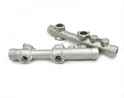

Hey there! As a supplier of Shell Mold Casting, I've seen firsthand how various factors can impact the quality of the final product. In this blog, I'll break down these factors and explain why they matter.
1. Pattern Design
The first step in shell mold casting is creating a pattern. This pattern is like a blueprint for the final casting. A well - designed pattern is crucial for a high - quality shell mold casting.
The dimensions of the pattern need to be extremely accurate. Even a small deviation can lead to a casting that doesn't meet the required specifications. For example, if the pattern is a bit larger than it should be, the final casting will also be oversized, which might cause problems when it comes to fitting the part into a larger assembly.
The surface finish of the pattern is also important. A smooth pattern surface will result in a smoother surface on the shell mold, and ultimately, on the casting. Rough patterns can cause rough spots on the casting, which might affect its functionality or aesthetic appeal.
Another aspect of pattern design is the draft angle. Draft angles are slopes added to the vertical walls of the pattern. They help in the easy removal of the pattern from the shell mold. Without proper draft angles, the pattern can get stuck in the mold, causing damage to the mold or the pattern itself, and resulting in a flawed casting.
You can learn more about the overall process on our Shell Mold Casting Process page.
2. Resin and Sand Selection
The materials used to make the shell mold, namely resin and sand, play a huge role in the quality of the casting.
Resin is the binder that holds the sand particles together in the shell mold. Different types of resins have different properties. For instance, some resins are more heat - resistant than others. In high - temperature casting processes, using a resin with low heat resistance can cause the shell mold to break down during casting, leading to a defective casting.
The quality of the resin also matters. A high - quality resin will provide better adhesion between the sand particles, resulting in a stronger shell mold. Low - quality resins might not hold the sand together well, causing the mold to crumble or develop cracks.
Sand is the main component of the shell mold. The grain size of the sand is a critical factor. Fine - grained sand can produce a smoother surface finish on the casting, but it might have lower permeability. Permeability is important because it allows the gases generated during casting to escape. If the sand has low permeability, the gases can get trapped in the casting, creating porosity. On the other hand, coarse - grained sand has higher permeability but might result in a rougher surface finish. So, finding the right balance in sand grain size is essential.
3. Shell Mold Manufacturing Process
How the shell mold is made can significantly affect the quality of the casting.
The temperature during the shell molding process is a key variable. If the temperature is too low, the resin might not cure properly, resulting in a weak shell mold. A weak mold can break during the casting process, causing the molten metal to leak and ruining the casting. On the other hand, if the temperature is too high, the resin can over - cure, making the mold brittle and more prone to cracking.


The thickness of the shell mold is also important. A shell mold that is too thin might not be strong enough to withstand the pressure of the molten metal during casting. This can lead to mold failure and a defective casting. A shell mold that is too thick, however, can increase the cost of production and might also cause longer cooling times for the casting, which can lead to other issues like shrinkage.
The way the sand - resin mixture is applied to the pattern also affects the quality of the shell mold. If the application is uneven, the shell mold will have inconsistent thickness, which can cause problems during casting.
To understand the basics of shell mold casting, check out our What Is Shell Mold Casting page.
4. Melting and Pouring of the Metal
The melting and pouring of the metal are critical steps in shell mold casting.
The quality of the metal itself is the first consideration. Impurities in the metal can cause defects in the casting. For example, if there are oxides in the molten metal, they can form inclusions in the casting, which can weaken the part and reduce its performance.
The melting temperature of the metal needs to be carefully controlled. If the temperature is too low, the metal might not flow properly into all the details of the shell mold, resulting in a casting with incomplete features. If the temperature is too high, it can cause excessive thermal stress on the shell mold, leading to mold damage and a poor - quality casting.
The pouring speed and technique are also important. A slow pouring speed can cause the metal to cool too quickly before it fills the entire mold, resulting in a casting with voids. A fast pouring speed, on the other hand, can cause turbulence in the molten metal, which can trap gases and lead to porosity in the casting.
5. Cooling and Solidification
After the metal is poured into the shell mold, the cooling and solidification process can have a big impact on the quality of the casting.
The rate of cooling affects the microstructure of the casting. A slow cooling rate can result in a coarser microstructure, which might reduce the strength and hardness of the casting. A fast cooling rate, however, can cause internal stresses in the casting, leading to cracking.
Controlling the cooling environment is also crucial. Uneven cooling can cause differential shrinkage in the casting, which can lead to warping or distortion. For example, if one part of the casting cools faster than another, the faster - cooling part will shrink more, causing the casting to bend or twist.
6. Post - Casting Processes
Once the casting is solidified, post - casting processes like cleaning, heat treatment, and machining can also affect the final quality.
Cleaning the casting is necessary to remove any residual sand or other contaminants from the surface. If the cleaning is not done properly, these contaminants can affect the surface finish and the performance of the casting.
Heat treatment can improve the mechanical properties of the casting. For example, annealing can relieve internal stresses, while quenching and tempering can increase the hardness and strength of the casting. However, if the heat treatment parameters are not set correctly, it can have a negative impact on the quality of the casting.
Machining is often required to achieve the final dimensions and surface finish of the casting. Poor machining practices can result in dimensional inaccuracies or a rough surface finish, which can make the casting unsuitable for its intended application.
In conclusion, the quality of shell mold casting is influenced by a wide range of factors, from pattern design to post - casting processes. As a Shell Mold Casting supplier, we take great care in every step of the process to ensure that we deliver high - quality castings to our customers.
If you're in the market for shell mold castings and want to discuss your requirements, we'd love to hear from you. Whether you need a small - scale production or a large - volume order, we have the expertise and resources to meet your needs. Contact us to start a conversation about your project and how we can help you get the best - quality shell mold castings.
References
- "The Science and Engineering of Materials" by Donald R. Askeland and Pradeep P. Phule
- "Foundry Engineering" by J. Campbell