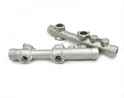

Hey there! As a supplier of Lost Wax Aluminum Casting, I've been in the business for quite a while, and I've seen firsthand the importance of getting the design right. Lost wax aluminum casting is a super cool process that lets you create some really detailed and complex parts. But there are a bunch of things you need to think about when designing for this method. So, let's dive into the design considerations for lost wax aluminum casting.
Part Geometry
One of the first things you gotta look at is the part geometry. Lost wax casting is great for making parts with intricate details, thin walls, and complex shapes. But there are still some limitations. For example, sharp corners and edges can cause problems during the casting process. They can lead to stress concentrations, which might result in cracks in the final part. So, it's a good idea to round off those corners and edges as much as possible. A radius of at least 0.5 mm is usually recommended.
Another aspect of geometry is draft angles. Draft angles are the slight tapers you add to the vertical walls of a part. They're crucial because they help the part come out of the mold easily. Without proper draft angles, the part might get stuck in the mold, causing damage to both the part and the mold. A draft angle of 1 - 3 degrees is typically sufficient, but it can vary depending on the size and complexity of the part.
Undercuts are also something to watch out for. Undercuts are features that prevent the part from being pulled out of the mold in a straight line. In lost wax casting, undercuts can be a real pain. They often require more complex mold designs or additional steps in the casting process. If possible, try to avoid undercuts or design them in a way that they can be easily removed or accommodated.
Wall Thickness
Wall thickness is another key consideration. In lost wax aluminum casting, you want to keep the wall thickness as uniform as possible. Uneven wall thickness can lead to issues like shrinkage porosity, where voids form in the part as the metal cools and shrinks. If the walls are too thick in some areas and too thin in others, the thick areas will cool more slowly, causing the metal to pull away from the thin areas and creating these voids.
As a general rule, the minimum wall thickness for lost wax aluminum casting is around 1.5 - 2 mm. However, this can vary depending on the size and complexity of the part. For larger parts, you might need slightly thicker walls to ensure proper filling of the mold. On the other hand, if you're making a very small and detailed part, you might be able to get away with thinner walls, but you need to be extra careful to avoid issues like incomplete filling.
Tolerances
Tolerances are the allowable variations in the dimensions of a part. When designing for lost wax aluminum casting, you need to be realistic about the tolerances you can achieve. Lost wax casting can produce parts with relatively high precision, but there are still some factors that can affect the final dimensions.
Factors like the thermal expansion and contraction of the metal, the accuracy of the pattern-making process, and the properties of the mold material can all contribute to dimensional variations. Generally, a tolerance of ±0.1 - 0.2 mm is achievable for most lost wax aluminum cast parts. But for more critical dimensions, you might need to work closely with your casting supplier to ensure that the required tolerances can be met.
Surface Finish
The surface finish of a part is often an important consideration, especially if the part will be visible or if it needs to mate with other components. Lost wax casting can produce parts with a relatively smooth surface finish right out of the mold, but there are still some factors that can affect it.
The quality of the pattern used in the casting process plays a big role in the surface finish. A high - quality pattern with a smooth surface will result in a better - finished part. Also, the type of mold material and the casting process itself can impact the surface finish. After casting, additional finishing operations like grinding, polishing, or sandblasting might be required to achieve the desired surface quality.
Material Selection
Even though we're talking about aluminum casting, there are different types of aluminum alloys to choose from. Each alloy has its own unique properties, such as strength, ductility, corrosion resistance, and heat resistance.
For example, if the part will be used in a high - stress application, you might choose an alloy with high strength, like 6061 or 7075 aluminum. If corrosion resistance is a major concern, an alloy like 3003 or 5052 might be a better choice. It's important to work with your casting supplier to select the right alloy for your specific application.
Assembly and Joining
If your part will be part of an assembly, you need to consider how it will be joined to other components. Lost wax casting allows for the creation of parts with built - in features for assembly, such as holes, threads, or bosses. But you need to design these features carefully to ensure proper fit and function.
For example, if you're adding threads to a part, you need to make sure that the thread size and pitch are compatible with the mating components. Also, if the part will be welded or brazed to other parts, you need to design the joint area to provide good access and proper fusion.
Cost Considerations
Last but not least, cost is always a factor. The design of a part can have a significant impact on the cost of lost wax aluminum casting. Complex geometries, tight tolerances, and high - quality surface finishes usually mean higher costs.


For example, parts with a lot of undercuts or intricate details will require more complex mold designs and longer production times, which will increase the cost. So, when designing a part, you need to find a balance between the desired functionality and the cost. You might be able to simplify the design in some areas without sacrificing too much performance, which can help reduce the overall cost.
If you're interested in Stainless Steel Investment Casting, Alloy Steel Investment Casting, or Stainless Steel Lost Wax Casting, we can also provide related services.
In conclusion, designing for lost wax aluminum casting involves a careful consideration of many factors, from part geometry and wall thickness to tolerances, surface finish, material selection, assembly, and cost. By keeping these design considerations in mind and working closely with a reliable casting supplier, you can ensure that you get high - quality, cost - effective parts that meet your specific requirements.
If you're looking for a lost wax aluminum casting supplier and have any questions or need a quote for your project, don't hesitate to reach out. We're here to help you turn your design ideas into reality.
References
- ASM Handbook, Volume 15: Casting. ASM International.
- Aluminum Association Technical Papers on Aluminum Alloys and Casting Processes.
- Modern Casting Magazine Articles on Investment Casting Technology.