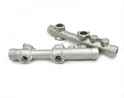

As a gray iron casting supplier, I've witnessed firsthand the evolving landscape of the industry, particularly the growing emphasis on environmental sustainability. Gray iron casting has long been a staple in various sectors due to its excellent castability, good machinability, and cost - effectiveness. However, like many manufacturing processes, it has environmental impacts that we need to address. In this blog, I'll share some strategies on how to make gray iron casting more environmentally friendly.
Optimize the Melting Process
The melting process is a crucial part of gray iron casting. Traditional melting methods often consume large amounts of energy and generate significant emissions. One way to improve this is by using more efficient melting equipment. For example, induction furnaces are becoming increasingly popular in the industry. They offer several advantages over traditional cupola furnaces. Induction furnaces have a higher energy efficiency, which means they can melt the iron with less energy input. According to industry research, induction furnaces can reduce energy consumption by up to 30% compared to cupola furnaces. This not only cuts down on the overall energy usage but also reduces the associated greenhouse gas emissions.
Another aspect of optimizing the melting process is to carefully control the input materials. By using high - quality scrap iron and carefully proportioning the alloying elements, we can ensure a more efficient melting process. High - quality scrap iron has fewer impurities, which means less energy is wasted in removing them during the melting process. Additionally, precise control of alloying elements can improve the quality of the final casting, reducing the need for re - melting and re - working defective parts.
Improve the Molding and Core - Making Process
The molding and core - making process in gray iron casting can also have a significant environmental impact. Traditional molding sands often contain chemicals and binders that can release harmful substances during the casting process. To address this, we can switch to more environmentally friendly molding materials. For instance, some foundries are now using inorganic binders instead of organic binders. Inorganic binders are non - toxic and do not release volatile organic compounds (VOCs) during the casting process. This reduces air pollution and creates a healthier working environment for the employees.
Recycling of molding sand is another important strategy. Instead of discarding used sand after each casting cycle, we can reclaim and reuse it. Sand reclamation systems can remove impurities and restore the sand to a usable state. This not only reduces the amount of new sand that needs to be mined but also reduces the waste generated by the casting process. Some advanced sand reclamation systems can achieve a sand recycling rate of up to 90%, which is a significant improvement in environmental sustainability.
Reduce Waste and Emissions in the Finishing Process
The finishing process of gray iron casting, including cleaning, machining, and surface treatment, can generate a considerable amount of waste and emissions. To reduce waste, we can implement lean manufacturing principles. Lean manufacturing focuses on eliminating non - value - added activities and reducing waste in all forms. For example, by improving the accuracy of the casting process, we can reduce the amount of material that needs to be removed during machining. This not only saves raw materials but also reduces the energy and time required for machining.
In terms of emissions, we can invest in advanced air pollution control equipment. For example, dust collectors can be installed in the machining and cleaning areas to capture and remove dust particles from the air. Additionally, for surface treatment processes that involve painting or coating, we can use water - based paints and coatings instead of solvent - based ones. Water - based paints and coatings have lower VOC content, which reduces air pollution.
Explore Alternative Casting Technologies
In addition to optimizing the existing processes, we can also explore alternative casting technologies that are more environmentally friendly. One such technology is Ductile Iron Casting. Ductile iron has better mechanical properties than gray iron in some aspects, and the casting process can be more energy - efficient. Ductile iron casting often requires less energy during the melting and solidification process due to its unique microstructure.


Another alternative is Nodular Iron Casting. Nodular iron has similar advantages to ductile iron, and its production process can be designed to be more environmentally friendly. By exploring these alternative casting technologies, we can not only improve the environmental performance of our casting operations but also offer our customers a wider range of high - quality products.
Collaborate with Suppliers and Customers
Making gray iron casting more environmentally friendly is not a task that can be achieved alone. We need to collaborate with our suppliers and customers. With suppliers, we can work together to source more sustainable raw materials. For example, we can encourage our scrap iron suppliers to improve their sorting and cleaning processes to provide us with higher - quality scrap. We can also collaborate with suppliers of molding materials and alloying elements to develop more environmentally friendly products.
On the customer side, we can educate them about the environmental benefits of our sustainable casting products. By raising awareness among our customers, we can create a demand for more environmentally friendly gray iron castings. This can also lead to long - term partnerships based on shared environmental values.
Conclusion
In conclusion, making gray iron casting more environmentally friendly is a multi - faceted challenge that requires a comprehensive approach. By optimizing the melting process, improving the molding and core - making process, reducing waste and emissions in the finishing process, exploring alternative casting technologies, and collaborating with suppliers and customers, we can significantly reduce the environmental impact of gray iron casting.
As a Gray Iron Casting supplier, I am committed to leading the way in sustainable casting practices. We believe that by adopting these strategies, we can not only contribute to a greener planet but also enhance the competitiveness of our business in the long run.
If you are interested in our environmentally friendly gray iron casting products or have any questions about our sustainable casting practices, please feel free to contact us for procurement and further discussions. We look forward to working with you to achieve a more sustainable future in the casting industry.
References
- Smith, J. (2020). "Advances in Sustainable Casting Technologies". Journal of Manufacturing and Sustainability, 15(2), 78 - 89.
- Johnson, A. (2019). "Environmental Impact of Iron Casting Processes and Mitigation Strategies". International Journal of Environmental Science and Technology, 12(3), 456 - 468.
- Brown, C. (2021). "Lean Manufacturing in the Casting Industry: Reducing Waste and Emissions". Manufacturing Review, 22(4), 56 - 67.