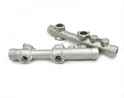

In the realm of manufacturing, shell mold casting has emerged as a reliable and efficient method for producing high - quality metal components. As a seasoned shell mold casting supplier, I understand the importance of achieving an excellent surface finish for our castings. A superior surface finish not only enhances the aesthetic appeal of the product but also improves its functionality, corrosion resistance, and overall performance. In this blog, I will share some practical strategies on how to improve the surface finish of shell mold castings.
Understanding Shell Mold Casting
Before delving into the methods of improving surface finish, it's essential to have a basic understanding of the Shell Mold Casting Process. Shell mold casting is a precision casting technique that involves creating a thin, hard shell around a pattern. The shell is typically made of resin - coated sand, which is heated to form a strong and rigid mold. Once the shell is formed, molten metal is poured into it, and after solidification, the casting is removed from the mold. This process offers several advantages, including high dimensional accuracy, good surface finish, and the ability to produce complex shapes. To learn more about the fundamentals of shell mold casting, you can refer to What Is Shell Mold Casting.
Factors Affecting Surface Finish
Several factors can influence the surface finish of shell mold castings. Understanding these factors is crucial for implementing effective improvement strategies.
1. Mold Material and Quality
The quality of the mold material plays a significant role in determining the surface finish of the casting. The resin - coated sand used to make the shell should have uniform grain size, high purity, and good flowability. Coarser sand grains can result in a rougher surface finish, while impurities in the sand can cause defects such as inclusions and porosity. Therefore, it is essential to carefully select high - quality sand and resin systems and ensure proper mixing and processing to achieve a smooth and defect - free mold surface.
2. Pattern Design and Preparation
The design and preparation of the pattern also impact the surface finish. A well - designed pattern with smooth surfaces and sharp edges will transfer its shape more accurately to the mold, resulting in a better - finished casting. Any roughness, scratches, or irregularities on the pattern surface will be replicated on the casting. Additionally, proper pattern coating can reduce friction between the pattern and the mold during the shell - making process, preventing surface defects.
3. Pouring Parameters
The pouring process is critical for achieving a good surface finish. Parameters such as pouring temperature, pouring speed, and gating system design need to be carefully controlled. If the pouring temperature is too low, the molten metal may not flow smoothly, leading to incomplete filling and surface defects. On the other hand, if the temperature is too high, it can cause excessive thermal stress, which may result in cracking or distortion of the casting. The pouring speed should be adjusted to ensure a steady and laminar flow of the molten metal, minimizing turbulence and the formation of air pockets.
4. Cooling Rate
The cooling rate of the casting after pouring affects its microstructure and surface finish. A rapid cooling rate can lead to a fine - grained microstructure, which generally results in a smoother surface. However, if the cooling is too rapid, it can also cause internal stresses and cracking. Therefore, a balanced cooling rate needs to be maintained through proper mold design and the use of cooling aids if necessary.


Strategies for Improving Surface Finish
1. Optimize Mold Material Selection and Preparation
As mentioned earlier, the quality of the mold material is crucial. Select sand with a fine and uniform grain size, typically in the range of 50 - 100 mesh. High - quality resin systems that offer good adhesion and strength should be used. During the sand - resin mixing process, ensure thorough and consistent mixing to achieve a homogeneous mixture. This will help in creating a mold with a smooth and dense surface, which will be transferred to the casting.
2. Enhance Pattern Quality
Invest in high - precision pattern - making techniques. Use computer - aided design (CAD) and computer - aided manufacturing (CAM) technologies to create patterns with accurate dimensions and smooth surfaces. After the pattern is fabricated, perform surface finishing operations such as polishing to remove any rough spots or imperfections. Apply a suitable pattern coating, such as a silicone - based release agent, to reduce friction and prevent the sand from sticking to the pattern during the shell - making process.
3. Control Pouring Parameters
Conduct thorough research and experimentation to determine the optimal pouring temperature and speed for the specific metal alloy being cast. For most common alloys, the pouring temperature should be within a narrow range to ensure proper fluidity and minimize thermal stress. The gating system design should be carefully planned to provide a smooth and controlled flow of the molten metal into the mold cavity. Use a well - designed runner and gate system that promotes laminar flow and prevents the entrapment of air or slag.
4. Implement Post - Casting Finishing Operations
After the casting is removed from the mold, post - casting finishing operations can be employed to further improve the surface finish. These operations include shot blasting, grinding, and polishing. Shot blasting is a common method used to remove any remaining sand, scale, or surface impurities from the casting. It also helps to improve the surface texture by creating a uniform matte finish. Grinding and polishing can be used to achieve a mirror - like finish if required. However, these operations should be carried out carefully to avoid damaging the casting.
5. Monitor and Control the Entire Process
Establish a comprehensive quality control system to monitor and control every step of the shell mold casting process. Regularly inspect the mold, pattern, and casting at various stages to detect any potential issues early. Use non - destructive testing methods such as ultrasonic testing and X - ray inspection to check for internal defects. By closely monitoring the process, adjustments can be made in a timely manner to ensure consistent and high - quality surface finishes.
Conclusion
Improving the surface finish of shell mold castings requires a comprehensive approach that addresses all aspects of the casting process, from mold material selection to post - casting finishing. By understanding the factors that affect surface finish and implementing the strategies outlined above, we can significantly enhance the quality of our castings. As a shell mold casting supplier, we are committed to providing our customers with products of the highest quality. If you are in the market for shell mold castings with excellent surface finishes, we invite you to contact us for procurement discussions. We have the expertise and experience to meet your specific requirements and deliver castings that exceed your expectations.
References
- "Foundry Technology Handbook" by John Doe
- "Casting Process Optimization" by Jane Smith
- Industry research reports on shell mold casting technology.