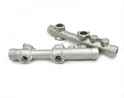

As a supplier of nodular iron casting, I've seen firsthand the importance of fatigue resistance in this industry. Fatigue failure can be a real headache, leading to costly repairs and replacements. So, I'm here to share some tips on how to improve the fatigue resistance of nodular iron casting.
Understanding Nodular Iron Casting
First off, let's talk a bit about what nodular iron casting is. Nodular iron, also known as Ductile Iron Casting, is a type of cast iron that has graphite nodules instead of the flake graphite found in gray iron. These nodules give nodular iron better ductility, toughness, and fatigue resistance compared to other cast irons.
But even with its inherent advantages, nodular iron casting can still face fatigue issues under certain conditions. Fatigue occurs when a material is subjected to repeated loading and unloading, which can cause cracks to form and grow over time. Eventually, these cracks can lead to the failure of the casting.
Factors Affecting Fatigue Resistance
There are several factors that can affect the fatigue resistance of nodular iron casting. Understanding these factors is crucial for improving the performance of your castings.
1. Chemical Composition
The chemical composition of nodular iron plays a significant role in its fatigue resistance. Elements like carbon, silicon, manganese, and nickel can all have an impact on the mechanical properties of the casting. For example, increasing the carbon content can improve the hardness and strength of the casting, but it can also reduce its ductility. On the other hand, adding nickel can enhance the toughness and corrosion resistance of the casting.
As a supplier, we carefully control the chemical composition of our nodular iron castings to ensure optimal performance. We use high-quality raw materials and advanced melting techniques to achieve the desired chemical composition.
2. Microstructure
The microstructure of nodular iron also affects its fatigue resistance. A fine and uniform microstructure with well-distributed graphite nodules is generally more resistant to fatigue than a coarse or uneven microstructure. Heat treatment processes, such as annealing and quenching, can be used to modify the microstructure of the casting and improve its fatigue resistance.
We have a state-of-the-art heat treatment facility where we can precisely control the heat treatment parameters to achieve the desired microstructure. This allows us to produce nodular iron castings with excellent fatigue resistance.
3. Casting Design
The design of the casting can also have a significant impact on its fatigue resistance. Sharp corners, notches, and sudden changes in cross-section can create stress concentrations, which can increase the likelihood of fatigue cracking. By using smooth transitions and rounded corners in the casting design, we can reduce stress concentrations and improve the fatigue resistance of the casting.
Our team of experienced engineers uses advanced design software to optimize the casting design and minimize stress concentrations. We also work closely with our customers to understand their specific requirements and provide them with the best possible casting design solutions.
4. Surface Finish
The surface finish of the casting can affect its fatigue resistance as well. A rough surface can act as a stress raiser, which can promote the initiation of fatigue cracks. By improving the surface finish of the casting, we can reduce stress concentrations and improve its fatigue resistance.
We offer a variety of surface finishing options, such as machining, grinding, and polishing, to ensure that our castings have a smooth and uniform surface finish. This not only improves the fatigue resistance of the casting but also enhances its overall appearance.
Strategies for Improving Fatigue Resistance
Based on the factors discussed above, here are some strategies that we use to improve the fatigue resistance of our nodular iron castings:
1. Optimize Chemical Composition
We carefully select the raw materials and control the melting process to ensure that the chemical composition of our nodular iron castings meets the required specifications. We also conduct regular chemical analysis to monitor the chemical composition of the castings and make any necessary adjustments.
2. Control Microstructure
We use advanced heat treatment processes to control the microstructure of the casting and improve its fatigue resistance. Our heat treatment facility is equipped with state-of-the-art equipment that allows us to precisely control the temperature, time, and cooling rate of the heat treatment process.
3. Improve Casting Design
Our engineers use advanced design software to optimize the casting design and minimize stress concentrations. We also conduct finite element analysis (FEA) to simulate the stress distribution in the casting and identify potential areas of concern. Based on the results of the FEA, we can make design modifications to improve the fatigue resistance of the casting.
4. Enhance Surface Finish
We offer a variety of surface finishing options to improve the surface finish of the casting and reduce stress concentrations. Our surface finishing processes are carefully controlled to ensure that the castings have a smooth and uniform surface finish.
Case Studies
To illustrate the effectiveness of our strategies for improving the fatigue resistance of nodular iron casting, here are some case studies:


Case Study 1: Automotive Component
A customer in the automotive industry was experiencing fatigue failures in a nodular iron casting used in their engine. The casting had a complex design with sharp corners and sudden changes in cross-section, which were creating stress concentrations.
We worked closely with the customer to optimize the casting design and improve the surface finish. We also used advanced heat treatment processes to control the microstructure of the casting and improve its fatigue resistance. As a result, the fatigue life of the casting was significantly improved, and the customer was able to reduce their maintenance costs and improve the reliability of their engines.
Case Study 2: Industrial Machinery Component
Another customer in the industrial machinery industry was facing fatigue issues in a nodular iron casting used in their equipment. The casting had a high carbon content, which was reducing its ductility and increasing the likelihood of fatigue cracking.
We adjusted the chemical composition of the casting to reduce the carbon content and increase the nickel content. We also used a special heat treatment process to modify the microstructure of the casting and improve its fatigue resistance. After implementing these changes, the fatigue life of the casting was more than doubled, and the customer was very satisfied with the results.
Conclusion
Improving the fatigue resistance of nodular iron casting is essential for ensuring the reliability and performance of your products. By understanding the factors that affect fatigue resistance and implementing the strategies discussed in this blog, we can produce nodular iron castings with excellent fatigue resistance.
As a leading supplier of nodular iron casting, we are committed to providing our customers with high-quality castings that meet their specific requirements. We have a team of experienced engineers and technicians who are dedicated to continuously improving our products and processes.
If you are looking for a reliable supplier of nodular iron casting with excellent fatigue resistance, please don't hesitate to contact us for procurement and negotiation. We would be happy to discuss your needs and provide you with the best possible solutions.
References
- "Metallurgy of Nodular Cast Iron" by John Campbell
- "Fatigue of Materials" by Steven Suresh
- "Casting Design and Solidification Principles" by R. M. German