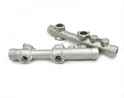

As a supplier of Nodular Iron Casting, ensuring the safety of our products during transportation and storage is of utmost importance. Nodular Iron Casting, known for its excellent mechanical properties and wide - ranging applications, requires careful handling to maintain its quality from the factory to the end - user. In this blog, I will share some key strategies and practices to guarantee the safety of Nodular Iron Casting throughout these processes.
Pre - transportation Preparation
Before the Nodular Iron Casting leaves our facility, a series of pre - transportation steps are essential. First, a thorough inspection of each casting is carried out. We check for any surface defects, cracks, or dimensional inaccuracies. This inspection not only ensures that the product meets the quality standards but also helps to identify any potential weak points that could be exacerbated during transportation.
Next, proper packaging is crucial. We use high - quality packaging materials that can withstand the rigors of transportation. For smaller Nodular Iron Castings, we often use wooden crates lined with shock - absorbing materials such as foam or rubber. These materials help to cushion the castings from impacts and vibrations. For larger castings, we may use custom - made steel frames or pallets, which provide a stable base and protect the castings from being damaged by other cargo.
In addition to physical protection, we also label the packages clearly. Each package is marked with information such as the product name, quantity, weight, and handling instructions. This helps the transportation personnel to handle the castings correctly and reduces the risk of mismanagement.
Transportation Considerations
When it comes to transporting Nodular Iron Casting, choosing the right transportation mode is vital. We have experience with different modes, including road, rail, and sea transportation, and each has its own set of considerations.
Road Transportation
Road transportation is often the most flexible option for short - to medium - distance deliveries. However, it also exposes the castings to various risks such as potholes, sudden stops, and rough roads. To mitigate these risks, we work with experienced logistics partners who have well - maintained trucks. The trucks are equipped with proper securing mechanisms, such as straps and chains, to keep the castings in place during transit.
We also pay attention to the loading and unloading processes. Trained workers are responsible for these tasks to ensure that the castings are handled gently. For example, when loading the castings onto the truck, we use forklifts or cranes with appropriate attachments to avoid any direct impact on the castings.
Rail Transportation
Rail transportation is suitable for long - distance and large - volume shipments. One of the advantages of rail is its relatively stable movement compared to road transportation. However, the loading and unloading at rail terminals can be more complex. We ensure that the castings are properly secured on the railcars using specialized fixtures. Additionally, we coordinate closely with the railway operators to ensure that the castings are protected from the elements during transit.
Sea Transportation
Sea transportation is often used for international shipments. When shipping Nodular Iron Casting by sea, we need to consider factors such as saltwater corrosion and rough sea conditions. We use waterproof and corrosion - resistant packaging materials to protect the castings. The containers are also inspected regularly during the voyage to ensure that there are no signs of damage or water ingress.
Moreover, we work with shipping companies that have a good safety record. They are responsible for the proper stowage of the containers on the ship to prevent any shifting or collision during the journey.
Storage Conditions
Once the Nodular Iron Casting arrives at the storage facility, proper storage conditions must be maintained.
Temperature and Humidity Control
Nodular Iron Casting can be affected by extreme temperatures and high humidity. High humidity can lead to rusting, while extreme temperature changes can cause thermal stress and potentially damage the castings. Therefore, our storage facilities are equipped with temperature and humidity control systems. We keep the temperature within a stable range and maintain the humidity at a level that minimizes the risk of corrosion.
Storage Layout
The layout of the storage area is also important. We store the castings in an organized manner, with sufficient space between each casting to prevent them from colliding. Heavy castings are placed on the lower levels, while lighter ones are stored on the upper shelves. This not only ensures the safety of the castings but also makes it easier for inventory management and retrieval.
Protection from Physical Damage
To protect the castings from physical damage, we use storage racks and pallets. These structures provide a stable base for the castings and prevent them from coming into contact with the floor or other hard surfaces. We also install protective barriers around the storage area to prevent accidental collisions from forklifts or other equipment.
Monitoring and Quality Assurance
Throughout the transportation and storage processes, we implement a comprehensive monitoring system. We use sensors to monitor the temperature, humidity, and vibration levels inside the packages and storage facilities. This data is collected and analyzed regularly to detect any potential issues early.
In addition, we conduct regular quality inspections. When the castings are in storage, we randomly select samples for inspection to ensure that their quality has not been compromised. If any problems are detected, we take immediate corrective actions, such as re - packaging or re - treating the castings.
Importance of Safety in the Supply Chain
Ensuring the safety of Nodular Iron Casting during transportation and storage is not only about protecting the product itself but also about maintaining the reputation of our company. Our customers rely on us to provide high - quality castings, and any damage during transportation or storage can lead to customer dissatisfaction and potential loss of business.
Moreover, safety in the supply chain is closely related to cost - effectiveness. By reducing the risk of damage, we can avoid the costs associated with product replacement, re - work, and customer compensation. This ultimately benefits both our company and our customers.


Conclusion
In conclusion, ensuring the safety of Nodular Iron Casting during transportation and storage requires a comprehensive approach. From pre - transportation preparation to proper storage conditions and continuous monitoring, every step plays a crucial role. As a Nodular Iron Casting supplier, we are committed to providing our customers with high - quality products that are well - protected throughout the supply chain.
If you are interested in purchasing Nodular Iron Casting, High Manganese Steel Casting, or Gray Iron Casting, please feel free to contact us for a detailed discussion. We are ready to provide you with the best solutions and services.
References
- ASM Handbook Committee. (2008). ASM Handbook Volume 15: Casting. ASM International.
- Schaeffler, R. W. (1969). How to control the quality of iron castings. Foundry Management & Technology.