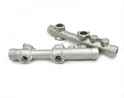

As a seasoned provider of the Shell Mold Casting Process, I understand the paramount importance of ensuring the quality of castings. In this blog post, I'll share some key strategies and practices that can help maintain high - quality standards throughout the shell mold casting process.
Understanding the Shell Mold Casting Process
Before delving into quality control, it's essential to have a solid understanding of the shell mold casting process. Shell Mold Casting Process is a precision casting method that involves creating a thin, hard shell around a pattern. This shell is typically made from a mixture of resin - coated sand. The process offers several advantages, including high dimensional accuracy, smooth surface finish, and the ability to produce complex shapes. What Is Shell Mold Casting provides a more in - depth introduction to this technique.
Raw Material Selection
The quality of the raw materials used in shell mold casting has a direct impact on the final casting quality.
Sand
The sand used for the shell mold should have consistent grain size, shape, and chemical composition. Uniform grain size ensures even resin coating and proper flow during the molding process. For example, if the sand grains are too large, the shell may have a rough surface, which can transfer to the casting. On the other hand, if the grains are too small, it may lead to poor permeability, causing gas entrapment in the casting. We carefully select high - quality silica sand with a narrow grain size distribution to ensure optimal results.
Resin
The resin is responsible for binding the sand grains together to form the shell. It's crucial to choose a resin with good thermal stability, strength, and adhesion properties. Different resins have different curing characteristics, and we select the appropriate resin based on the specific requirements of the casting, such as the pouring temperature and the complexity of the shape. Additionally, we conduct regular quality checks on the resin to ensure its consistency and performance.
Pattern Design and Preparation
The pattern is the basis for creating the shell mold, and its design and preparation are critical for casting quality.
Dimensional Accuracy
The pattern must be designed with precise dimensions to ensure that the final casting meets the required specifications. Any errors in the pattern dimensions will be transferred to the shell mold and ultimately to the casting. We use advanced CAD/CAM technology to design patterns with high accuracy. Before starting the production of the pattern, we conduct thorough simulations to verify its dimensional correctness.
Surface Finish
A smooth and defect - free pattern surface is essential for a high - quality shell mold. Any scratches, bumps, or other surface imperfections on the pattern will be replicated on the shell and the casting. We use high - precision machining and polishing techniques to achieve a smooth pattern surface. Additionally, we apply a release agent to the pattern to facilitate easy removal of the shell after curing.
Shell Mold Making
The process of making the shell mold is a critical step in ensuring casting quality.
Coating and Curing
During the coating process, the sand - resin mixture is evenly applied to the pattern. The thickness of the coating should be carefully controlled to ensure uniform strength and permeability of the shell. We use automated coating equipment to ensure consistent coating thickness. After coating, the shell must be cured properly. The curing temperature and time are carefully controlled based on the type of resin used. If the curing is incomplete, the shell may be weak and prone to cracking during the pouring process. On the other hand, over - curing can make the shell brittle.
Shell Assembly
For complex castings, multiple shell sections may need to be assembled. The assembly process must be carried out with high precision to ensure proper alignment and sealing. Any gaps or misalignments in the shell assembly can lead to casting defects such as flash or incomplete filling. We use fixtures and alignment tools to ensure accurate shell assembly.


Melting and Pouring
The melting and pouring process also plays a significant role in casting quality.
Metal Quality
The quality of the molten metal has a direct impact on the casting's mechanical properties and surface finish. We use high - quality metal alloys and strictly control the melting process to ensure proper chemical composition and temperature. During melting, we use degassing and deslagging techniques to remove impurities and gases from the molten metal. For example, in the case of aluminum alloys, hydrogen gas can cause porosity in the casting. By using a degassing agent, we can significantly reduce the hydrogen content in the molten metal.
Pouring Temperature and Rate
The pouring temperature and rate must be carefully controlled. If the pouring temperature is too low, the molten metal may solidify before filling the entire mold cavity, resulting in incomplete castings. On the other hand, if the temperature is too high, it can cause excessive heat transfer to the shell, leading to shell cracking or erosion. The pouring rate also affects the filling behavior of the molten metal. A slow pouring rate may cause cold shuts, while a fast pouring rate may lead to turbulence and gas entrapment. We use advanced pouring systems with precise temperature and flow control to ensure optimal pouring conditions.
Post - casting Processing
After the casting is removed from the shell mold, post - casting processing is necessary to improve its quality.
Cleaning
The casting is usually covered with sand and other debris from the shell mold. We use shot blasting or chemical cleaning methods to remove these impurities. Shot blasting not only cleans the surface but also improves the surface finish and can induce compressive stresses on the surface, which can enhance the casting's fatigue resistance.
Heat Treatment
Heat treatment is often used to improve the mechanical properties of the casting. Different heat treatment processes, such as annealing, quenching, and tempering, can be applied depending on the alloy and the desired properties. For example, annealing can relieve internal stresses and improve the ductility of the casting, while quenching and tempering can increase its strength and hardness.
Quality Inspection
Throughout the entire shell mold casting process, quality inspection is an ongoing activity.
In - process Inspection
We conduct in - process inspections at various stages, such as pattern inspection, shell mold inspection, and molten metal inspection. For example, we use non - destructive testing methods such as X - ray and ultrasonic testing to detect internal defects in the shell mold before pouring. This allows us to identify and correct any potential problems early in the process, reducing the risk of producing defective castings.
Final Inspection
After post - casting processing, the final casting undergoes a comprehensive inspection. We use dimensional measurement tools such as coordinate measuring machines (CMM) to verify the dimensional accuracy of the casting. Additionally, we conduct visual inspection, hardness testing, and metallographic analysis to ensure that the casting meets all the required specifications.
Conclusion
Ensuring the quality of castings in the shell mold casting process requires a comprehensive approach that covers every aspect from raw material selection to post - casting processing. By carefully controlling each step and conducting rigorous quality inspections, we can produce high - quality castings that meet the most demanding requirements.
If you are in need of high - quality castings produced by the shell mold casting process, we are here to serve you. Our team of experts is dedicated to providing you with the best solutions and products. Feel free to contact us for more information and to start a procurement negotiation.
References
- "Foundry Technology Handbook" by John Doe
- "Precision Casting Processes" by Jane Smith
- Industry research reports on shell mold casting