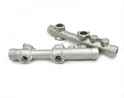

As a supplier of Nodular Iron Casting, I often encounter inquiries about the differences between nodular iron casting and gray iron casting. This blog aims to provide a comprehensive comparison between the two, highlighting their unique characteristics, applications, and advantages.
Composition and Microstructure
The fundamental difference between nodular iron casting and gray iron casting lies in their composition and microstructure. Gray iron contains graphite flakes, which give it a gray appearance when fractured. These flakes act as stress concentrators, making gray iron relatively brittle and having lower tensile strength. On the other hand, nodular iron, also known as Ductile Iron Casting, has graphite in the form of nodules. The addition of magnesium during the casting process causes the graphite to form these spherical nodules, which significantly improves the ductility and toughness of the material.
Mechanical Properties
The mechanical properties of nodular iron and gray iron are quite distinct. Gray iron has excellent compressive strength, which makes it suitable for applications where the material is primarily subjected to compressive forces, such as engine blocks and machine tool bases. However, its low tensile strength and ductility limit its use in applications that require high resistance to tensile and impact loads.
In contrast, nodular iron offers superior mechanical properties. It has high tensile strength, good ductility, and excellent impact resistance. These properties make nodular iron suitable for a wide range of applications, including automotive components, pipes, and valves. For example, in the automotive industry, nodular iron is used to manufacture crankshafts, suspension components, and brake parts, where high strength and toughness are essential.
Castability
Both nodular iron and gray iron have good castability, but there are some differences in the casting process. Gray iron has a lower melting point and better fluidity than nodular iron, which makes it easier to cast complex shapes. However, gray iron is more prone to shrinkage and porosity defects, which can affect the quality of the castings.
Nodular iron, on the other hand, requires a more precise casting process due to its higher melting point and lower fluidity. The addition of magnesium during the casting process also requires careful control to ensure the formation of graphite nodules. However, nodular iron has better resistance to shrinkage and porosity defects, which results in higher-quality castings.
Machinability
Machinability is an important consideration in the manufacturing process. Gray iron is relatively easy to machine due to its graphite flakes, which act as a lubricant during machining. However, the graphite flakes can also cause tool wear and reduce the surface finish of the machined parts.
Nodular iron has a more homogeneous microstructure, which makes it more difficult to machine than gray iron. However, with the use of appropriate cutting tools and machining parameters, nodular iron can be machined to achieve good surface finish and dimensional accuracy.
Corrosion Resistance
Corrosion resistance is another important factor to consider, especially in applications where the castings are exposed to harsh environments. Gray iron has poor corrosion resistance due to its graphite flakes, which can act as an anode and accelerate the corrosion process.
Nodular iron, on the other hand, has better corrosion resistance than gray iron. The spherical graphite nodules in nodular iron reduce the surface area of the anode, which slows down the corrosion process. Additionally, nodular iron can be further protected by applying coatings or treatments to improve its corrosion resistance.


Applications
The differences in the properties of nodular iron and gray iron make them suitable for different applications. Gray iron is commonly used in applications where high compressive strength and good machinability are required, such as engine blocks, machine tool bases, and pipes.
Nodular iron, on the other hand, is used in applications where high strength, ductility, and impact resistance are essential. Some common applications of nodular iron include automotive components, pipes and valves, agricultural equipment, and construction machinery.
Cost
Cost is always a consideration in the manufacturing process. Gray iron is generally less expensive than nodular iron due to its simpler composition and casting process. However, the cost of the final product also depends on other factors, such as the complexity of the design, the quantity of the castings, and the required quality.
In some cases, the higher cost of nodular iron may be justified by its superior mechanical properties and performance. For example, in applications where the castings are subjected to high stress and impact loads, the use of nodular iron can result in longer service life and lower maintenance costs.
Conclusion
In conclusion, nodular iron casting and gray iron casting have significant differences in their composition, microstructure, mechanical properties, castability, machinability, corrosion resistance, applications, and cost. As a supplier of Nodular Iron Casting, I understand the unique requirements of different industries and can provide high-quality nodular iron castings that meet the specific needs of our customers.
If you are looking for a reliable supplier of nodular iron castings, or if you have any questions about the differences between nodular iron casting and gray iron casting, please feel free to contact us. We are committed to providing our customers with the best products and services, and we look forward to working with you.
References
- ASM Handbook, Volume 15: Casting, ASM International
- Metals Handbook Desk Edition, Third Edition, ASM International
- Ductile Iron - Design and Application, Ductile Iron Society