
Hey there! As a supplier of Ultrasonic Flaw Detection equipment, I'm super excited to break down how this nifty technology works. You know, in the world of quality control and nondestructive inspection, Ultrasonic Flaw Detection is a real game - changer. So, let's dive right in!
The Basics of Ultrasonic Flaw Detection
First off, what are we talking about when we say "ultrasonic"? Well, ultrasonic waves are sound waves with frequencies higher than the upper audible limit of human hearing. In most cases, we're dealing with frequencies between 2 MHz and 10 MHz in Ultrasonic Flaw Detection.
The core principle behind Ultrasonic Flaw Detection is pretty simple. We use an ultrasonic transducer to generate these high - frequency sound waves and send them into the material we want to inspect. The transducer is like the heart of the system. It's a device that can convert electrical energy into ultrasonic waves and vice versa.
When the ultrasonic waves enter the material, they travel through it. If the material is homogeneous, the waves will keep going in a straight line. But here's the key: if there's a flaw in the material, like a crack, a void, or an inclusion, the waves will interact with it. Some of the waves will be reflected back from the flaw, and these reflected waves are what we're looking for.
How the Equipment Works
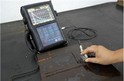
Let's talk about the equipment. The main components of an Ultrasonic Flaw Detection setup include the ultrasonic transducer, a pulser - receiver unit, and a display.
The pulser - receiver unit is responsible for sending electrical pulses to the transducer. When the transducer receives these electrical pulses, it vibrates and generates ultrasonic waves. These waves then travel into the material.
Once the waves hit a flaw and get reflected back, they return to the transducer. The transducer then converts these ultrasonic waves back into electrical signals. The pulser - receiver unit amplifies these signals and sends them to the display.
The display is where we can actually see what's going on inside the material. It shows us a waveform. The position of the peaks on the waveform tells us the distance of the flaw from the surface of the material, and the height of the peaks gives us an idea of the size of the flaw.
Different Modes of Ultrasonic Flaw Detection
There are a few different modes of Ultrasonic Flaw Detection, and each has its own uses.


Pulse - Echo Mode
This is the most common mode. In pulse - echo mode, the same transducer is used to both send and receive the ultrasonic waves. It's like shouting into a cave and listening for the echo. The transducer sends out a pulse of ultrasonic waves, and then it waits to receive the reflected waves. This mode is great for detecting flaws in thick materials.
Through - Transmission Mode
In through - transmission mode, we use two transducers. One transducer sends the ultrasonic waves through the material, and the other transducer on the opposite side receives the waves. If there's a flaw in the material, it will block or scatter some of the waves, and the receiving transducer will detect a decrease in the wave amplitude. This mode is useful for detecting flaws in thin materials.
Advantages of Ultrasonic Flaw Detection
Now, you might be wondering why we use Ultrasonic Flaw Detection instead of other methods. Well, there are several reasons.
First of all, it's non - destructive. That means we can inspect a material without damaging it. This is crucial in industries where the integrity of the material needs to be maintained, like aerospace and automotive.
Secondly, it's very sensitive. Ultrasonic Flaw Detection can detect very small flaws that might not be visible to the naked eye. This helps us catch potential problems early, before they become serious.
It's also fast. We can quickly scan a large area of a material and get results in real - time. This makes it a great choice for high - volume production environments.
Comparing with Other Inspection Methods
There are other non - destructive inspection methods out there, like Dye Penetrant Inspection and Magnetic Powder Inspection. Let's see how Ultrasonic Flaw Detection stacks up against them.
Dye Penetrant Inspection is a method where we apply a colored dye to the surface of the material. The dye seeps into any surface - opening flaws. Then, we remove the excess dye and apply a developer, which makes the flaws visible. While this method is good for detecting surface flaws, it can't detect internal flaws. Ultrasonic Flaw Detection, on the other hand, can detect both surface and internal flaws.
Magnetic Powder Inspection is used for ferromagnetic materials. We apply a magnetic field to the material and then sprinkle magnetic powder on it. If there's a flaw, the magnetic field will be disrupted, and the powder will accumulate at the flaw, making it visible. But this method only works on ferromagnetic materials, while Ultrasonic Flaw Detection can be used on a wide range of materials, including non - ferromagnetic ones.
Real - World Applications
Ultrasonic Flaw Detection has a ton of real - world applications. In the aerospace industry, it's used to inspect aircraft components like wings, engine parts, and landing gears. These components need to be free of flaws to ensure the safety of the aircraft.
In the oil and gas industry, Ultrasonic Flaw Detection is used to inspect pipelines. Pipelines carry oil and gas over long distances, and any flaw in the pipeline could lead to leaks, which are not only dangerous but also environmentally harmful.
In the manufacturing industry, it's used to inspect castings, forgings, and welds. By detecting flaws early in the manufacturing process, we can save time and money by avoiding the production of defective parts.
Conclusion
So, there you have it - a rundown of how Ultrasonic Flaw Detection works. It's a powerful and versatile technology that plays a crucial role in ensuring the quality and safety of materials and products in many industries.
If you're in the market for Ultrasonic Flaw Detection equipment, or if you have any questions about how it can be used in your specific application, don't hesitate to reach out. We're here to help you find the right solution for your needs. Whether you're a small - scale manufacturer or a large - scale industrial operation, we've got the expertise and the equipment to support you. Let's start a conversation and see how we can work together to improve your quality control processes.
References
- ASNT (American Society for Nondestructive Testing). "Ultrasonic Testing Handbook."
- Krautkramer, J. and Krautkramer, H. "Ultrasonic Testing of Materials."