


Introduction
In the world of precision metal casting, choosing the right process can greatly influence the accuracy, surface finish, and cost-efficiency of a final product. Two commonly used methods-shell mold casting and investment casting-are renowned for producing intricate parts used in industries like automotive, aerospace, machinery, and energy equipment manufacturing.
While both methods can achieve high precision, they differ in materials, processes, and applications. Understanding these differences helps manufacturers and buyers select the best casting process for their needs.
What Is Shell Mold Casting?
Shell mold casting is a precision sand casting process that uses a thin shell of sand coated with resin to form the mold. The process begins by heating a metal pattern and covering it with a mixture of fine sand and thermosetting resin. As the resin hardens, it forms a strong shell around the pattern. This shell-typically 5 to 10 mm thick-is then assembled, clamped, and filled with molten metal.
Once the metal solidifies, the shell is broken away, revealing the finished casting. The resulting parts have excellent dimensional accuracy, smooth surface finish, and consistent mechanical properties.
Shell mold casting is particularly suitable for medium to high-volume production of components such as valve bodies, pump housings, brackets, and engine parts. It offers better surface quality than traditional sand casting and lower tooling costs compared to investment casting.
Differences Between Shell Mold Casting and Investment Casting
Although both techniques produce high-quality precision components, there are several key distinctions between shell mold casting and investment casting:
1. Mold Material and Preparation
Shell Mold Casting: Uses a resin-coated sand shell formed around a heated metal pattern.
Investment Casting: Uses a ceramic mold created around a wax pattern, which is melted away before metal pouring (hence "lost-wax" casting).
2. Surface Finish and Accuracy
Investment casting provides a superior surface finish and higher dimensional precision, making it ideal for aerospace, medical, and turbine components.
Shell mold casting offers good accuracy and smoother surfaces than green sand casting but may require light machining.
3. Cost and Production Efficiency
Shell mold casting is generally more cost-effective for medium or large batches due to faster mold preparation.
Investment casting is more expensive but preferred for complex, thin-walled components requiring near-net-shape results.
4. Metal Types and Applications
Shell mold casting works well with ferrous and non-ferrous metals, such as cast iron, steel, and bronze.
Investment casting is ideal for high-performance alloys used in aerospace, defense, and precision machinery.
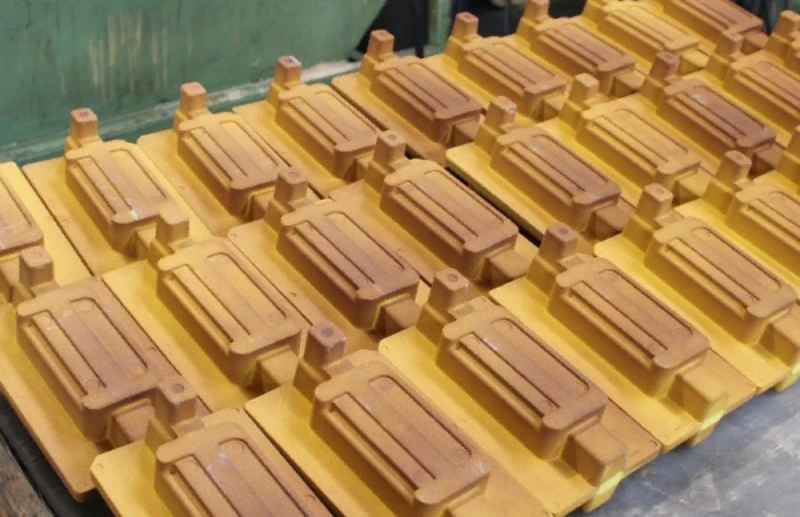
Advantages of Shell Mold Casting
- High dimensional accuracy and repeatability
- Smooth surface finish with minimal post-processing
- Excellent mechanical strength due to fine-grain sand
- Lower tooling and labor costs than investment casting
- Suitable for both ferrous and non-ferrous alloys
These characteristics make shell mold casting an excellent balance between cost-efficiency and precision, especially for industrial components requiring consistent quality.
Wabon Precision Metal: Your Partner in Advanced Casting Solutions
Wabon Precision Metal is a professional manufacturer and exporter of precision castings, specializing in mold making, CNC machining, and surface finishing. The company operates precision casting and machining production lines across a 30,000-square-meter facility and employs approximately 180 skilled staff.
Headquartered in Jining, Shandong Province, China-a city rich in history and known as the hometown of Confucius-Wabon enjoys convenient transportation access, bordering Qingdao Port to the east and Jinan Yaoqiang International Airport to the north.
Wabon Precision Metal welcomes international clients to visit the factory in person or take a virtual VR tour. With advanced technology, rigorous quality control, and strong export capabilities, Wabon provides reliable precision casting solutions that meet global standards of quality, efficiency, and performance.
Conclusion
Both shell mold casting and investment casting are essential techniques in modern metal manufacturing, each offering unique strengths. Shell mold casting excels in cost-effective production and structural reliability, while investment casting achieves unparalleled detail and surface finish.
With its advanced facilities and experienced engineering team, Wabon Precision Metal delivers both innovation and precision-ensuring customers receive castings that meet the highest expectations in quality and performance.
