


These years, I've noticed the topic of AI and digital twins in cold forming showing up more and more in manufacturing discussions. At first glance, it sounds like another typical Industry 4.0 buzzword combination. But when you actually look at what's happening on the shop floor, it's not abstract at all-it's solving problems engineers have struggled with for a long time: tool wear, unstable quality, long setup cycles, and unexpected machine downtime.
Cold forming itself is a fairly efficient process. Instead of cutting metal away like machining does, it reshapes material at room temperature under high pressure. You'll find it everywhere in automotive parts, fasteners, and precision metal components.
The process is efficient, but also surprisingly sensitive. Small variations in material batches, lubrication conditions, or tool wear can quickly lead to defects. The frustrating part is that these issues don't always show up immediately. In many factories, engineers still rely heavily on experience, visual checks, and repeated trial runs. It works to a point, but it's not always stable or scalable when production volume increases.
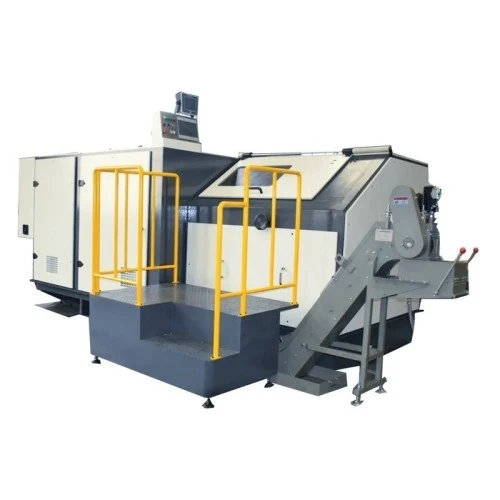
Where digital twins actually change things
This is where digital twin technology starts to make sense
.
A digital twin is basically a virtual counterpart of a real machine or process. In cold forming, it can represent the press machine, tooling setup, material behavior, and even stress or temperature changes during forming. But the key difference from traditional simulation is that it doesn't stay static. It keeps updating based on real production data, so the virtual model gradually stays aligned with what is actually happening on the production line.
In practice, it feels less like a simulation tool and more like a "mirror" of the factory process.
What happens when AI is added
Once AI is introduced on top of that, the system becomes much more proactive.
From what I've seen, machine learning models are particularly good at finding patterns hidden in historical production data. Patterns that operators might not notice at all. For example, a slight increase in vibration during a specific stage of the press cycle might not seem important at first. But over time, the system may learn that this usually correlates with accelerated tool wear a few days later.
Instead of waiting for the tool to fail, the system can flag it early. Sometimes it will suggest maintenance; other times it may recommend adjusting process parameters. Either way, the shift is from reacting to predicting.
Process optimization becomes less trial-and-error
Traditionally, parameters like press force, speed, and lubrication are set based on experience. Engineers adjust them gradually, often through repeated trials until the output stabilizes. It works, but it takes time-and a lot of material can be wasted during tuning.
With AI-driven digital twins, the situation is quite different. You can test thousands of parameter combinations virtually before running a real production batch. That alone reduces a large amount of on-site trial-and-error.
In some cases, it also allows machines to operate closer to their optimal performance window without increasing defect rates. That's something difficult to achieve with manual adjustment alone.
Quality control shifts upstream
Quality inspection used to happen after production. You make the part, then check if it's good or not.
But now, with sensor data combined with digital twin models, quality prediction can actually happen during the forming process itself. Force curves, acoustic signals, die temperature-these signals are continuously fed into the system.
When something starts to drift away from the expected pattern, the system can detect it early. In some cases, it can even predict the likelihood of defects before the part is fully formed. That means fewer scrap parts and less wasted material, which is a big deal in high-volume production.
The reality: it's not plug-and-play
Of course, this doesn't mean the technology is easy to implement.
One of the biggest issues is data quality. Cold forming environments are noisy-literally and digitally. Sensors don't always produce clean signals, and older machines often don't have proper data acquisition systems in the first place.
There's also the integration problem. Many legacy machines were never designed to "talk" to modern AI platforms. Connecting them into a unified data system can take more effort than building the AI model itself.
So while the concept sounds elegant, the foundation work is often the hardest part.
The direction is still very clear
Even with these challenges, the direction of development is hard to miss. As more factories move toward Industry 4.0, digital twins combined with AI are gradually shifting from experimental projects to practical tools.
The mindset is also changing. Instead of fixing problems after they happen, manufacturers are increasingly trying to predict and prevent them before they occur.
And in the long term, I don't think the biggest value is just cost reduction or efficiency improvement. It's something deeper-understanding the cold forming process itself at a much higher resolution.
When simulation, real-time production data, and AI learning form a closed loop, the gap between design and manufacturing starts to shrink. In an industry where even small improvements in precision, uptime, or scrap rate can translate into significant financial impact, that shift is not just useful-it's transformative.


